



By Johnathan Paoli
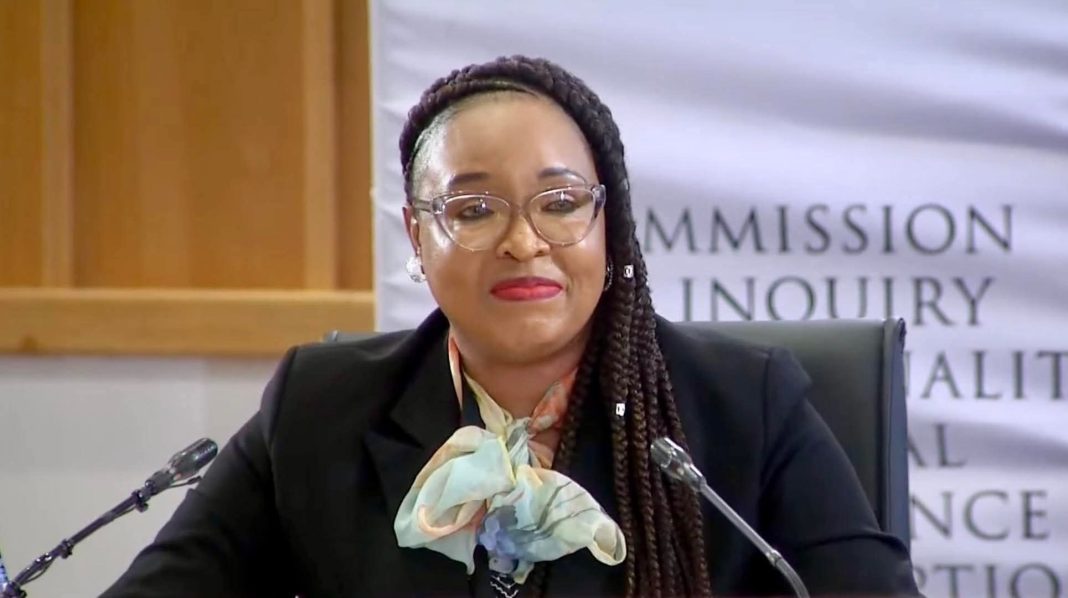
Acting Deputy National Commissioner for Crime Detection, Lieutenant General Khosi Senthumule, has laid bare the chaotic disbandment of the Political Killings Task Team (PKTT), the disputed movement of its 121 dockets, and her strained working relationship with Lieutenant General Shadrack Sibiya.
Testifying before the Madlanga Commission on Friday, Senthumule—led by evidence leader advocate Thabang Pooe—described a police organisation under intense pressure, hobbled by poor communication, political directives that were poorly applied, and competing interpretations of authority between national and provincial leadership.
She opened by sketching her long career in state intelligence, where she worked in counterintelligence and vetting investigations before rising to lead domestic collection operations in the Northern Cape.
She later transitioned into the SAPS, eventually becoming Divisional Commissioner for Detective and Forensic Services in 2021, the division now headed by Sibiya.
Her intelligence background, she said, shaped her assessment of the PKTT’s effectiveness—and her discomfort with how its disbandment was carried out.
Senthumule told the commission that she returned from leave on 17 January, weeks after Police Minister Senzo Mchunu issued the 31 December 2024 directive disbanding the PKTT. Crucially, she testified that she never received that directive.
Instead, she first learned informally from Crime Intelligence head and PKTT operational commander General Dumisani Khumalo that “all dockets must go to the detectives”, meaning Sibiya’s office. Yet neither she nor Khumalo were told the files were expected in Pretoria.
When asked whether Sibiya followed up, she confirmed he had—inquiring whether she had begun discussions with Khumalo. She had not, she said, because she had nothing in writing.
“I could not proceed on an instruction communicated verbally. If General Sibiya wanted me to act, he needed to put it in writing,” she testified.
Defending the PKTT’s structure, Senthumule described it as a “one-stop shop” that had proven its value. She highlighted its embedded ballistics specialists and cited successes, including uncovering a cache of unregistered firearms.
By late 2022, she testified, the last inter-ministerial committee regarded the task team as best practice.
Its collapse, she said, created operational instability and fractured working relationships.
A major theme of the day was the legal authority over the 121 dockets.
Senthumule stressed what she called a previous mistaken assumption in the South African Political Service, namely dockets do not belong to national commissioners but to provinces.
Thus, in the PKTT matter, KwaZulu-Natal Provincial Commissioner Nhlanhla Mkhwanazi, not Sibiya, was the legally empowered authority.
Yet, according to her testimony, Sibiya insisted on centralising all dockets under detectives, including those already in court.
Senthumule, Khumalo and the National Commissioner all resisted this, arguing that removing court-ready cases from investigators who had built relationships with victims would cause delays, trauma, and jeopardised prosecutions.
Asked about her working relationship with Sibiya, she described it as “cordial, but touch-and-go”.
“Today you could be on his good books, tomorrow in his bad books. for no reason,” she said.
A WhatsApp exchange presented to the commission revealed tensions over her deployment to Cape Town, with Sibiya at one stage telling her he had been advised to keep quiet and let you go.
She replied respectfully, she said, because she did not want to be his enemy.
One of the most telling moments was her account of finally attempting the handover.
On 28 March, she and Khumalo briefed PKTT members and signed for 118 dockets, later increased to 121 when three more were located.
But when she contacted Provincial Commissioner Mkhwanazi to arrange delivery, he refused.
The refusal triggered further confusion, forcing her to escalate the matter to the National Commissioner, who then instructed Sibiya to give direction.
Senthumule confirmed that in the 6 March meeting, Sibiya again pushed for all PKTT dockets and all members to be transferred to detectives.
But the meeting ultimately rejected that proposal, agreeing that 114 dockets and their investigators would remain with the PKTT until finalised.
She said Sibiya’s position was supported by the minister and the chief of staff.
As proceedings closed, commissioners confronted Senthumule directly, criticising the delays, confusion, and leadership disputes that left 121 sensitive political-murder dockets effectively stranded for months.
The hearing continues on Monday.
INSIDE POLITICS


