


By Simon Nare
Tourism Minister Patricia de Lille has pledged South Africa’s commitment to the G20 member states to advance tourism financing and implement an action plan aimed at strengthening resilience and ensuring sustainable tourism.
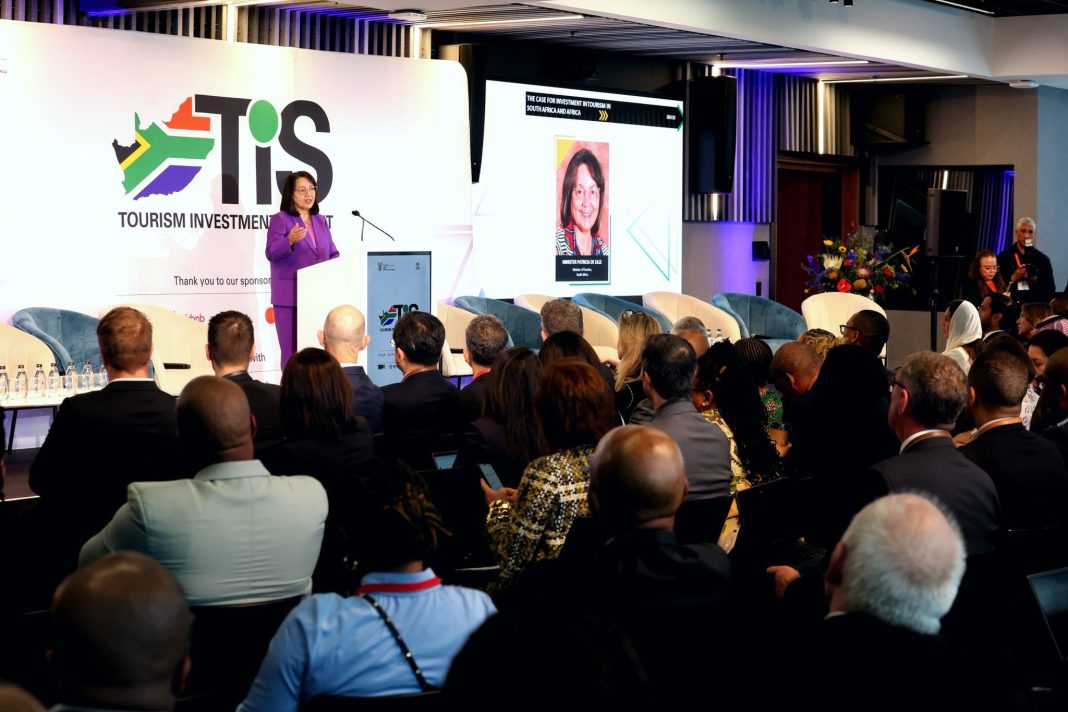
Delivering her keynote address at the G20 Tourism Investment Summit in Cape Town on Wednesday, De Lille revealed that the tourism report on air connectivity—designed to enable seamless travel for visitors—was among the key deliverables.
She said that improved accessibility was vital to showcase South Africa’s diverse attractions, from the meeting point of two great oceans to the vast Kalahari Desert, from world-renowned safaris to vibrant modern skylines
“The question before us today is not whether South Africa is beautiful. The question is: What more can we offer the world? This Summit marks the beginning of that answer. This is our inaugural Tourism Investment Summit, a G20 legacy project,” said De Lille.
She presented eight projects to delegates and urged the private sector to partner with the government on flagship infrastructure initiatives, which she said offered “guaranteed bankable prospects.”
De Lille noted that there had been an overwhelming response from potential investors who had already made inquiries.
She added that the projects represented only a fraction of what the department has planned, describing them as “rich, diverse, and growing.”
“We stand here not only as a nation of immense tourism potential, but also as a gateway to Africa. Our theme, ‘G20 Tourism Investment for Jobs, Growth, and Transformation,’ reminds us that this is not just about business,” she said.
“This is about livelihoods. This is about reshaping South Africa and positioning Africa as a global tourism powerhouse. Together, through regional collaboration, enabling policies, and smart infrastructure, we can achieve this vision.”
The minister told delegates that the Government of National Unity had demonstrated how policy shifts could unlock economic growth.
She highlighted that, as of 1 June 2025, the Amended National Treasury Regulation 16 for Public-Private Partnerships came into effect.
The amendments allowed the department to embrace a range of models—from Design-Build-Operate partnerships to blended finance and even crowdfunding.
She called on investors to build tourism infrastructure that not only created jobs but also uplifted communities.
She further revealed that the projects required significant investment, from the God’s Window Skywalk in Mpumalanga, which needed R200 million, to the Hole in the Wall Resort in the Eastern Cape, which required R141 million.
Combined, the projects represented R1 billion in investment-ready opportunities.
De Lille noted that tourism contributed at least 8.5% to South Africa’s gross domestic product.
She also revealed that in July alone, the country welcomed over 880,000 visitors—a 26% increase compared to the same period last year.
“Again, investors, guide us on what the demand-led skills of the future are. What will be the skills that we need in the next 5 to 10 years? South Africa’s human capital is one of its strongest assets. With 56% of the population under the age of 30 and an adult literacy rate of 95%, the country provides a broad and adaptable labour base,” she said.
The minister revealed that, supported by advanced universities and national skills development efforts, such as those led by the Culture, Art, Tourism, Hospitality, and Sport Sector Education and Training Authority, the tourism workforce was prepared for inclusive, service-oriented growth.
She added that it was encouraging to see the private sector already showing confidence, citing the unveiling of the V&A Waterfront’s R20 billion Granger Bay precinct development as an example.
Following the launch of the Tour Operators Scheme in India and China, South Africa has unlocked access to key tourist destinations.
By the end of September, the Home Affairs Department will roll out the Electronic Travel Authorisation system, which will digitalize and automate all short-stay visas, enabling secure and seamless travel for tourists across the globe.
“This Summit is about jobs, growth, and transformation. Tourism is labour-intensive. Every investment here means jobs for young South Africans. Every Rand or Dollar invested is an opportunity created. And every partnership formed here will help us transform tourism into a driver of inclusive, sustainable prosperity,” she said.
INSIDE POLITICS