


By Johnathan Paoli
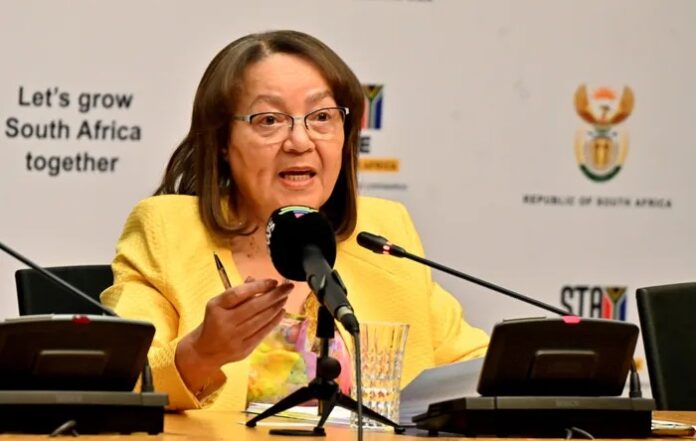
Tourism Minister Patricia de Lille on Tuesday strongly defended her decision to dissolve the South African Tourism (SAT) board, telling Parliament’s Portfolio Committee on Tourism that ongoing governance failures, irregular meetings, and unlawful conduct left her with no alternative.
Former board members, however, pushed back, accusing the minister of political interference, selective enforcement of the law, and undermining the very body she was meant to oversee.
“There’s no crisis, absolutely no crisis,” De Lille insisted, stressing that her actions were about protecting public funds and enforcing accountability.
“Every cent matters. Every law in this country matters.”
In her presentation, De Lille detailed a long history of governance problems at SAT.
She reminded MPs that she had dissolved an earlier board in 2023 over the controversial R1 billion Tottenham Hotspur sponsorship deal, a case now under Special Investigating Unit (SIU) scrutiny.
The SIU recommended that delinquent directors face consequences, and De Lille confirmed she has asked President Cyril Ramaphosa to issue a proclamation to recover funds and pursue prosecutions.
She said her latest action against the SAT board followed continued dysfunction: the resignation of a CFO citing interference, critical vacancies left unfilled despite Auditor-General warnings, and board members allegedly breaching their fiduciary duties.
She pointed in particular to Lawson Naidoo, whom she accused of unlawfully assuming powers of a chairperson through a “board representative” role, extending contracts, and approving payments without a valid mandate.
“The board acted unlawfully and exceeded its powers. Instead of writing to me to appoint an acting chair, they gave Mr Naidoo powers reserved only for the chairperson under the Tourism Act. That is ultra vires,” De Lille said.
She emphasised that she had repeatedly warned the board, in meetings on 4 July and letters on 13 July, against convening irregular gatherings and failing to resolve staff grievances. “
To stabilise the entity, De Lille has appointed six interim members to manage SAT’s affairs until a new permanent board is in place.
Former SAT board member Lawson Naidoo told MPs that the minister’s reasons for dissolving the board were contradictory and procedurally flawed.
He argued that what De Lille labelled an “unlawful meeting” was in fact a round-robin resolution, a legitimate mechanism when members cannot assemble.
“There was no meeting on 1 August. Yet the Minister relies on this claim in her dissolution letter. We were denied the chance to respond to the reasons ultimately used to dissolve us. The audi alteram partem rule was violated,” Naidoo said.
He also rejected the claim that he had acted alone.
“All decisions were unanimous, communicated via WhatsApp and email. I was never an acting chair — only a representative to coordinate communication. Everything I did was with the board’s full mandate,” he said.
Jolene Kelly, former chair of SAT’s human capital and remuneration committee, painted a bleak picture of the agency.
She said staff morale was in crisis, with a string of suspensions, grievances, and resignations hollowing out the institution.
“SAT currently has no CEO, no Company Secretary, no Head of Legal, and no CFO. This is a major loss of institutional memory and the ability to execute. It is a crisis,” Kelly said.
This, she argued, left the board ineffective and forced members to pass a vote of no confidence.
Former board member Oupa Pilane said the governance failures De Lille cited stemmed from her own neglect of statutory duties.
He accused the minister of ignoring the Tourism Act’s requirement to appoint both a chairperson and deputy chairperson, leaving the board rudderless.
“It took nine months for her to do what the law prescribes. If there was a deputy chair, none of this would have happened. Condemning the board for her own dereliction is disingenuous,” Pilane said.
Pilane further charged that De Lille interfered directly in SAT operations, holding meetings with executives and approving staff travel without board involvement.
Former SAT board chair Makhosazana Khanyile told MPs the Minister’s narrative was “misleading and defamatory.”
She said neither she nor deputy chair Lizelle Haskins were removed from the board—only from leadership roles, after De Lille publicly inflated meeting numbers and miscast governance costs as board fees.
Khanyile said the board held two quarterly and 11 special meetings, most at management’s request for statutory approvals or urgent reporting, and that the R900 000 figure cited by the Minister covered broader governance expenses (travel, accommodation, training, insurance).
The board, she argued, was exercising rigorous oversight of a “weak and dysfunctional” management team and reacting to AGSA red flags, including a material irregularity, while the Minister fixated on meeting frequency.
She further accused De Lille of operational interference—approving branding campaigns, sidelining the board from strategic sessions, and seeking to influence AGSA’s audit scope, including around SAT’s New York office.
After a tense 30 August 2024 meeting where the Minister allegedly warned she would “deal with [the board] like politicians,” Khanyile said she and Haskins resigned and faced reputational attacks; litigation has followed.
Deputy chair Lizelle Haskins confirmed the defamation suit (in De Lille’s personal and official capacities), saying the pair first sought a retraction, apology, and mediation, requests she says the minister rebuffed.
Haskins focused on the CEO’s probation: a three-month period from 1 March 2024 proceeded without a signed performance agreement, KPIs or deliverables, a “foundational governance failure.”
The board extended probation to allow proper metrics, but the CEO’s self-rating of 4.9/5 in August clashed with committee chairs’ scores of 1–2, citing late annual financial statements, reactive crisis management, and poor preparation for key meetings.
Haskins said the minister ignored detailed documentation on these failings and instead accused the board of “excessive meetings.”
INSIDE POLITICS