


By Thapelo Molefe
The Border Management Authority (BMA) has credited new surveillance technologies and aggressive enforcement for a dramatic rise in border interceptions during the 2025 Easter period.
BMA commissioner Michael Masiapato said on Monday that from 15 April to 24 April, the BMA processed 1,057,063 legitimate traveller movements through South Africa’s 71 ports of entry, an 8% increase from Easter 2024.
A total of 6253 individuals attempting to enter or exit the country illegally were intercepted, which was a 61% spike from the previous year.
“This year, we talk about having intercepted over 6000. So that automatically demonstrates the 62% we are talking about,” Masiapato told reporters.
“That is a demonstration of the impact of the drones because it was a targeted interception.”
The deployment of drones and body-worn cameras was central to this success, allowing authorities to detect and intercept illegal crossings in real time.
“We then deploy the drones in the sky… After we put the drones in the sky, we are then able to then communicate with the border guards on the ground through the push-to-talk devices that they will be having,” Masiapato explained.
“We are able to tell them there are 10 people actually trying to enter the country illegally in this particular geolocation.”
A significant shift this year was the arrest of 112 facilitators allegedly involved in aiding illegal crossings, rather than simply deporting migrants.
“What the drones enable us to do is… zoom on that individual (facilitator) and make sure when the interception happens, the border guards on the ground are made to understand who the facilitator is, so that the facilitator is then dealt with differently,” Masiapato said.
Previously, facilitators who lead groups across the border, have often escaped prosecution.
“Out of the 10 you have intercepted, maybe there are three facilitators. After you deport them, two hours down the line they are back into their business,” he noted. “Now, the more we take facilitators out of the value chain, the more we’ll start having some impact.”
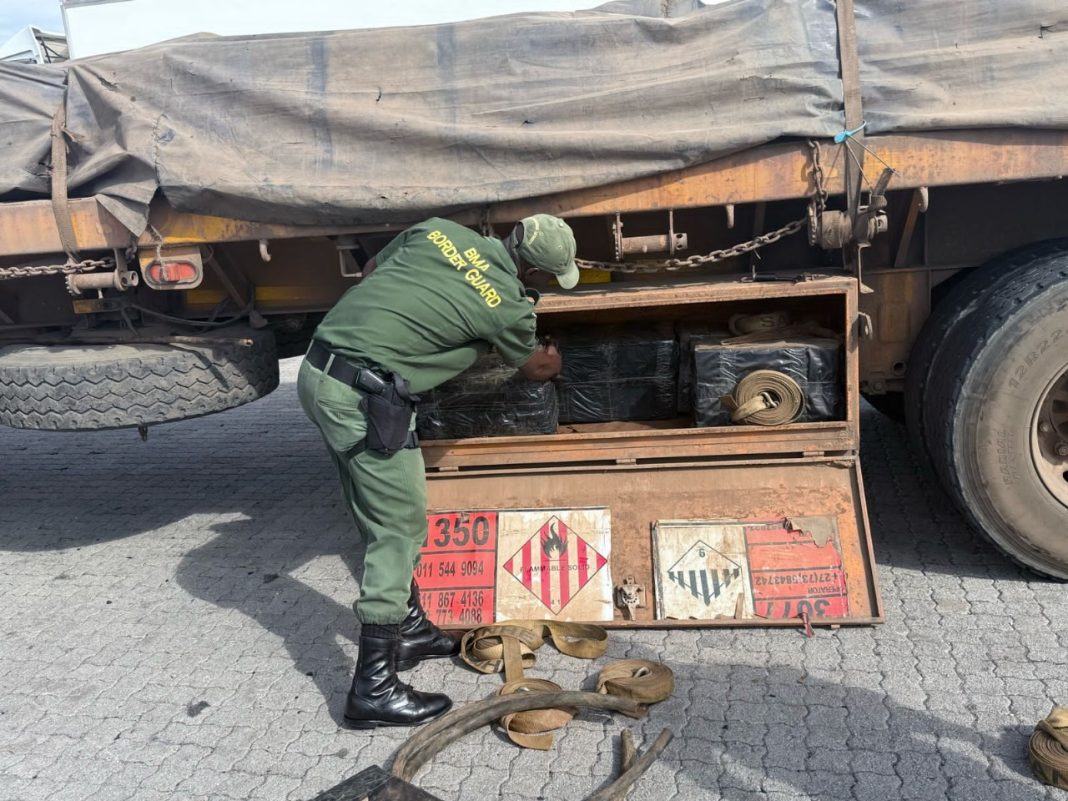
Authorities also confiscated around 5181kg of cannabis, 34 boxes of counterfeit cigarettes and multiple counterfeit goods, including branded clothing, shoes and passports.
Masiapato highlighted the BMA’s close cooperation with other agencies like SA Police Service, soldiers, the SA Revenue Service and provincial traffic units for helping ensure the successful operation. There were no major traffic jams on corridors leading to key ports like Beitbridge, Lebombo and Maseru Bridge.
The operation also intensified health and biosecurity inspections. Port health officials screened over 215,000 travellers and disinfected 836 flights amid measles concerns from Zimbabwe.
Agricultural inspectors seized over 3043kg of non-compliant goods including medicinal herbs and animal products.
Despite the successes, Masiapato acknowledged ongoing challenges, including corruption within the BMA’s ranks.
Two immigration officers were arrested at Beitbridge for allegedly facilitating the illegal movement of undocumented individuals.
“Because of the measures that we’ve put in, we’re able to pick them up and they were arrested on the spot,” he said, clarifying that one of the officials, who was 61-years-old, was integrated into the new BMA structures.
Addressing concerns about human trafficking, Masiapato said no children were found trafficked during the period.
“In this particular period of these 10 days, we did not have an instance where any minor, for example, or a child was identified to be being trafficked,” he stated.
However, some mothers travelling illegally with children were deported following the correct protocol.
Masiapato also stressed the importance of public cooperation.
“We want to call upon any South African, in particular, they should not use their personal vehicles for this enterprise because it is an illegal activity in view of Section 9.2 of the Immigration Act.”
Looking forward, he emphasised the need for greater investment in technology such as sensors and artificial intelligence to further modernise border security.
“There are a lot of things that we are actually looking at, but all of these things are expensive,” he said.
However, Masiapato was full of praise for the joint operation.
“Despite significant environmental and personnel-related constraints, I am pleased to report that through joint efforts, the 2025 Easter operation was a success. We maintained the integrity of our borders, protected public health, generated revenue, and disrupted unlawful activities.”
INSIDE POLITICS