


By Johnathan Paoli
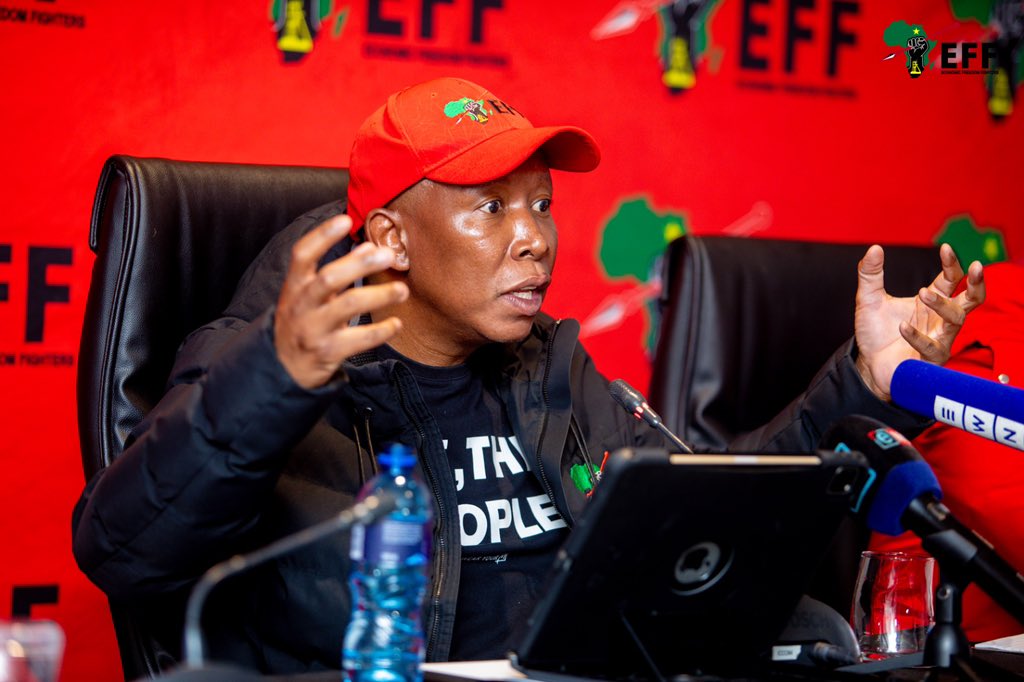
The Economic Freedom Fighters has rejected the Equality Court’s ruling that found its leader Julius Malema guilty of hate speech, describing the judgment as a deliberate distortion of history and political rhetoric.
EFF spokesperson Sinawo Thambo said the ruling “fundamentally misreads” the context, philosophy and intent of Malema’s words, arguing that the speech was rooted in the liberation tradition, referencing South Africa’s history of structural violence and resistance.
“The language of revolution cannot be sanitised to comfort the sensitivities of those who continue to enjoy the fruits of colonial dispossession and have never experienced racial violence whatsoever,” Thambo said.
The party insisted Malema was not calling for the killing of white people, but highlighting the irreconcilable conflict between white supremacy and Black liberation thought.
Thambo maintained the real violence lay in the daily experiences of landlessness, unemployment and racism endured by Black South Africans.
He confirmed the party would appeal the decision at the Supreme Court of Appeal.
The Equality Court in Cape Town ruled that remarks made by Malema at the EFF’s Western Cape Provincial People’s Assembly in October 2022, where he told supporters they should “never be scared to kill” and declared that “racism is violence and violence can only be ended by violence”, constituted hate speech and incitement to violence under Section 10 of the Equality Act.
Judge Mark Sher found the statements amounted to exhortations to kill white males linked to the 2020 Brackenfell High School clashes, where EFF supporters and parents had violently confronted each other over alleged racial exclusion at a matric dance event.
Sher ruled that the comments were not abstract revolutionary theory but “a clear instruction” that carried the potential to incite large-scale racial violence.
He further held that the EFF, by endorsing and defending the remarks, was jointly liable with Malema for legal costs, including expert fees.
The decision has been welcomed by other parties and civil society groups who argue it affirms the constitutional limits of free expression when it incites violence and racial hatred.
The Democratic Alliance hailed the judgment as a triumph for the rule of law.
Party leader John Steenhuisen said the ruling reaffirmed that political leaders must be held accountable for reckless rhetoric that undermines national unity.
“We hope that this ruling will serve as a warning, and a guide to all Leaders in South Africa to conduct themselves in ways that strengthen, rather than break, our society and all we have worked so hard to build,” Steenhuisen said.
He warned that Malema’s divisive language not only threatened social cohesion, but also damaged South Africa’s global reputation, citing concerns raised internationally, including by the United States and United Kingdom.
The DA vowed to explore “further action to enforce serious consequences” against Malema, adding that the judgment validated its long-standing opposition to the EFF’s entry into national government.
The Freedom Front Plus also welcomed the ruling, saying it had long pushed for decisive legal action against Malema’s rhetoric.
Party leader Corne Mulder said Malema had grown “untouchable” in his belief that context could excuse racially inflammatory remarks.
“The Freedom Front Plus hopes that the court’s finding sends a loud and clear message to everyone in South Africa: Hate speech and racial division are intolerable,” Mulder said.
AfriForum, which has campaigned vigorously against Malema’s rhetoric, described the ruling as confirmation of the EFF’s extremism.
Head of public relations, Ernst van Zyl, said Malema’s statements amounted to “incitement of violence against minorities”.
“It is outrageous that the president of South Africa continues to treat Malema with kid gloves despite international warnings,” Van Zyl said.
He noted that Malema had previously been denied a UK visa over similar concerns and that the US State Department had repeatedly flagged his rhetoric as extremist.
Judge Sher, while stressing that the Equality Act was not designed to suppress legitimate criticism of racism, said Malema’s remarks crossed the line into vigilantism.
“Calling for someone to be killed because they are a racist who has acted violently is an act of incitement of the most extreme form of harm possible,” he said.
Sher emphasised that South Africa’s democracy was built on reconciliation and lawful remedies, not retaliatory violence.
INSIDE POLITICS