


By Thapelo Molefe
The government has announced sweeping plans to overhaul the country’s policing strategy in a bid to rebuild public trust, tackle violent crime, and modernise the SA Police Service.
This follows a three-day National Policing Summit, which was held under the theme “Efficiency in Action: Optimising South Africa’s Policing Potential”.
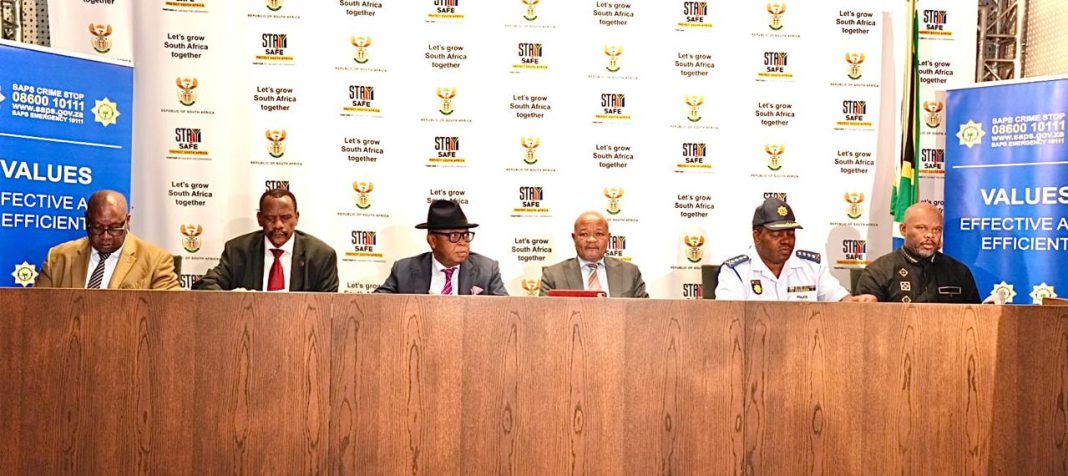
On Friday, Police Minister Senzo Mchunu and National Police Commissioner Fannie Masemola laid out what they described as a “turning point” in law enforcement reform.
Mchunu told reporters that the SAPS must become efficient, proactive and accountable to the people of South Africa.
“The people of South Africa demand a police service that is worthy of their trust—and most importantly, the people of South Africa demand that we act,” he said.
During the briefing, government officials confirmed that a new National Policing Summit Operations Room would be established to monitor the implementation of resolutions taken at the summit.
Masemola explained that the room would act as a central performance hub, tracking delivery on commitments over the next five years.
“This significant move will hold the management of the SAPS accountable to the nation. We will work out key performance areas, assign budgets, and establish timeframes that are realistic and implementable,” Masemola said.
One of the most urgent issues discussed was the adoption of new technologies, including the digitisation of the docket management system.
Mchunu clarified that this would be achieved through direct collaboration with the private sector, but he pushed back against suggestions that private businesses would have access to sensitive case data.
“It’s a deliberate act on our side to seek partners who can help close gaps, whether they’re budgetary or related to capacity. But they won’t drive the cars they donate, and they won’t see the dockets,” he said.
As part of this private-public partnership, the SAPS confirmed that five police stations have already been earmarked for upgrades and that new forensic laboratories would be opened in every province. These labs were meant to address long standing backlogs and inefficiencies in forensic investigations.
According to the minister, the implementation of these plans would begin immediately, with a business-police partnership forum already established to drive coordination.
Questions from journalists also focused heavily on police visibility and the rollout of body-worn cameras.
Masemola said the camera programme would begin this year, with an initial rollout targeting frontline services such as Flying Squad, Highway Patrol and Public Order Policing.
“We won’t be able to deploy across the full service immediately, but we are prioritising the most critical units,” he said.
He also confirmed plans to integrate CCTV camera systems operated by municipalities into SAPS’ provincial command centres as part of the broader integrated justice system, which sought to link law enforcement, home affairs and correctional services data systems.
Another major theme that emerged was the need to address internal SAPS morale and leadership. Mchunu acknowledged that results from an internal morale survey pointed to high levels of stress, low motivation and systemic fatigue.
The minister committed to reforms in recruitment practices, better psychological support for officers and a clearer pipeline for leadership development.
“We must professionalise policing from the inside out. This is not just about tools—it’s about values, culture, and leadership,” Mchunu said.
On the regulatory side, reporters asked about the controversial proposed amendments to the Private Security Industry Regulation Act, which some private security companies claim could hinder their operations.
Private Security Industry Regulatory Authority CEO Manabela Chauke clarified that there were no plans to disarm the private security industry.
“We are regulating conduct, not taking away weapons. What we are saying is that the use of high-calibre weapons must be justified through proper risk assessments, especially when operating in public spaces,” Chauke explained.
He noted that over 6000 submissions had already been received on the draft regulations and that extensive consultations would continue.
Mchunu also responded to questions about his relationship with KwaZulu-Natal Provincial Commissioner Nhlanhla Mkhwanazi, amid speculation about internal tensions.
“I have very good relations with all provincial commissioners, including commissioner Mkhwanazi. If I have any complaint, it is that they must work harder to make citizens feel safer,” the minister said.
He also addressed questions surrounding the Independent Police Investigative Directorate’s (IPID) handling of cases involving the provincial commissioner, stating that no formal briefings had been received and reiterated IPID’s independence in such matters.
“They don’t report to us unless they choose to. What I know, I’m reading from the media just like you,” he said.
Masemola detailed SAPS’ ongoing operations against violent crimes, noting that the service continued to recover around 130 illegal firearms per week and has destroyed 279,000 illegal firearms in the past six years.
Since May 2023, nearly 10,000 suspects have been arrested for illegal gun possession.
He also confirmed that an anti-gang unit was active in Gauteng and has been deployed to hotspot areas like Eldorado Park.
On the issue of police misconduct, Masemola acknowledged a case in Nelson Mandela Bay where a SAPS officer found in possession of an illegal firearm received only a suspended sentence.
“That sanction is unacceptable. We will follow due process and apply our disciplinary policies accordingly,” he said.
The commissioner also confirmed a special team has been established to address escalating taxi violence in the south of Gauteng, particularly Soweto, where a dispute between rival taxi associations has led to violent clashes.
SAPS is working with the transport department to mediate the conflict, and further engagements are planned with affected stakeholders.
Wrapping up the session, Mchunu reaffirmed the government’s commitment to greater community involvement, noting recent engagements with community policing forums (CPFs) and a plan to convene a national CPF dialogue in the coming weeks.
“We’ve worked well with CPFs. We met with them during the summit, and we will continue supporting them—not only with warm jackets and torches, but with serious engagement,” he said.
Despite the strong declarations and detailed commitments, public skepticism remains. For many South Africans, trust in the police remains fragile, and promises of reform are not new.
Yet the minister insisted that the momentum built from this summit must not be lost.
“This is not a once-off event. This must become standard practice. We are not waiting. We are implementing.”
INSIDE POLITICS