


By Lebone Rodah Mosima
The Department of Human Settlements has entered the local government debate fully aware of systemic failures, structural barriers, and governance challenges that continue to undermine municipalities and hinder the delivery of sustainable basic services.
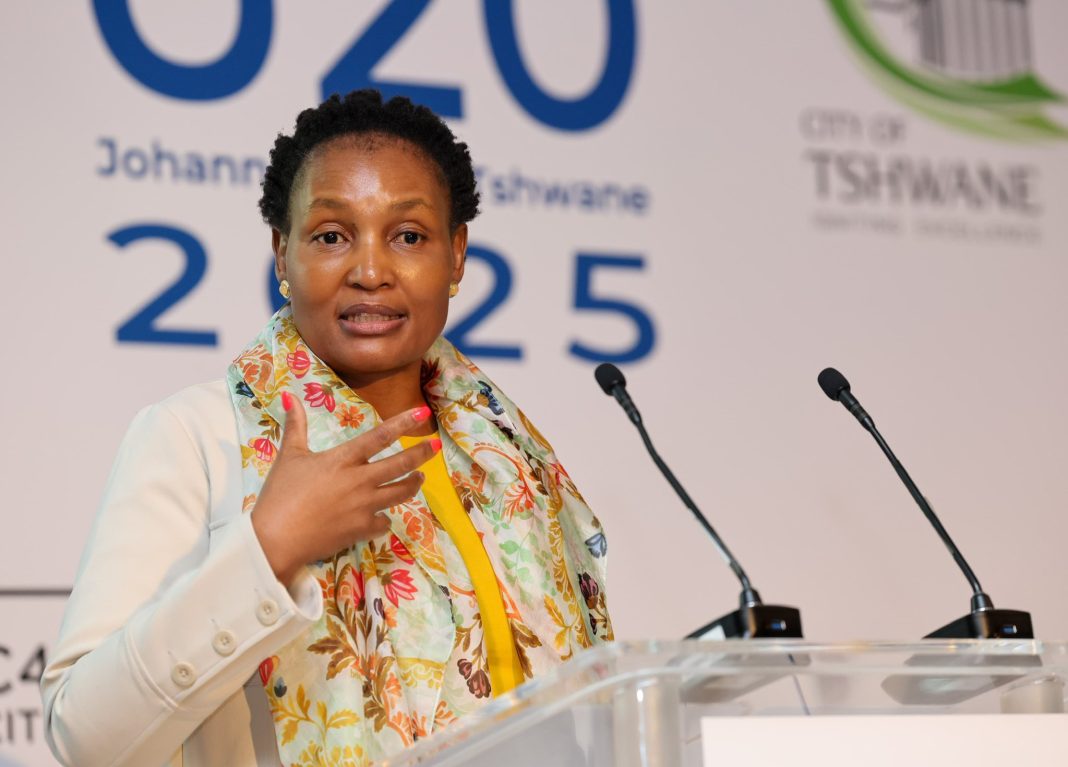
On Tuesday, Human Settlements Minister Thembi Simelane addressed the 2025 Local Government Week, convened under the theme “Restoring the Dignity of our People through Proper Spatial Planning, Provision of Human Settlements, Water and Sanitation.”
“Over the weekend, the African National Congress turned its focus to local government. We took stock of the underlying issues affecting the sector and renewed our commitment to accelerate service delivery in struggling municipalities,” Simelane said.
“We will live up to our organisational directives and commitments to turn things around, consistent with our adopted Local Government Action Plan.”
Her remarks followed President Cyril Ramaphosa’s warning to councillors that restoring service delivery was key to winning back public trust.
He urged ward representatives to be proactive in addressing residents’ concerns.
Simelane highlighted the adoption of the Breaking New Ground (BNG) policy, which shifts focus from simply delivering houses to creating sustainable, integrated communities.
The policy prioritises upgrading informal settlements, expanding access to social and economic amenities, and integrating different housing types and subsidies.
While progress has been made, Simelane admitted more work lies ahead.
National Council of Provinces (NCOP) chairperson Refilwe Mtshweni-Tsipane stressed that Human Settlements programmes remain central to transforming communities once excluded under apartheid.
“As part of rolling out major infrastructure projects, last month we handed over 1,000 houses in Cornubia, a mixed-income development in Durban that links to King Shaka International Airport. The project will ultimately deliver 28,000 homes and demonstrates our deliberate commitment to building integrated settlements in practice, not just in theory,” she said.
Mtshweni-Tsipane added that the Social Housing Regulatory Authority (SHRA) is actively challenging apartheid-era spatial planning, leading efforts to “revive cities through social housing.”
“Human settlements are not just about shelter, but about dignity, safety, and opportunity—elements of human development long denied to many South Africans,” she said.
She noted that the White Paper on Human Settlements affirms housing as a local government function, rooted in the Spatial Planning and Land Use Management Act (SPLUMA).
Through tools such as Integrated Development Plans (IDPs), Spatial Development Frameworks (SDFs), and Land Use Management Strategies (LUMS), municipalities are tasked with advancing integrated, sustainable settlements.
The NCOP chairperson further pointed to the 2025–2030 Strategic Plan, aligned with the priorities of the 7th administration, particularly inclusive growth and job creation.
“The plan will create economic opportunities where people live, work, and worship. But challenges such as limited budgets, high unemployment, rising construction costs, and disruptions by construction mafias remain real obstacles,” she said, stressing that good governance and sound planning are essential.
Looking ahead, government has committed to modernising services. In 2025/26, the Housing Subsidy System (HSS) will be upgraded to the National Digital Human Settlements Management System (NDHSMS).
This new platform will enhance transparency, efficiency, and accountability under the District Development Model (DDM), while allowing citizens to apply for housing opportunities online, track their applications in real time, and receive updates via SMS and WhatsApp.
“Allocations will be automated to ensure fairness and transparency, eliminating opportunities for manipulation. I have instructed the team to make sure the system is fully operational by March 2026,” Simelane said.
Delivering title deeds remains another priority. Between 2024 and 2029, government aims to register 80,000 deeds, unlocking over R16 billion in asset value.
Since the relaunch of the Title Deeds Fridays Campaign in August 2025, more than 1,000 deeds have been handed over, adding nearly R200 million in value.
Since 2023, the campaign has delivered 68,460 deeds.
Provinces were encouraged to partner with the private sector, particularly in bulk water and sanitation infrastructure. To this end, the department is developing a Public-Private Partnership (PPP) Framework to guide catalytic housing projects.
Simelane also pointed to the roll-out of smart cities, including Lanseria and Matlosana, which will drive digital transformation in spatial planning and modern construction methods.
“Through these initiatives, we reaffirm our commitment to sustainable, inclusive growth and restoring the dignity of our people. Human settlements are not only about homes—they are about improving quality of life, protecting the environment, and fostering innovation,” Mtshweni-Tsipane said.
INSIDE POLITICS