


By Johnathan Paoli
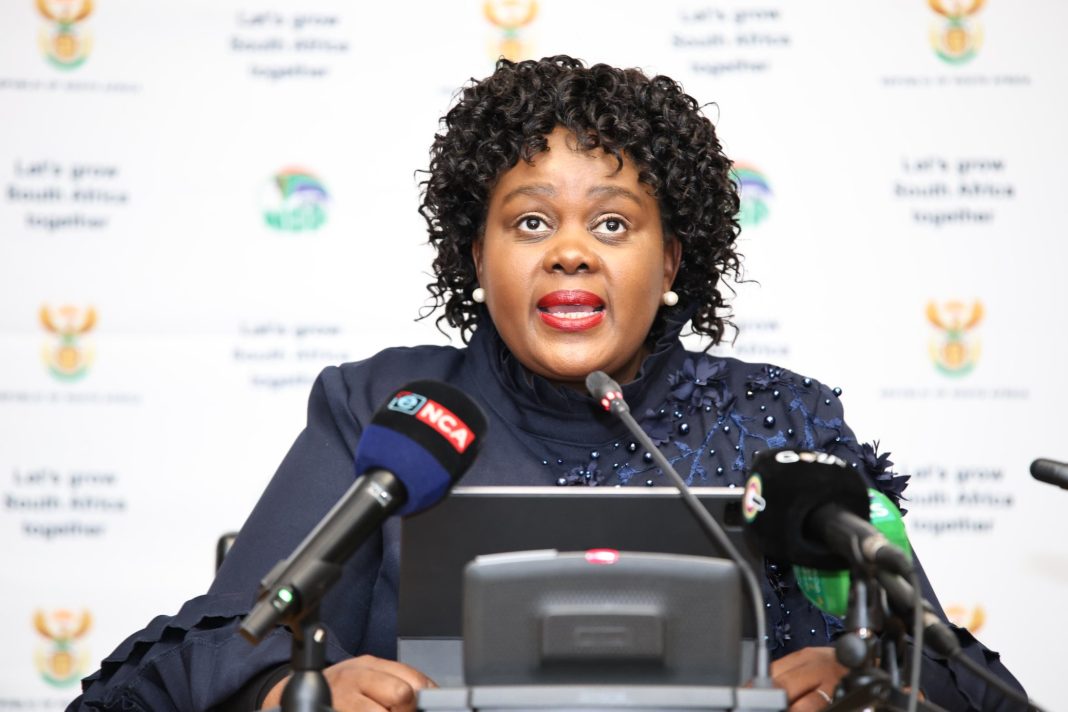
Justice and Constitutional Development Minister Mmamoloko Kubayi has applauded 89 senior managers from the Special Investigating Unit (SIU), who graduated as part of an advanced training initiative aimed at professionalising the public service and enhancing the state’s fight against corruption.
Speaking at the ceremony held under the theme “Celebrating Capacity Building in the Fight Against Corruption”, Kubayi praised the graduates for their dedication to ethical governance and public service excellence.
“Because of the dedication you have shown in doing your job, placing your lives and those of loved ones at risk, the special investigation unit stands as a monument of excellence in public service and more importantly, a demonstration that corruption can be beaten,” Kubayi said.
The programme was delivered in partnership with Stellenbosch Business School and forms part of broader efforts to create a capable, ethical and developmental state, aligned with priority three of the Medium-Term Development Plan.
Quoting President Cyril Ramaphosa’s statement on the National Framework Towards the Professionalisation of the Public Sector, Kubayi said the ceremony marked a clear response to the president’s call for a public service “staffed by men and women who are professional, skilled, selfless, and honest”.
She commended the SIU as a symbol of excellence in the justice and security cluster, noting that the unit’s successes in exposing procurement corruption and recovering billions in misused public funds had restored public confidence.
Kubayi, however, warned that public trust remained fragile.
She criticised unethical officials who misused public funds for personal gain, indulged in extravagant lifestyles and treated the state’s coffers “as a personal piggy bank”, saying that the public was well aware of the whispers and stories about “clubs, cars and corruption”.
She added that the justice and security cluster had “barely scratched the surface” in tackling priority crimes.
Despite notable efforts, only 33% of targets were met in securing cyberspace, combatting fraud and money laundering and integrating the justice system.
“You are part of a justice system value chain. When one part of the chain fails, the entire system suffers. SIU is not exempt from this,” she cautioned the graduates, urging them to translate their new knowledge into measurable improvements in performance, referrals for prosecution and systems reform.
The minister challenged the notion that corruption was a victimless crime, emphasising its devastating effects on the poor and vulnerable.
She cited stolen healthcare funds as a direct violation of constitutional rights and described misappropriated resources as “services denied to those most in need”.
She commended the SIU for recovering large sums through forensic investigations and civil litigation, but urged them to go further. Prevention and deterrence were just as crucial as recovery.
The graduation event also featured the signing of key Memoranda of Understanding (MOUs) with higher education institutions, aimed at developing cutting-edge skills to combat increasingly sophisticated financial crimes.
Two agreements were signed with Sol Plaatje University’s Faculty of Natural and Data Sciences, to strengthen forensic data analytics and market intelligence; and with Campus Protection Services, to enhance investigative training for security personnel at public universities.
Two more MOUs are planned, including one with Unisa for a Master’s qualification in Forensic Auditing and Anti-Corruption targeting law enforcement agencies across Africa, and another with the University of Johannesburg, to develop a pipeline of talent in critical areas of public administration.
Kubayi warned that corruption was becoming more complex due to globalisation, artificial intelligence and emerging technologies.
“In the era of the Fourth Industrial Revolution, investigators must be highly skilled and specialised. Without the ability to detect and prevent illicit financial flows, future state capture will be digital and undetectable,” she said.
She described scenarios in which AI could be weaponised to falsify financial records, create shell entities, or replicate cyber identities to commit fraud.
Kubayi stressed the importance of understanding international criminal behaviour in today’s borderless digital economy.
She called for greater cross-border cooperation and urged public servants to match the agility and innovation of transnational criminal networks.
INSIDE POLITICS