


Simon Nare
The National Prosecuting Authority will need to clean its house and confront its challenges head-on in order to function to the best of its ability.
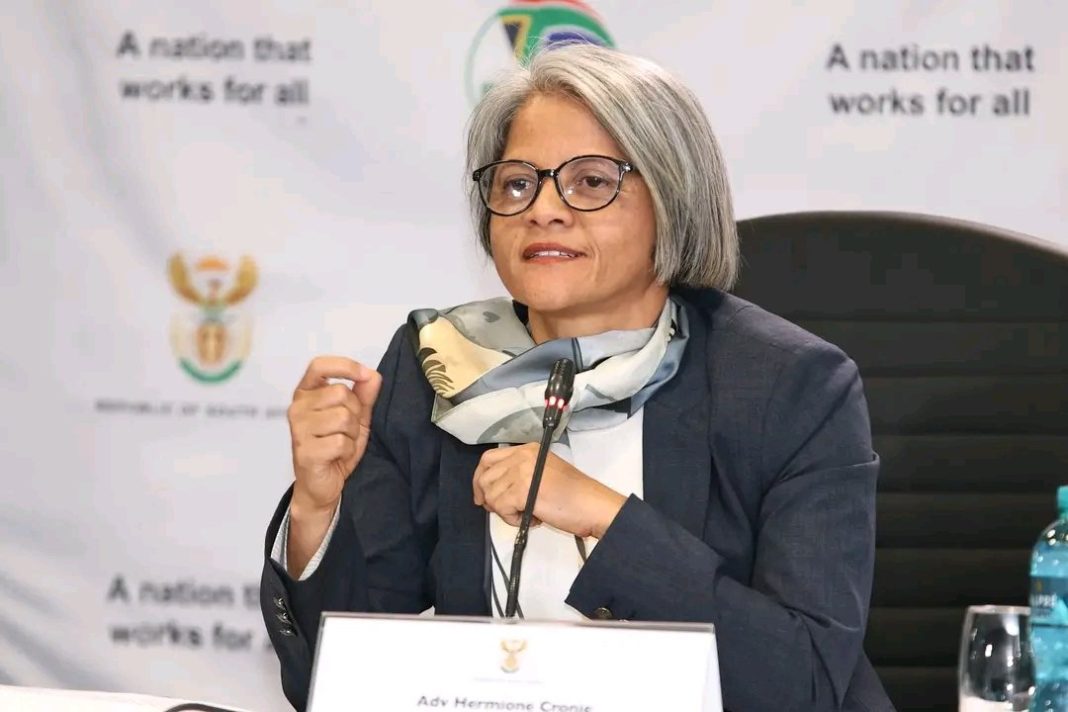
This was the submission of former head of the NPA’s Investigating Directorate (later IDAC), Advocate Hermione Cronje, on Thursday, during interviews by the advisory panel to replace Advocate Shamila Batohi, the outgoing National Director of Public Prosecutions (NDPP).
Cronje and former NDPP head Advocate Menzi Simelane, who was also interviewed on Thursday, were two of the six candidates shortlisted for the job.
Cronje told the panel – chaired by Minister of Justice and Constitutional Development Mmamoloko Kubayi – that the lack of skills in the NPA was derailing its success in trying cases.
She described the challenges facing the institution as “catastrophic”, and called for an honest approach to dealing with them. In response, some of the panellists asked why she would then want to return to lead the institution.
“People are not taking these issues seriously, and it’s eminently solvable. You can address it. but you have to confront it. I do think that our performance has plummeted. I can refer you to the statistics. The NPA doesn’t not publish these statistics.
“It used to publish them. In 2005 and 2006, we used to tell you how many cases we enrolled in a year and you would get a sense of where we were,” she said.
She said that prosecutors were not being rewarded to try risky cases by the authority because its focus was on a high prosecution rate.
Cronje said the NPA needed to relook at the statistics it was generating, because research revealed that productivity had dropped significantly.
“We have more prosecutors now. We also have more crime now, but we are putting away fewer cases. That doesn’t even start to show the problems [with delays]. If we are not going to be prepared to interrogate the problems at the NPA and brutally look at what is working and what is not working, and fix what is not working, then we are forever going to be disappointed,” she said.
Cronje proposed regular integrity testing of prosecutors because of attempts to bribe them. This was “not because they are more likely to be corrupt,” she said, “but because they are in institutions where chances are high that they will be subjected to [bribes].”
She said that prosecutors should also undergo lifestyle audits.
“We need consequences all over the place. We need strategies all over the place so that we can keep ourselves honest,” she said.
As for Simelane’s interview, he came to the advisory panel with his integrity already in question.
He served as Director-General at the Department of Justice and Constitutional Development between 2005 and 2009, and then as NDPP from December 2009 until his appointment was set aside by the Constitutional Court in 2012.
Civil society organisation Freedom-Under-Law (FUL) has told the panel to reject Simelane’s candidacy.
In a formal letter to Kubayi last week, FUL said the apex court found it was irrational to ignore adverse findings from the Ginwala Inquiry into former NDPP Vusi Pikoli, which it said went directly to Simelane’s credibility, honesty and integrity.
The organisation said the Ginwala report described Simelane’s testimony as “contradictory” and “without basis in fact or in law”, and said he withheld key legal opinions and other relevant material that could have misled the inquiry.
FUL also said the Ginwala Inquiry criticised Simelane’s role in drafting a letter that it described as tantamount to executive interference in prosecutorial independence.
It added that advocate-disciplinary proceedings had also raised serious questions about his fitness, saying a Johannesburg Society of Advocates panel found him guilty of misconduct and that a striking-off application was pending.
Asked by the panel on Thursday about the Ginwala Inquiry, Simelane said he would not accept suggestions that questioned his integrity, and that he had been a reliable witness at the inquiry.
“I am not going to accept that, because if I accept that, these issues will remain unattended, and they have been attended for 18 years now. So, I am not going to allow [this interview] to go that route,” he said.
When speaking about the working of the NPA, he said the lack of public knowledge about the organisation’s work, its poor communications, and lack of transparency contributed to public mistrust.
He said when he led the organisation, he introduced performance measurements that were non-existent at the time.
“There were no performance agreements. So I insisted, there and then, to one of the superiors present: please take the performance agreements of my former DDGs in the department, have a look at them, and create a performance agreement for me to use with the deputies and DPPs, because I needed a way of managing it. Then I realised that there were not performance agreements. So that’s how I introduced performance agreements at that level,” he said.
Further, said Simelane, there were legal issues that cropped up and landed on his desk, and when he asked who was responsible for legal, it was unclear.
That led to him establishing the Legal Affairs Desk and employing lawyers to handle those issues.
Also interviewed on Thursday was Advocate Xolisile Jennifer Khanyile. On day one, Advocates Nicolette Astraid Bell, Adrian Carl Mopp and the IDAC head, Advocate Andrea Johnson, were interviewed.
INSIDE POLITICS