


By Johnathan Paoli
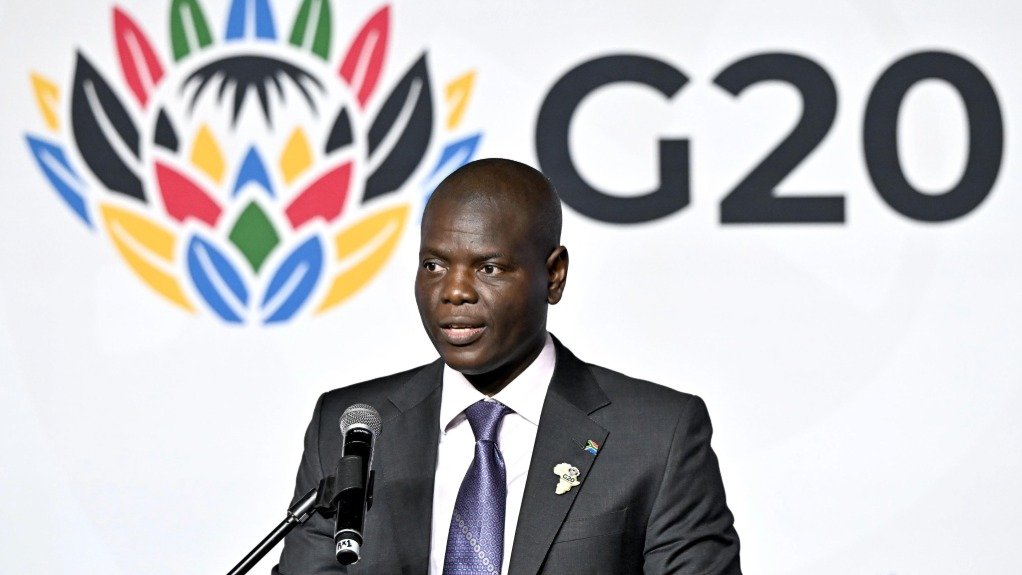
International Relations and Cooperation Minister Ronald Lamola has hit back at United States Secretary of State Marco Rubio, accusing Washington of “double standards” in global politics and of dispensing unsolicited democracy lessons it does not consistently uphold.
Rubio, in a recent post, claimed South Africa no longer ranks among the world’s 20 largest economies and blamed the ANC government for economic stagnation, citing regulatory burdens and race-based policies.
He further dismissed South Africa’s presidency of the G20 as an exercise in “spite, division, and radical agendas that have nothing to do with economic growth.”
But Lamola has rejected these assertions, saying Washington’s exclusion of Pretoria from recent G20 engagements undermines the principles of multilateralism and reduces global governance to a tool of domination rather than cooperation.
He stressed that South Africa is a founding member of the G20 and that no member has the unilateral authority to exclude another.
In his formal response to Rubio’s Substack critique, Lamola said that South Africa is not a subordinate in international affairs but an equal sovereign state whose democratic trajectory warrants respect, not condescension.
“Secretary Rubio, the world is watching. It is growing weary of double standards. It is tired of lectures on democracy from those who seem to have forgotten that democracy, at its best, must listen as much as it speaks,” Lamola wrote.
He stressed that South Africa’s political and economic decisions are rooted in its own Constitution and history, not in the expectations of external powers.
While Lamola emphasised that South Africa remains committed to respectful engagement with the United States, he said the partnership cannot be based on hierarchy or condescension.
“We do not seek your approval for our path. Our path is our own, chosen by our people and guided by our sovereign laws. But we do seek, and we will always extend, a hand of respectful partnership,” the minister wrote.
The remark lands as a direct rebuke to Rubio’s characterisation of South Africa’s domestic policies as discriminatory and its G20 Presidency as obstructive.
Lamola argued instead that Washington’s claims reflect a long-standing tendency by powerful states to pass judgment on developing democracies while overlooking their own contradictions.
He challenged the US stance on democratic norms by pointing to inconsistencies between its rhetoric and its actions, noting that South Africa’s Government of National Unity, currently comprising ten parties, was proof of a robust and functioning democracy.
To cast South Africa as a state hostile to minorities or slipping into authoritarianism, he argued, was to ignore both its constitutional foundations and its political reality.
He further situated South Africa’s domestic transformation policies within a broader historical context, emphasising that equity, land reform and economic redress are constitutional imperatives rooted in the legacy of apartheid.
These, Lamola insisted, cannot be reduced to racialised narratives that suggest hostility toward white citizens.
Washington’s critiques, he suggested, oversimplify and distort a complex democratic journey that is only three decades old.
Lamola also rejected Rubio’s suggestion that South Africa sabotaged consensus during its G20 Presidency.
“It is a matter of public record that the United States chose not to attend our G20 meetings. Given that absence, the notion of our “sabotaging” consensus is not just incorrect, it misunderstands the very purpose of a forum like the G20,” he wrote.
“Our role as host was not to force agreement, but to create the conditions for it: a table of equals, governed by the spirit of Ubuntu. That spirit, “I am because we are”, is not a slogan. It is the philosophy that steered our nation away from the precipice of bloodshed and towards reconciliation. It is what led delegates from across the world to describe our gathering as a “people’s G20.” True leadership doesn’t mean everyone leaves getting everything they want; it means everyone leaves feeling they have been truly heard.”
Instead, Lamola argued that South Africa fostered a consultative and equitable environment shaped by the philosophy of Ubuntu.
He reminded Rubio that other foreign delegates praised South Africa’s approach, with leaders from India, Germany, France, Japan and the International Monetary Fund publicly commending the country’s hospitality and leadership.
Lamola used these testimonials to underline South Africa’s point of global leadership not measured by dominance, but by the ability to make all participants feel included.
In his closing words, he reiterated the country’s dual commitment to sovereignty and engagement: South Africa does not seek US approval, but it remains open, willing and ready for respectful partnership.
INSIDE POLITICS