


By Johnathan Paoli
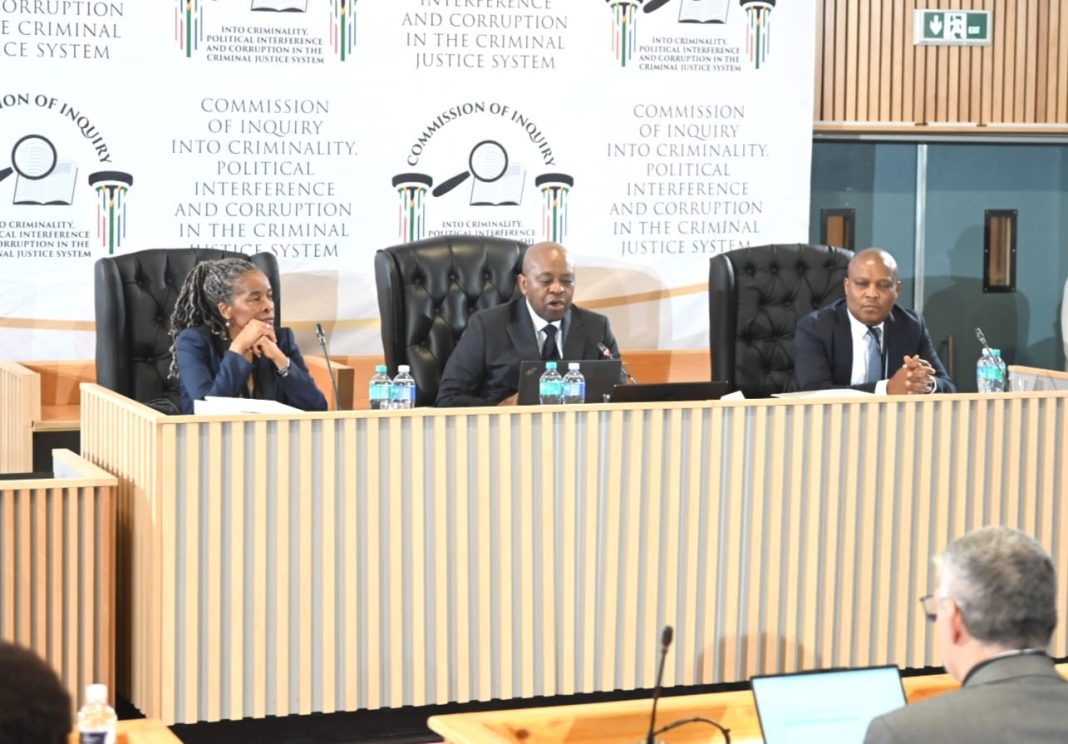
The Madlanga Commission will hear the testimony of its next witness behind closed doors on Thursday and Friday.
Chief evidence leader Advocate Matthew Chaskalson (SC) confirmed that the witness’s evidence “concerns matters that are the subject of active and ongoing police investigations” and could not be heard in public without jeopardising those investigations.
“When the police are at an advanced stage of investigations, one can’t ventilate the content of those investigations publicly without running the risk of compromising those investigations. That’s the unfortunate situation we find ourselves in at the moment,” Chaskalson said
Earlier this week, attorneys representing News24 and the Daily Maverick had formally opposed the commission’s application for an in-camera hearing, citing public interest and transparency concerns.
However, after further engagement with the evidence leaders, both outlets withdrew their opposition.
Advocate Charles du Plessis, representing the two publications, told the commission they were now satisfied with the legal basis for confidentiality.
“I confirm that the media respondents will no longer oppose the in-camera hearing of the witness described in paragraph four of the order of 14 October. We think that is the best resolution under the circumstances. We are comforted by the assurance that the commission will continue to have oversight over what happens in camera,” he said.
Commission chairman, Justice Mbuyiseli Madlanga, acknowledged the agreement but clarified that the decision to proceed in camera was based on the commission’s own assessment of the risks involved, not merely the withdrawal of media opposition.
“The decision is reached on the commission’s own assessment of what has been put before it. For those reasons, the hearing today and tomorrow will be in camera,” he said.
Chaskalson emphasised that the need for secrecy was temporary and that once the relevant police investigations reached a safer stage, the commission intended to make Witness X’s evidence public.
“As soon as the need for secrecy has passed, the evidence will be made public. We are hopeful that long before this commission concludes its work, the investigations will have reached a stage where this information can safely enter the public domain,” he said.
Chaskalson said that the commission will adopt a new procedural measure: a mandatory 72-hour public notice before any future in-camera hearings.
“There will not be any in-camera witnesses called without a 72-hour notice to the public, so that if anyone wants to object, they can do so,” he said.
Responding to a question from Madlanga about the evidentiary value of in camera testimony, Chaskalson assured the panel that no secret evidence would be used to make findings against any individual.
“We accept that the commission cannot make findings against any person on the basis of secret information. If by the time the commission ends there are certain allegations heard in camera that cannot be made public or put to the implicated parties, we won’t be asking for findings based on those allegations,” Chaskalson said.
He expressed confidence, however, that this situation was unlikely to arise, saying that the evidence heard this week “will, in time, be heard by the public and by the implicated persons before the commission concludes its business”.
INSIDE POLITICS