


By Johnathan Paoli
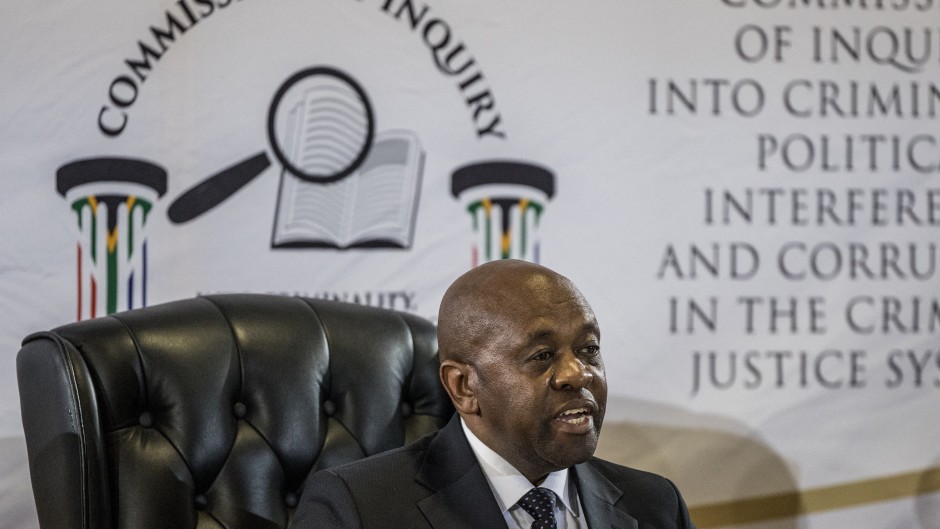
Explosive testimony before the Madlanga Commission of Inquiry reignited questions about whether crucial omissions in a police ballistics report on the murder of Armand Swart were the result of mere “typing errors” or a calculated attempt to sabotage the investigation.
Senior counsel Michael Chaskalson, leading evidence for the commission on Monday, raised the possibility that errors in the first report by a South Africa Police Service (SAPS) analyst were not accidental, but deliberate.
“This may not be a mistake but an attempt at sabotage,” Chaskalson warned, noting that the investigating team had already voiced similar suspicions.
At the centre of the controversy is the analyst, “Captain Magotla’s” initial report, which not only failed to mention 15 AK-47 cartridges found in the possession of the Swart murder suspects, but also carried the wrong case number; a blunder that could have broken the chain of custody and fatally compromised the case in court.
“If the defence had spotted this mistake, they could have argued that the guns analysed were not linked to their client,” Chaskalson explained.
The omissions concern the April 2024 murder of engineer Swart, who was shot outside his workplace at Q Tech in Vereeniging in what police initially described as a case of mistaken identity.
Testifying under oath, SAPS Ballistics Section head Brigadier Mishack Mkhabela admitted that Magotla’s report contained “typing errors” and a “glaring mistake”, particularly in its failure to mention the 15 cartridges.
However, he maintained these were administrative errors, not deliberate acts of interference.
“If Magotla were trying to sabotage the investigation, he would need his head read,” Mkhabela said.
He added that once the errors were discovered, they were corrected and an internal investigation was initiated.
But Chaskalson pushed back, revealing that a reviewer had refused to sign off on the initial report because of multiple irregularities, yet it was inexplicably released regardless.
Further, Magotla later filed a supplementary affidavit and even inserted a replacement page, followed by a third revised report, to address ongoing mistakes.
The commission also heard that the date on the corrected report was itself inaccurate, and that the corrections were commissioned by Magotla’s partner, raising questions of conflict of interest.
Mkhabela conceded this “may be perceived” as improper.
Chaskalson concluded that the entire ballistics process might need to be redone from scratch.
“This entire investigation should be redone so that the Swart murder case is not jeopardised,” he said.
A meeting to decide on the matter has been scheduled for 31 October.
One of the most serious concerns centred on the use of the wrong case number in the report.
According to Chaskalson, this could provide grounds for the defence to challenge the authenticity of the ballistic link between the seized weapons and the crime scene.
Mkhabela countered that SAPS analysts are trained to record what they see, even if the case number written on an evidence bag is incorrect.
“If the investigating officer has written the wrong number, you document it as it appears on the package,” he explained.
Commissioner Sesi Baloyi questioned why Magotla, who had written the correct case number elsewhere in his report, did not alert investigators to the discrepancy.
Mkhabela admitted this was possible but argued that the commission must first inspect the evidence bag before drawing conclusions.
Mkhabela’s testimony also shed light on systemic dysfunction within SAPS forensic services.
The firearms seized from Tau and Kekana were only uploaded to the Integrated Ballistics Identification System (IBIS) on 6 September 2024, nearly five months after Swart’s murder.
Mkhabela attributed this delay to severe backlogs.
Another puzzle emerged, namely the Vereeniging and Bramley dockets linked to Swart’s killing were inexplicably transferred to KwaZulu-Natal for further examination.
He added that he only learned of the dockets’ transfer after the fact, questioning why his Pretoria office was bypassed.
According to him, the KZN lab later generated new lab numbers for the cases, further complicating record integrity.
Despite the administrative confusion, Mkhabela confirmed that the seized weapons have been linked to several major criminal cases.
The AK-47 recovered from the Swart murder suspects is tied to eight other murders and attempted murders, including the killings of musicians DJ Sumbody and DJ Vintos.
The 9mm Taurus pistol seized in the same operation has been connected to 19 other cases, including the attempted murder of Tebogo Thobejane, ex-girlfriend of businessman Cat Matlala.
Chaskalson warned that these links could be undermined if the procedural and documentary flaws were not addressed through a new, independent investigation.
The commission will resume its hearings on Tuesday morning.
INSIDE POLITICS