


By Thebe Mabanga
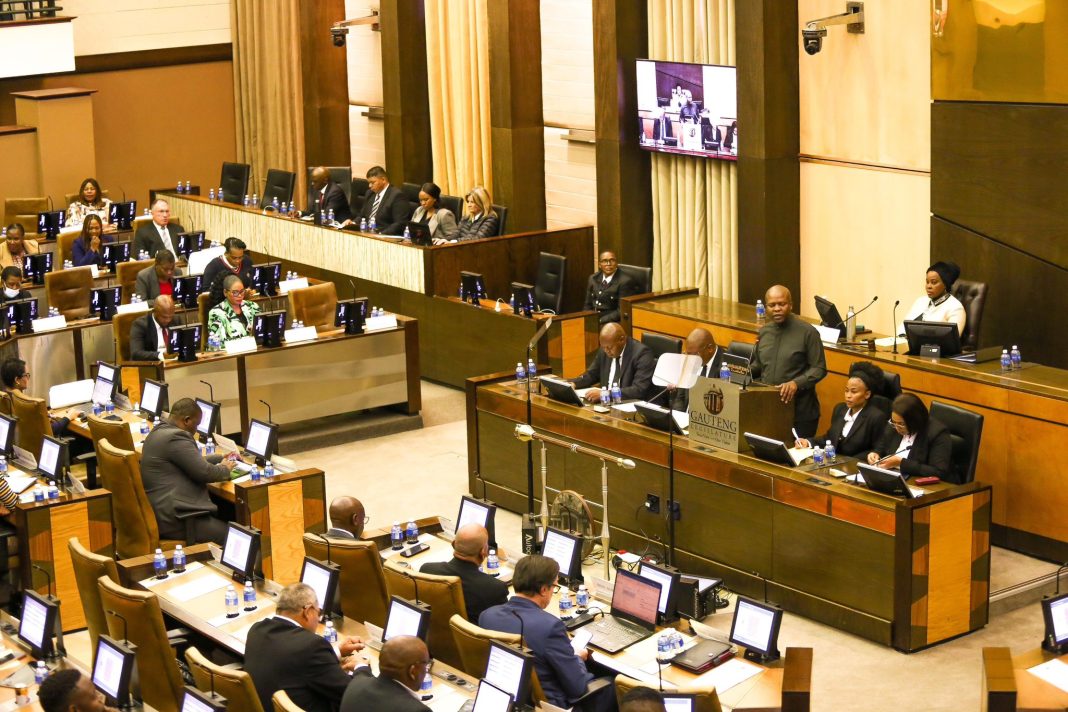
Gauteng finance MEC Lebogang Maile managed to find an additional R868 million as he tabled a revised budget from the 18 March. The budget now stands at R172,3 billion.
Maile said the additional resources were made “possible through the provincial allocation of unspent funds and revenue over collection from the previous financial year”.
On the tabling of the second budget for Gauteng, Maile said: “The intense debate around this year’s National Budget has been a worthwhile exercise for the country. While some view the Budget tabling process as an indication of disruption, we view it as the clearest expression of the strength and maturity of South Africa’s democracy.”
He said the revised National Budget created scope for him to tweak the provincial budget to accommodate Premier Panyaza Lesufi’s 13 priorities outlined in his State of the Province Address. They are aimed at improving service delivery and amplifying the province’s commitment to host the G20 Summit in November.
Maile was frank about the economic reality facing the province, including fiscal contrasts to growth.
“With a shrinking equitable share and slow economic growth, Gauteng provincial government departments must internalise these fiscal constraints and align spending with the 2024- 2029 Medium-Term Development Plan.”
He noted that there was a slight improvement in economic growth outlook and falling inflation, but said: “This does not negate the reality that the journey ahead of us is going to be difficult, demanding the commitment of the government, private sector and civil society.”
In April, the province hosted the Gauteng Investment Conference with the aim of attracting R800 billion in investment pledges over the next three to five years. Maile said the Investment Book presented at the conference featured 117 projects across Gauteng’s economic corridors, totaling an estimated R239 billion in potential investment.
At the beginning of April this year, Gauteng pioneered a new Invoice Management System (IMS), which Maile described as “a cutting-edge, advanced technology-driven platform designed to bring innovation and efficiency to invoice processing across the Gauteng provincial government”.
The fully automated system that replaced the Electronic Invoice System is designed to reduce delays, enhance accuracy and provide real-time visibility for seamless invoice processing in the provincial government.
Gauteng is also in the process of modernising its supply chain management processes.
“It is our primary objective to ensure that provincial departments and entities in Gauteng receive all their tenders electronically, and that the evaluation of said tenders are conducted through advanced technological means.
“This digitisation is crucial if we are to stem the tide on inefficient SCM processes,” Maile said.
The system, currently in use by the Gautrain Management Agency, will also be piloted at the Gauteng Provincial Treasury, the Office of the Premier, the Gauteng Department of Roads and Transport and two entities – Constitution Hill and G-Fleet.
Maile announced that Gauteng departments collected R8.4 billion through motor vehicle licence fees, gambling taxes and interest earned on investments.
“While it amounts to only 5% of the total budget, this revenue is important as it complements our ability to fund service delivery priorities in the province,” the MEC noted.
Gauteng will see its equitable share grow from R133,9 billion this year to R144,2 billion in three years, an annual increase of 4%. Conditional grant allocations will increase from R28.9 billion in the 2025/26 financial year to R29.2 billion in 2027/28 in the outer year of the MTEF.
Gauteng’s equitable share allocation falls by R6,2 billion over the next three years, but this is countered by allocations such as honouring the public service wage agreement. R207 million was added for the teacher assistant programme.
Notable allocations include the Office of the Premier receiving an additional R50 million to fund Nas’iSpani, a skills development initiative spearheaded by the Gauteng City Region Academy.
The Gauteng Department of Economic Development will receive R100 million, which will be largely geared towards supporting SMMEs and starting the groundwork for Gauteng Investment Conference pledges.
The Gauteng Department of Human Settlements receives R332 million, of which R232 million is to service informal settlements with sanitation services.
The Gauteng Department of Environment will also receive an additional R50 million in the 2025/2026 financial year to enable it to jointly collaborate with relevant municipalities in the programme to clean and green.
The Gauteng Department of Health’s 2025/26 financial year allocation amounts to R67.1 billion, and a total of R141.9 billion over the MTEF while education receives R68 billion, and cumulatively R211.2 billion over the MTEF, to expand access to quality basic education and early childhood development.
INSIDE POLITICS