


By Johnathan Paoli
EFF leader Julius Malema has challenged African lawyers to take an active role in dismantling systems of oppression and driving liberation across the continent.
Delivering the keynote address at the Nigerian Bar Association’s (NBA) Annual Conference in Enugu on Sunday, Malema said lawyers and activists have always stood side by side in the fight for justice, arguing that both are instruments of justice bound by a duty to advance human dignity rather than uphold systems of inequality.
“Our duty is not to be instruments of injustice and neocolonialism. It is to be agents of change, brave enough to identify unjust laws, speak out, and ensure that our judiciary serves our people,” he told the gathering.
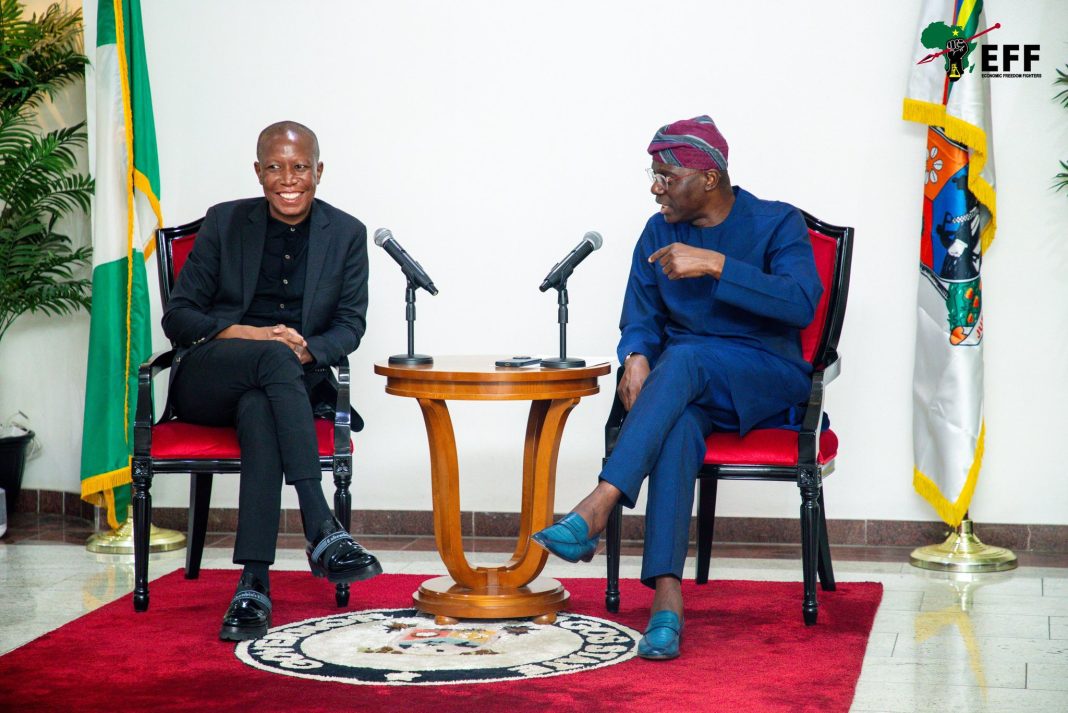
Welcomed by dignitaries including the Governor of Enugu and the Sultan of Sokoto, Malema described Nigeria as a “home” for South Africans, citing its historic solidarity during the anti-apartheid struggle.
He thanked the NBA for the invitation, stressing the legal fraternity’s central role in shaping just societies.
But he cautioned that the law itself has long been used to legitimise oppression.
Recalling Africa’s colonial past, Malema reminded the audience that apartheid in South Africa and colonial systems elsewhere were built on legal frameworks that sanctioned racial segregation, land dispossession and exploitation.
He cited examples such as slavery being legally permitted, sexual crimes against African women going unpunished, and colonial states codifying the theft of land and mineral wealth.
These histories, he argued, show that legality does not necessarily equal justice.
“It was once legal to come to our shores and kidnap Africans, to take our land because we were not ‘civilised’ enough,” he said.
He cautioned that modern governance risks repeating these injustices, with authoritarian leaders using state machinery to entrench their rule.
“We must all ask whether the time has not once again arrived for liberation to be achieved by reimagining our laws for the better,” Malema urged.
Malema contextualised his party’s birth within Africa’s liberation struggles, recalling the 2012 Marikana massacre in which 34 mineworkers were killed by police during a wage strike.
He described the EFF, launched in 2013, as a revolutionary movement rooted in Marxism-Leninism and the teachings of Frantz Fanon, dedicated to completing Africa’s unfinished liberation.
Outlining the EFF’s “seven cardinal pillars,” Malema listed expropriation of land without compensation, nationalisation of key industries, abolishing the tender system, providing free education and healthcare, driving industrialisation, advancing African economic integration, and shifting from reconciliation to justice through accountable governance.
He highlighted the party’s legislative interventions in South Africa as evidence of how legal frameworks can be transformed.
These included the Nationalisation of the Reserve Bank Bill, which seeks to expand the central bank’s mandate to include job creation; the Public Finance Management Amendment Bill, aimed at regulating loans from institutions such as the IMF and World Bank; and the Student Debt Cancellation Bill to free graduates from crippling debt.
Malema also pointed to the Sourcing Bill, intended to curb outsourcing and labour brokering, which he described as central to corruption.
Turning to public health, he criticised alcohol advertising for glamorising drinking while obscuring its destructive social consequences, calling for tighter regulations akin to past restrictions on cigarette advertising.
“It cannot be that alcohol is advertised only with beautiful people at the beach. It must be a true reflection of what it will do to you,” he argued.
Throughout his address, Malema framed the legal fraternity as vital allies in the struggle for liberation, urging African lawyers to challenge laws that sustain poverty and inequality and to transform institutions originally designed to exclude Africans.
He closed with a call for renewed solidarity between Nigeria, South Africa, and the wider continent, praising Nigeria’s sacrifices during apartheid — from the Southern African Relief Fund to boycotts of international sporting events.
This legacy, he said, must inspire a new era of Pan-African unity.
Malema’s participation also included meetings with NBA President Mazi Afam Osigwe and other leaders, underscoring a commitment to deepening collaboration between the legal fraternity and progressive movements.
He was accompanied by EFF Deputy Secretary General Leigh-Ann Mathys, National Spokesperson Thembi Msane and Head of Presidency Vuyani Pambo.
INSIDE POLITICS