


By Johnathan Paoli
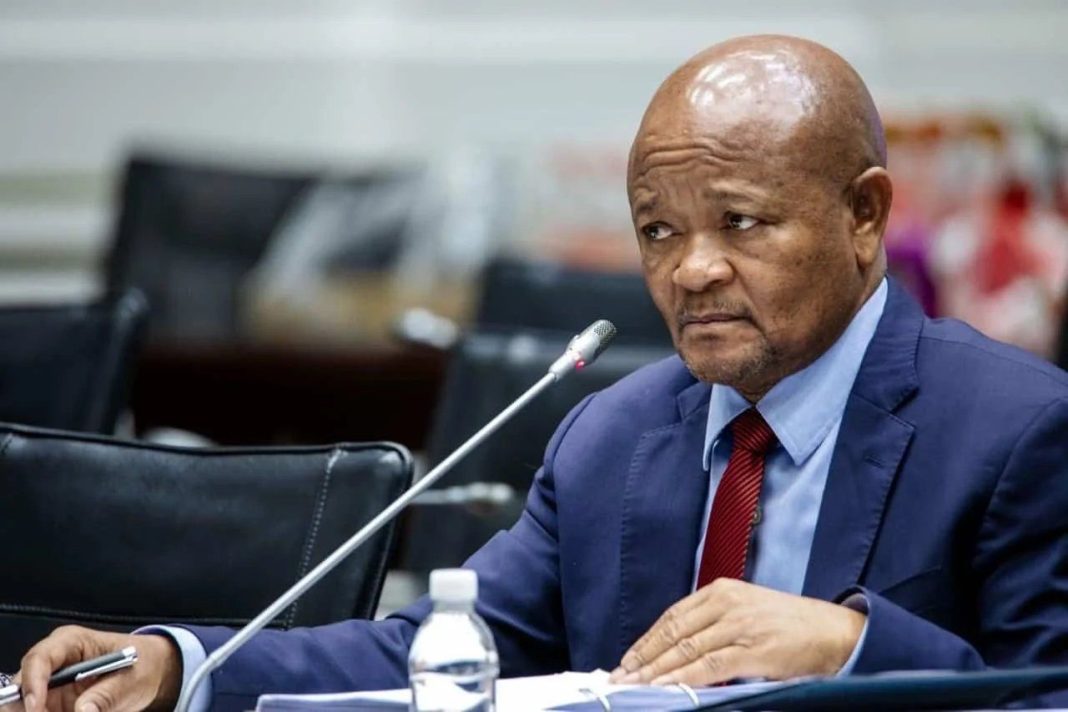
Suspended Police Minister Senzo Mchunu returned to the Madlanga Commission on Wednesday to defend his controversial decision to disband or, as he repeatedly insisted, “absorb”, the Political Killings Task Team (PKTT).
His testimony centred on complaints of alleged human rights abuses within the unit, concerns about governance failures, and what he said was an untenable concentration of policing resources on political killings at the expense of the murder crisis gripping the country.
Mchunu resumed his evidence with Advocate Mahlape Sello leading him, after briefly standing down for subpoenaed witness Julius Mkhwanazi.
Challenging the claim that the police minister exercises no operational role whatsoever, he said the post-apartheid policing model was deliberately designed to place the service under “public control” through a political head.
“I want to point out right at the beginning that we dispel the notion that the Minister of Police has no operational role whatsoever insofar as police are concerned. The police reside under a political head for a good reason,” he said.
Citing the Constitution, he emphasised that the minister holds three distinct powers, including the authority “to direct the National Commissioner when exercising his or her powers” to manage and control the South African Police Service (SAPS).
This, he said, was directly relevant to his decision on the PKTT.
Mchunu insisted that the national commissioner’s power to “organise and reorganise” SAPS into units did not apply to the PKTT, which had not been established through that office.
His December directive to dismantle the team was, he said, firmly grounded in constitutional and legislative provisions.
He added that he consulted special advisor Advocate Vusi Pikoli, who “indicated comfort” with the approach.
By mid-2024, he said, the ministry began receiving a wave of complaints from civil society organisations, whistleblowers, SAPS members, Parliament and ordinary citizens about the task team.
“The PKTT has for some time been credibly accused of systematic human rights violations, and I must indicate it’s quite concerning to hear stories here and there of members of PKTT wearing balaclavas when they do some of the operations that you wouldn’t expect them to do so,” he said.
The concerns were serious enough that eight individuals requested private meetings with him, which he claimed to have honoured in “strict confidentiality”.
Their names were placed in a sealed envelope he intends the commission to review.
Other complainants, he said, included academic Mary De Haas and SAPS whistleblower Patricia Morgan-Mashale.
According to Mchunu, complainants alleged that PKTT members wore balaclavas in situations where such anonymity was unnecessary, creating a culture “not in line with democracy and what is expected of the police”.
His view, he told the commission, was that “it is possible for police, whether in units or teams, to perform their duties successfully without violating any human rights”.
A second major justification for terminating the PKTT was what he described as an “unfair” and “unsustainable” allocation of policing resources to political killings; a category he said comprised a small fraction of the country’s overall murder profile.
The PKTT, he emphasised, was established specifically to investigate political killings, “not any other murder”. Yet it had come to be treated as a specialised organised-crime-fighting unit, a mandate he argued it was never designed for.
Statistics he presented showed that between 2016/17 and 2024/25 SAPS recorded an average of 23 043 murders nationally each year, with KwaZulu-Natal alone accounting for 5 314.
By contrast, political killings recorded an average of just 18 deaths annually.
“I don’t think it’s fair to devote substantial resources to one category of killings… when the evidence is that there’s an urgent need to focus on all murders,” he told the commission.
This concern prompted him to convene a high-level SAPS meeting late in 2024 focused on four priorities: murders, firearm proliferation, drug proliferation and gender-based violence and femicide.
While political killings remained important, he said, it was clear that “outside that category, there’s a lot happening”.
The minister insisted his decision was not a repudiation of the PKTT’s work but a strategic shift based on hard data.
“It was time to mainstream them,” he said, adding that the team’s expertise needed to be absorbed into permanent murder and robbery units.
He said that by late 2024, the general consensus in KZN, where he lives, was that political killings were declining.
For that reason, he said, the directive should not be viewed as a dissolution but an “absorption” of the task team into the core investigative structures of SAPS.
The commission continues.
INSIDE POLITICS