


By Johnathan Paoli
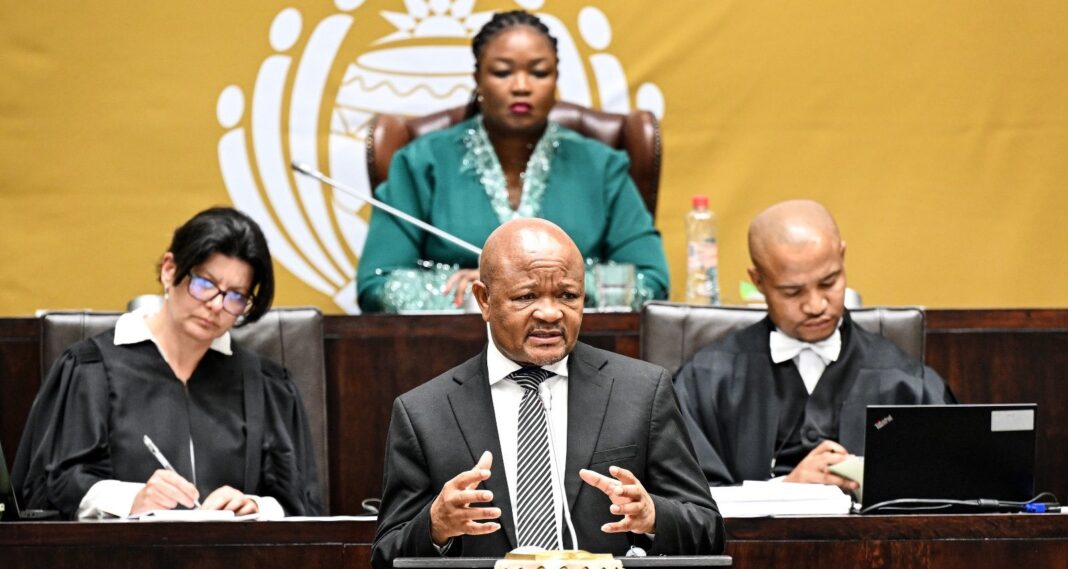
Suspended Police Minister Senzo Mchunu on Tuesday mounted a strong defence against damning allegations made by KwaZulu-Natal Police Commissioner Nhlanhla Mkhwanazi, telling Parliament’s ad hoc committee that the claims against him were “twisted”, “inaccurate”, and “politically motivated”.
The inquiry resumed with evidence leader and senior counsel Norman Arendse completing his main examination of Mchunu’s evidence before members of parliament began questioning him.
Mchunu used the session to dismantle what he described as “manipulative and inconsistent” testimony from Mkhwanazi, who has accused him of interfering with police investigations, protecting criminal syndicates, and lying about his association with controversial figures such as Brown Mogotsi and alleged crime boss Vusimusi “Cat” Matlala.
“I have never seen him with my naked eye,” Mchunu said of Matlala, adding that any affidavit by Matlala denying a relationship was obtained through his lawyers “at their own initiative” after he expressed a wish to clarify false claims.
Committee chairperson Soviet Lekganyane said both Arendse and Mchunu were allocated two hours before MPs would take over, with questioning expected to continue into Tuesday night.
Central to the hearing was the question of Mchunu’s relationship with Mogotsi, whom Mkhwanazi claimed was “very close to the minister”.
Mchunu maintained that he had known Mogotsi since 2017, but denied any improper association or collusion.
He told the committee that during a 5 March meeting of the Portfolio Committee on Police this year, he had been shown a photograph of a man who was not Mogotsi and therefore denied knowing him at the time.
Mchunu accused Mkhwanazi of twisting his words to fit his narrative during his now-famous 6 July press briefing, where the suspended commissioner publicly alleged that Mchunu had denied knowing Mogotsi entirely.
Arendse then confronted the minister with Signal messages allegedly sent by Mogotsi about an internal police case involving senior officers.
Mchunu confirmed receiving the messages but said he never responded because he “did not understand what [Mogotsi] was referring to”.
The committee also questioned Mchunu about the appointment of his chief of staff, Cedrick Nkabinde, whom Mkhwanazi had linked to internal efforts to “discredit” him. Mchunu said he first met Nkabinde in 2017 when he was an investigator at IPID, handling a case in which Mchunu was being “unjustifiably pursued” by the Hawks.
He acknowledged recommending Nkabinde for the post years later, saying he valued his “understanding of police work” and compliance with administrative processes. “You need someone you can trust,” said Mchunu, stressing that senior police experience was not a requirement for the position.
Asked whether Nkabinde could have given his contact details to Mogotsi or Matlala, Mchunu replied curtly: “I don’t know what Senior Counsel is talking about.”
A major focus of questioning from MPs revolved around Mchunu’s 31 December directive ordering the disbandment of the Political Killings Task Team (PKTT), a move that Mkhwanazi and others said crippled sensitive investigations.
Mchunu firmly rejected that assertion, saying his intention was to “restructure and integrate” the unit’s work within the national Serious and Violent Crime Division.
African National Congress (ANC) MP Thokozile Sokanyile pressed Mchunu on the timing of the directive, questioning why it was issued while National Police Commissioner Fannie Masemola was on leave.
Mchunu initially struggled to follow her line of questioning but later clarified that his use of the term “immediately” in the directive referred only to the request for a preliminary report, not an order to act in Masemola’s absence.
ANC MP Xola Nqola focused his questioning on issues of transparency, presidential consultation, and internal procedures around the PKTT’s dissolution.
He raised concerns about Mchunu asking Nkabinde to record a conversation with Mkhwanazi, noting that the committee had not received evidence of any threat that Mchunu claimed was made by Mkhwanazi.
Mchunu maintained that the threat occurred before the recording began and said Nkabinde could testify to this.
However, Economic Freedom Fighters leader Julius Malema interjected that no such recording existed, a view supported by Lekganyane, who said no evidence had been presented.
Nqola further asked whether academic Mary de Haas, a vocal PKTT critic, had influenced Mchunu’s decision.
Mchunu strongly denied this, saying his decision was based on multiple consultations and assessments, not a single individual.
Mchunu also challenged the claim that political killings declined solely because of the PKTT.
He accused Mkhwanazi of playing politics, saying that while the general avoided calling him corrupt before Parliament, he had freely done so in public.
“A police officer can’t talk like that, he can’t become a politician,” he said.
He also clarified his role in the cancellation of Matlala’s R360 million tender for police health services, saying it was he who initiated the review after reading a News24 report about irregularities.
Mchunu concluded by urging the committee to summon witnesses, including Matlala and Nkabinde, to “set the record straight”.
INSIDE POLITICS