


By Thapelo Molefe
Sport, Arts and Culture Minister Gayton McKenzie says the South African Football Association (SAFA) has been cleared of wrongdoing in the “yellow card blunder” that led to Bafana Bafana’s FIFA points deduction, describing it as a rare administrative mistake caused by under-resourcing and lack of support for national teams.
This follows McKenzie’s directive for an investigation into the circumstances that led to Bafana Bafana being stripped of their victory over Lesotho in a 2026 FIFA World Cup qualifier in March.
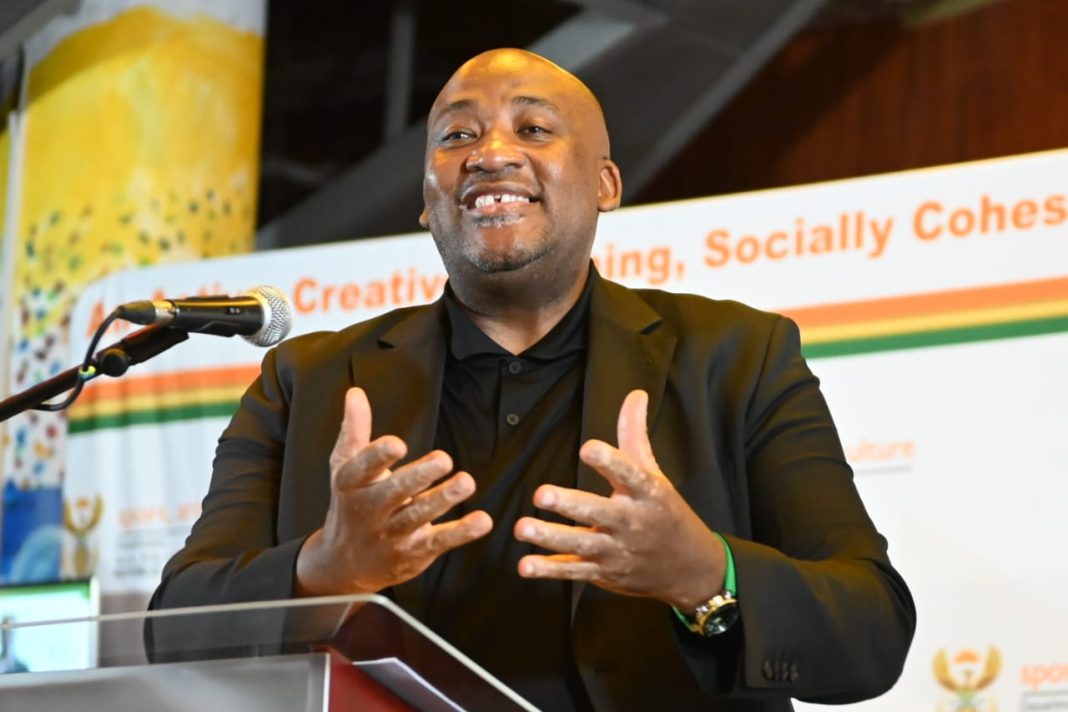
Speaking at a comprehensive media briefing on Tuesday, McKenzie said SAFA had fully complied with his call for accountability and had completed an internal investigation into the incident.
He explained that the disciplinary confusion, which saw midfielder Teboho Mokoena fielded while ineligible, arose from an unusual 16-month gap between two yellow cards issued to the player—one in March 2023 against Liberia and another in June 2024 against Nigeria.
“The investigation showed that this was not negligence or corruption,” McKenzie said.
“It was a very strange, highly unusual error that happened because people are overworked, underpaid and under-supported. Our national teams are trying to compete on the world stage with minimal resources.”
The blunder led FIFA to dock South Africa three points from their World Cup qualifier against Benin, a match Bafana had initially won 2–1 at home in Durban.
The ruling saw Benin awarded a 3–0 victory, temporarily jeopardising Bafana’s qualification campaign and sparking public outrage.
McKenzie said he had written to FIFA to apologise for the incident, describing it as an “embarrassment for the country,” but added that he was satisfied with SAFA’s transparency and corrective measures.
“South Africans demanded answers, and SAFA delivered. They investigated, they told us what happened, and they took responsibility,” he said.
“Team manager Vincent Tseka owned up to the mistake, even though he wasn’t even on the field at the time, he was fetching ice. That shows the kind of pressure these people are under.”
McKenzie said SAFA’s administrative challenges reflected a deeper problem in South African football which is a chronic lack of funding and human capacity.
“Bafana and SAFA are expected to perform miracles, but the truth is they are underfunded and understaffed,” he said.
“When you have one person doing the job of five, mistakes are going to happen. We can’t just criticise but we must strengthen them.”
In response to the funding gap, McKenzie announced that the Department of Sport, Arts and Culture will immediately allocate R5 million to Bafana Bafana to assist with preparations for the Africa Cup of Nations (AFCON) in January and the ongoing World Cup qualifiers.
“Our boys have done their part. They’ve qualified, they’re giving us hope, and it’s time for us to back them with resources,” McKenzie said.
“We can’t talk about national pride if our national team doesn’t even have proper support.”
He added that the government’s support would not stop at Bafana. Following calls from Deputy Minister Peace Mabe to promote gender equity in sports, McKenzie also confirmed R1 million for Banyana Banyana, R1 million for Amajita (Under-20), R500,000 for Amajimbos (Under-17) currently at the World Cup in Qatar, and R1 million each for the Proteas Women and Women’s Rugby teams.
“If Bafana get money, Banyana must get money too,” McKenzie said.
“We are done with unequal treatment, every athlete representing the flag deserves to be valued.”
He further appealed to corporate South Africa to come on board and invest in football development, arguing that the sport, which commands the country’s biggest fan base, remains the least funded among major national codes.
“Rugby and cricket are doing well because corporate South Africa is investing,” he said.
“Football deserves the same energy. If companies want to be truly patriotic, they must put money into soccer.”
McKenzie said he was encouraged by SAFA’s swift action to investigate the incident and implement new control systems to prevent similar errors.
“When I asked for answers, SAFA gave me a full report, not excuses,” he said.
“They’ve now put systems in place to ensure that player suspensions and eligibility are tracked properly. There’s been consequence management, and we are satisfied.”
The minister said the real challenge was not just about accountability but about capacity and structure, emphasising that SAFA and national teams needed more hands on deck.
“We can’t have one or two people doing everything. It’s not sustainable,” he said.
“We want SAFA to build administrative muscle, proper teams, proper systems, and proper funding. That’s how we avoid future embarrassments.”
McKenzie said he would continue engaging with SAFA’s leadership to help modernise its operations, with the department offering administrative and financial support where necessary.
As part of broader efforts to modernise South African football, McKenzie confirmed that Video Assistant Referee (VAR) technology will be introduced in the domestic league by next season.
The project will be led by former referee Daniel Bennett, alongside Victor Gomes, Jerome Damon, and Abdul Ibrahim, with an initial R20 million in government funding.
“VAR is not just about correcting referee mistakes, it’s about restoring faith in our football,” McKenzie explained.
“It will protect both players and referees and bring South African football in line with global standards.”
He said training for referees and technical officials would begin early next year, with the system being piloted in major Premier Soccer League fixtures before full rollout in the 2026/27 season.
“We will make sure that the money we spend delivers results,” McKenzie added. “Every cent will be monitored, and we will not allow waste.”
McKenzie closed his address with a rallying call to the nation to rally behind Bafana Bafana as they prepare for upcoming tournaments.
“Let’s stand behind our team. Let’s fill our stadiums and show pride in our flag,” he said.
“Don’t buy fake jerseys from the streets [but] buy official ones and show real support.”
He said SAFA had taken full accountability and was implementing real change, and urged South Africans to stop focusing on blame and instead focus on building.
“The easy thing is to criticise, but the right thing is to support,” McKenzie said.
“Bafana and SAFA have done everything we asked. Now, it’s our turn to believe in them again, because South Africa is, and always will be, a football nation.”
INSIDE POLITICS
McKenzie exonerates SAFA in FIFA blunder, cites funding gaps
- Advertisement -