


By Johnathan Paoli
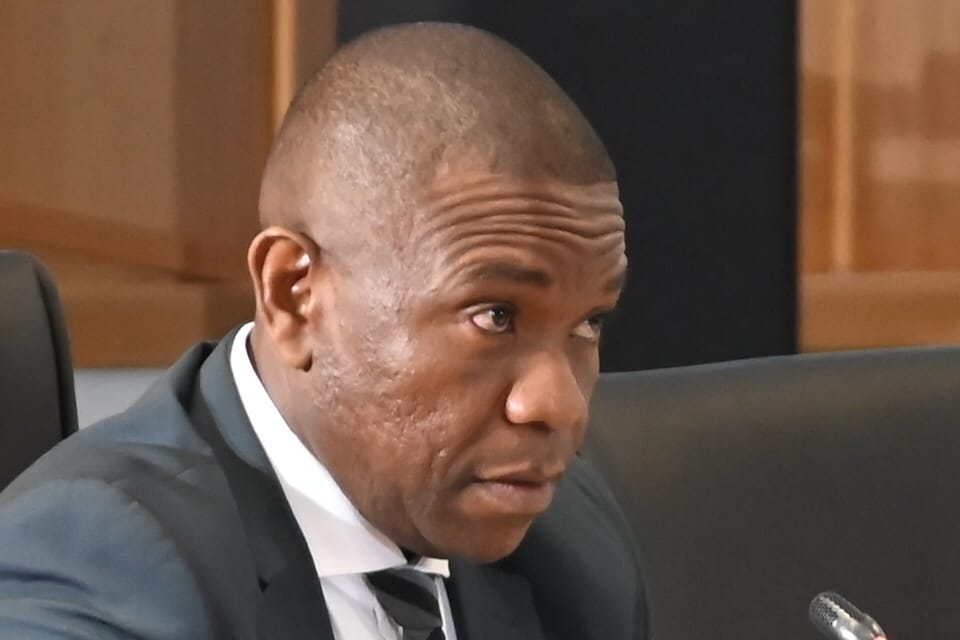
Day two of Parliament’s ad hoc committee probing allegations of corruption and political interference in the South African Police Service (SAPS) ended with testimony from KwaZulu-Natal provincial commissioner Lieutenant General Nhlanhla Mkhwanazi, who accused certain journalists of acting as “players in the mess” that has hollowed out the country’s law enforcement institutions.
Answering questions from the Economic Freedom Fighters (EFF), Democratic Alliance (DA) and uMkhonto weSizwe Party (MK) among other parties, Mkhwanazi said journalism has been weaponised in the service of powerful, illegal interests.
“Some people in the media space are not just reporting. They are influencing, intercepting, and advancing agendas that weaken the police. If the media wasn’t there, we wouldn’t be sitting here today,” Mkhwanazi said.
The allegations surfaced during exchanges with EFF leader Julius Malema, who pressed the general on whether political “deployed cadres” had eroded police discipline.
Mkhwanazi dissected the role of journalists and the media ecosystem in what he described as a parallel state.
He linked reporting to intelligence leaks, court manipulation, and the shielding of compromised officials.
He singled out the late former Police Minister Nathi Mthethwa, who, he said, had pressured him as acting commissioner to advertise in the Gupta-owned New Age rather than “independent” titles like City Press or the Sunday Times.
Mkhwanazi also alleged that journalists were part of covert networks exploiting intelligence leaks.
He said Crime Intelligence (CI) and the Independent Police Investigative Directorate (IPID) used intermediaries, including private investigator Paul O’Sullivan, to push selective narratives into the public domain.
Mkhwanazi said that the country must not “sit back and be run” by O’Sullivan, questioning why IPID operations were allegedly planned at his home and why Parliament had not scrutinised his financial ties.
MKP’s David Skosana sharpened the line of inquiry, pointing to journalists such as Karyn Maughan and Pauli van Wyk, who he said had “closed ranks” against Mkhwanazi in defence of entrenched interests.
The general replied that his criticism was directed at “individual journalists, not the media as a whole”, but he urged counterintelligence to target those he believes are serving political or criminal networks.
Mkhwanazi accused journalists of intercepting communications and manipulating public perception while criminal syndicates and rogue politicians looted state resources.
The general linked the rot to the controversial tenure of former Crime Intelligence head Richard Mdluli, protected, he said, by Mthethwa despite evidence of wrongdoing.
Attempts to discipline Mdluli were blocked by senior prosecutors such as advocate Lawrence Mrwebi, while propaganda campaigns shaped coverage of police affairs.
He alleged that SAPS management routinely monitored dissenting officers and manipulated media narratives to discredit whistleblowers.
His own communications, he said, had been intercepted by Crime Intelligence, while disciplinary dockets disappeared from the Priority KZN Task Team (PKTT) after being transferred to Pretoria.
Mkhwanazi’s testimony placed the media at the heart of what he called state capture’s aftershocks.
He argued that police commissioners’ premature removals, CI’s misuse of funds, and the manipulation of journalism had together created a “government within a government”.
He urged Parliament to investigate how journalists accessed classified information, whether IPID had been infiltrated by private interests, and why whistleblowers were targeted while powerful figures escaped scrutiny.
Earlier in the day, the South African National Editors’ Forum (SANEF) issued a scathing condemnation of Mkhwanazi following his remarks.
SANEF chair Makhudu Sefara said Mkhwanazi’s call for state security agencies to conduct a counterintelligence investigation into the news media represents an unprecedented attack on constitutional press freedoms.
He warned that such proposals echo the authoritarian tactics of the apartheid era, when journalism was stifled to protect state power.
The media body stressed that Mkhwanazi’s statements targeted specific journalists and outlets, including Sunday Times, City Press and News24, and appeared to be linked to investigative reporting on Crime Intelligence operations.
These reports have centred on the Inspector-General of Intelligence’s findings, which recommended criminal and disciplinary charges against National Police Commissioner Fannie Masemola, as well as suspended senior intelligence figures, for the irregular purchase of properties worth R120 million.
Sefara noted that the commissioner argued that allegations of corruption within Crime Intelligence should be handled in secret, claiming disclosure would destabilise the country, a position SANEF dismissed as a blatant attempt to shield misconduct from public accountability.
Reaffirming that journalists are legally protected from disclosing their sources under precedents such as Bosasa v Basson (2012) and SABC v Avusa (2010), the chair described Mkhwanazi’s remarks as intimidation designed to silence legitimate investigations.
The forum stressed that the targeting of reporters fits a broader pattern in which journalists, whistleblowers, investigators, and activists have faced harassment and violence for exposing corruption, including the misuse of Crime Intelligence’s secret slush funds.
SANEF called on Police Minister Firoz Cachalia and National Police Commissioner Fannie Masemola to publicly reject Mkhwanazi’s comments, warning that failure to do so would erode democratic accountability and entrench unchecked power.
Masemola is expected to testify on Thursday.
INSIDE POLITICS