


By Johnathan Paoli
KwaZulu-Natal police commissioner General Nhlanhla Mkhwanazi has fiercely defended the work of the Political Killings Task Team (PKTT), describing it as “unmatched” in its success rate and warning that suspended Police Minister Senzo Mchunu’s decision to dissolve it was both “irrational” and “influenced by outside interests”.
“Someone thought that the Political Killings Task Team was the one responsible for the investigations in Gauteng towards these criminal syndicates… which involved the participation of senior police officers in the SAPS, especially at head office, as well as senior politicians and their associates,” Mkhwanazi told the Madlanga Commission.
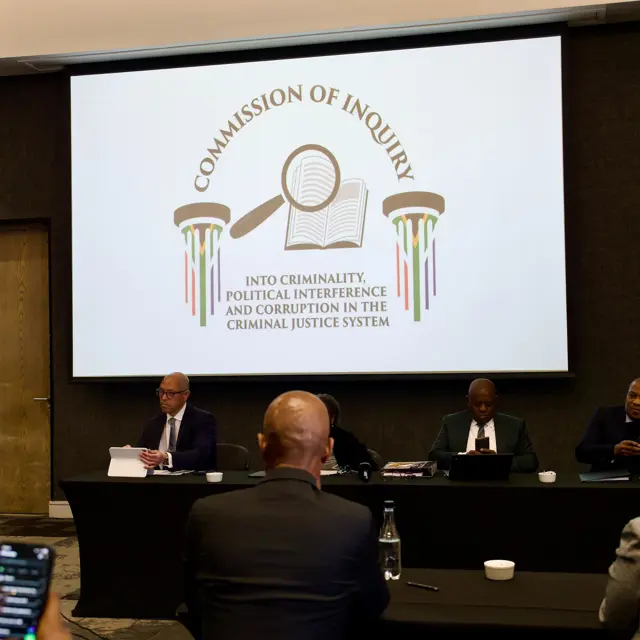
The commission, chaired by retired Constitutional Court Justice Mbuyiseli Madlanga, is probing Mkhwanazi’s explosive July allegations that the criminal justice system has been infiltrated by criminal syndicates with links to politicians, police officers, and businesspeople.
Its proceedings resumed on Thursday at the Brigitte Mabandla Justice College in Tshwane, where evidence leader Advocate Mahlape Sello pressed Mkhwanazi on the implications of disbanding the PKTT.
Mkhwanazi told the inquiry that the PKTT had revolutionised how political killings were handled, by fostering closer, prosecutor-driven collaboration between the police and the National Prosecuting Authority (NPA). The model mirrored the defunct Scorpions, which had once been lauded for its conviction rates.
“The team continued working; it never stopped. However, the number of members we deployed in the team was reduced, and this might have been influenced by the budget,” Mkhwanazi testified.
Sello highlighted how “confusion reigned” after Mchunu’s instruction, with 121 PKTT dockets transferred to Deputy National Commissioner Shadrack Sibiya.
Mkhwanazi said he was not responsible for the movement of those cases but confirmed they were scanned, audited, and eventually returned to ensure they had not been tampered with.
A key point of Thursday’s proceedings was a letter from KwaZulu-Natal Director of Public Prosecutions (DPP) Elaine Zungu, also known as Elaine Harrison, who warned in May that the PKTT’s dissolution risked derailing ongoing prosecutions.
Harrison wrote that she had never received official confirmation from the NPA or SAPS about whether the team was disbanded, raising alarm about political killing cases ahead of the 2026 municipal elections.
She insisted that any withdrawal of such cases would require detailed written motivation and flagged the dangers of witness killings, witness withdrawals from protection programmes, and questionable prosecutorial decisions.
Her letter was explicit: the PKTT had been central to ensuring successful prosecutions of politically motivated crimes, and its disbandment posed a direct threat to justice.
Mkhwanazi recounted several troubling examples of cases being dropped under suspicious circumstances.
In one, a prosecutor reduced a murder case to an inquest despite allegedly strong evidence.
In another, a murder charge was withdrawn despite what he described as “overwhelming evidence” against the accused.
He also raised concerns about an alleged hitman who was granted bail of just R10,000 and subsequently reoffended, highlighting the risks for witnesses in political killings cases.
According to Mkhwanazi, these irregularities pointed to systemic interference.
“There is a lot of interference with these investigations in different forms in order to close these cases by businesspeople and politicians. And by and large, because they’re political cases, the people on the higher level of the syndicates involved are the ones behind the closures of the dockets,” he said.
Despite the official disbandment order, Mkhwanazi said he worked to protect the task team’s operational capacity and its collaborative arrangements with prosecutors, courts, and correctional services.
He emphasised that disrupting this chain was a direct blow to justice.
“I felt it’s important to demonstrate that my efforts, starting from the day I became aware of the letter of the minister leading up to 6 July, were all aimed at making sure I protect this working arrangement of ours to administer justice to the communities out there,” he said.
He insisted that Mchunu’s decision was not based on police intelligence but rather on “whispers” from individuals who feared the task team’s investigations might expose their associates.
The commission heard that Mkhwanazi linked businessman Brown Mogotsi, associated with alleged cartel figure Cat Matlala, to Mchunu.
He further accused National Coloured Congress founder and member of parliament Fadiel Adams of improperly accessing intelligence information and using it recklessly to file dubious cases, which Mchunu’s office later escalated to the Independent Directorate Against Corruption (IDAC) despite earlier findings that they lacked merit.
Justice Madlanga expressed surprise at the “laborious activity” generated by Adams’ unsubstantiated complaints, questioning why so much official effort had been devoted to them.
For Mkhwanazi, the disbandment of the PKTT fits into a broader pattern of sabotage.
He maintains that political killings investigations are deliberately undermined by forces within both the state and private sector.
The Madlanga Commission is expected to continue after lunch.
INSIDE POLITICS