


By Johnathan Paoli
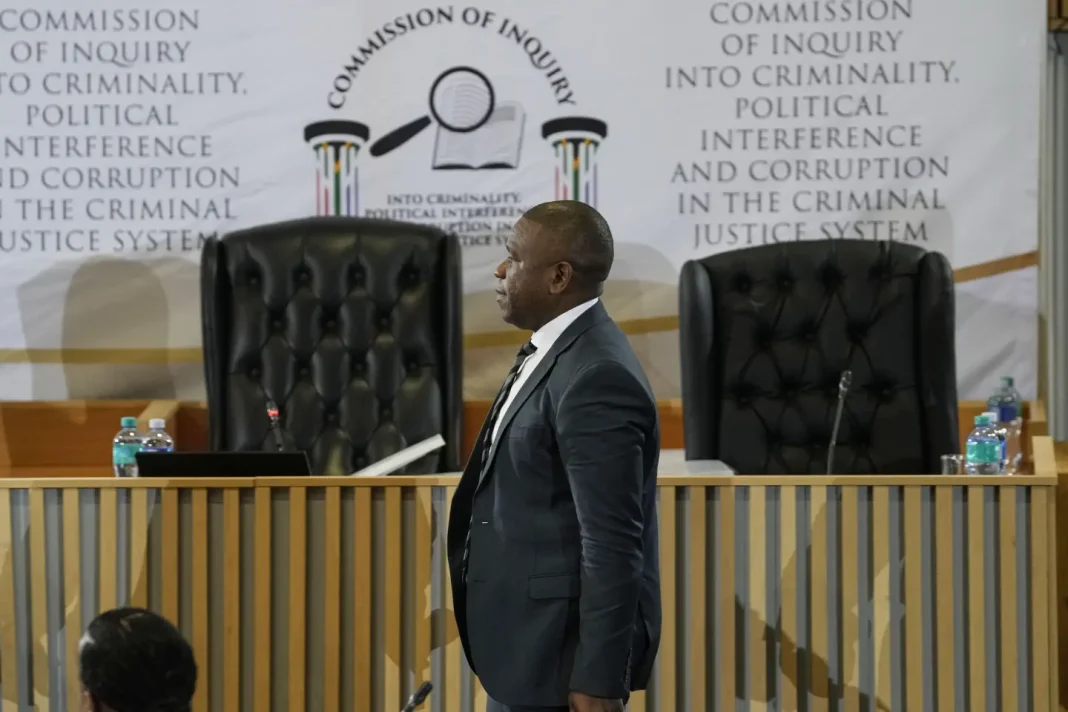
KwaZulu-Natal police commissioner Lieutenant-General Nhlanhla Mkhwanazi returned to the hot seat on Thursday for the second day of testimony before the Madlanga Commission of Inquiry, detailing a wide-ranging series of allegations he claimed to reveal systematic attempts to frustrate law enforcement and the administration of justice.
Speaking on matters ranging from unauthorised access to intelligence material to alleged political interference, Mkhwanazi laid focus on Member of Parliament (MP) Fadiel Adams, leader of the National Coloured Congress (NCC).
“Adams appeared to gain access to classified intelligence information, including personal information compiled for security clearance purposes. He is not on the State Security Portfolio Committee and should not have been given access. The material was sensitive and should have been treated as such,” Mkhwanazi said.
He said Adams had opened three cases relating to security vetting procedures and the alleged abuse of secret Crime Intelligence funds, yet none met the hallmarks of a criminal case.
One of these cases later resulted in arrests, following Adams’ complaints about the appointment of Brigadier Dineo Mokwele, which led to fraud and corruption charges against Crime Intelligence boss Dumisani Khumalo and others.
Mkhwanazi suggested the arrests were part of a larger plot aimed at frustrating the investigation of a Gauteng-based drug cartel, which the province’s counter-intelligence unit, supported by members of the now-disbanded Political Killings Task Team (PKTT), was investigating.
He stressed that Adams’ complaints, including claims about misuse of secret funds and the establishment of a so-called political task team under former Police Minister Bheki Cele, were investigated and found to be unsubstantiated.
Turning to Dianne Kohler-Barnard, Mkhwanazi accused the Democratic Alliance MP of “breaking the law and fuelling malicious attacks” within Crime Intelligence by publicly raising concerns over multimillion-rand property purchases by the division in Durban, which he argued should have been addressed in closed parliamentary oversight hearings.
He also contended that the Inspector-General of Intelligence (IGI) had been “used by politicians” to disrupt operational activities, drawing parallels with historical campaigns against the Scorpions in 2008 and SARS’ High-Risk Investigations Unit in 2014.
“Functional institutions registering success against corruption were felled because of unsubstantiated claims,” he said, warning that the same pattern risked repeating within the SAPS.
Mkhwanazi also claimed a broader campaign to discredit investigators, highlighting businessman Brown Mogotsi, an associate of Mchunu, who allegedly warned him of efforts to undermine his investigations through “defeating the ends of justice” cases.
He said he would provide details of his WhatsApp communications with Mogotsi in an in-camera session to protect himself from legal action.
The commissioner raised longstanding concerns regarding Cat Matlala, a businessman accused of criminal activity.
Mkhwanazi alleged that Matlala had benefitted from “too much privilege” within law enforcement, including having vehicles registered as municipal property and fitted with blue lights by a high-ranking Ekurhuleni Metro Police official.
IPID had reportedly recommended action against the implicated official, though the report remained classified.
Mkhwanazi further cited an incident involving murder-accused Katiso Molefe, noting police officers’ prior involvement with the registration of vehicles linked to him.
A significant portion of Thursday’s testimony revisited the disbandment of the PKTT by former Police Minister Senzo Mchunu.
Mkhwanazi described the task team as “unmatched” in its detection and conviction rates, and criticised Mchunu’s decision as “irrational,” suggesting it had been influenced by parties seeking to disrupt ongoing investigations into political and syndicate-linked criminality.
Mkhwanazi presented letters from KwaZulu-Natal Director of Public Prosecutions Elaine Harrison highlighting the adverse impact on ongoing investigations and warning of risks ahead of the 2026 municipal elections.
He also detailed historical challenges in ensuring police-prosecutor collaboration, pointing to a 2022 agreement he signed with Harrison aimed at improving efficiency between the SAPS and NPA.
“All my efforts, from the moment I became aware of the letter disbanding the PKTT to the 6 July press conference, were aimed at preserving this working arrangement to administer justice effectively,” Mkhwanazi said.
He referred to a 27 January 2025 ENCA interview where he accused Mchunu’s decision of being influenced by “whispers” regarding investigations that might implicate associates of senior officials.
Finally, Mkhwanazi addressed the handling of Adams’ complaints and subsequent referral to the Independent Directorate Against Corruption (IDAC).
He alleged that IDAC contained “malicious structures” operating contrary to its mandate and accused its personnel of undermining criminal justice operations.
He stressed that Adams’ complaints had been formally investigated and found unsubstantiated, yet were nonetheless referred to IDAC, which he contends raises questions about misuse of the institution.
Throughout the proceedings, Mkhwanazi consistently highlighted what he described as systemic interference in investigations, targeting police officers, prosecutors, and other elements of the justice system, with potential collusion from politicians and business figures.
The commission is expected to continue tomorrow morning.
INSIDE POLITICS