


By Johnathan Paoli
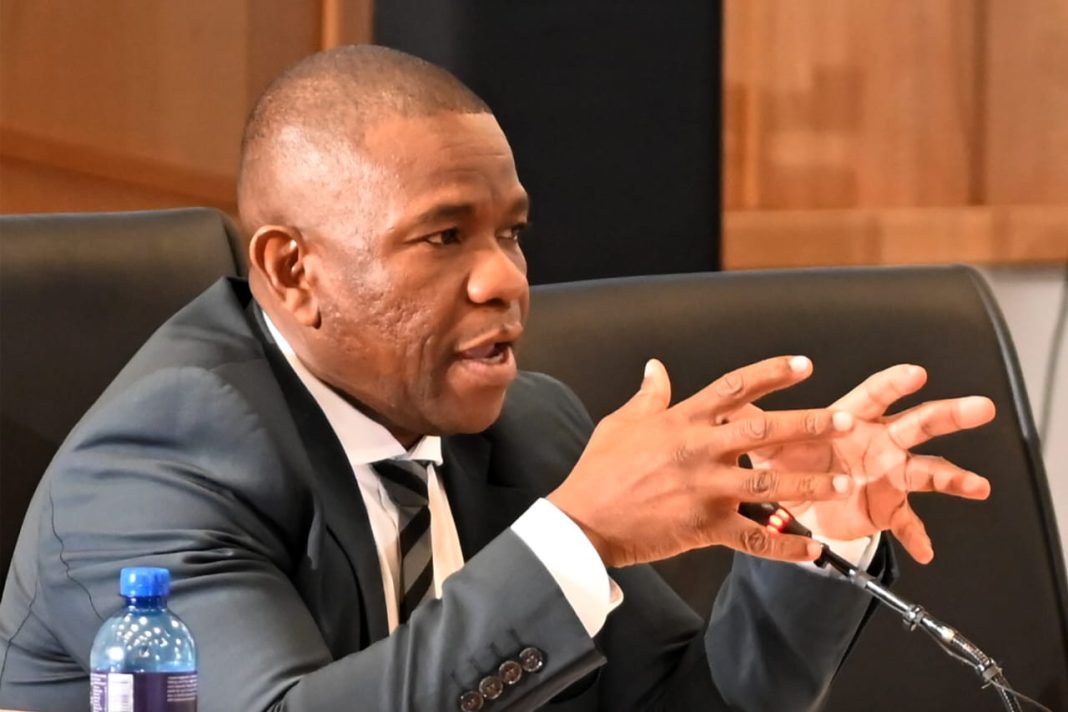
KwaZulu-Natal Police Commissioner Lieutenant-General Nhlanhla Mkhwanazi, testifying before the Madlanga Commission of Inquiry on Wednesday, said suspended Police Minister Senzo Mchunu may have acted unlawfully – and was possibly misled – when he disbanded the Political Killings Task Team (PKTT) and mishandled its sensitive criminal dockets.
Mkhwanazi’s evidence laid bare the turmoil surrounding the unit’s abrupt dissolution, painting a picture of confusion, political interference, and threats to the integrity of investigations into some of the country’s most high-profile and violent cases.
At the centre of his account were 121 criminal dockets once under custody of the PKTT. Instead of being returned to their originating police stations after the unit’s closure, the files were redirected to the national police office in Pretoria.
They were only later sent back to KwaZulu-Natal, where, according to Mkhwanazi, they were found to be intact.
“I want to stress that the files came back complete, nothing was missing, but an audit analysis later revealed something troubling. A small percentage of the dockets contained fresh entries that had not been there before. These included notations that investigations were complete and arrests could be made. In one case, there was even a record of contact with a victim. This raised serious concerns about who had handled the dockets while they were away,” Mkhwanazi testified.
Within a week of the dockets’ return, arrests were made.
Yet, according to Mkhwanazi, the period of uncertainty eroded public trust.
Families of victims complained to task team members that they had not received updates on cases, leading Mkhwanazi to conclude that progress had stalled during the months the files were out of his province’s hands.
The commissioner’s suspicions deepened when he learned that National Police Commissioner Fannie Masemola had not authorised his deputy, Shadrack Sibiya, to take custody of the files.
“I had made written enquiries about the fate of the dockets and was told they would be handed over to General Sibiya, but when I later confronted General Masemola, he insisted he had never given such an instruction. This contradiction alone shows how irregular this process was,” Mkhwanazi explained.
He cast doubt on the rationale behind Mchunu’s unilateral decision to dissolve the PKTT, noting that the unit had been formed by an Inter-Ministerial Committee (IMC) chaired by President Cyril Ramaphosa.
According to him, the committee included the ministers of Police, Justice, Defence, and State Security.
He argued that Mchunu could not have acted lawfully without consulting them.
He described PKTT as one of the most successful task teams in the SAPS, both in its detection and conviction rates.
“This was a team praised by the President himself. So, for the Minister to conclude that the team was adding no value, without even receiving a formal briefing on our work, it was misplaced. It was a wrong conclusion that has already had severe consequences for investigations in this province,” he said.
Mkhwanazi went further, suggesting that Mchunu may have been misled into disbanding the unit.
“Someone believed the PKTT was investigating organised crime syndicates in Gauteng that involved senior police officers and politicians. I believe the advice given to the Minister was intended to protect those interests. That is why the decision was taken,” he said.
The commissioner testified that he tried to challenge the disbandment through official channels.
He contacted parliament’s police portfolio committee, chaired by Ian Cameron, but his concerns were not acted upon.
He also attempted to secure a meeting with Mchunu, even sending him a WhatsApp message, but the suggested engagement never materialised.
At one stage, he asked Masemola to raise the matter directly with Ramaphosa, though this too went nowhere.
Despite Mchunu’s letter ordering the disbandment, Masemola continued signing extensions for PKTT’s deployment.
This contradiction, Mkhwanazi said, highlights the irregularity of the Minister’s decision.
“I told the National Commissioner that the decision was irrational and irregular. Stopping investigations suddenly would have a devastating impact, not just on KZN but on the credibility of SAPS itself. The people of this province would see me as having failed them,” he said.
His testimony underscored the deep tension between political authority and operational policing.
On 2 January this year, Mkhwanazi received a letter confirming the disbandment of the task team, which he initially believed to be fake given the lack of consultation.
“The implications were going to be severe. The unit was dealing with cases that directly affected ordinary South Africans. To simply pull the plug was reckless,” he said.
For families of victims of political violence, the PKTT represented a measure of hope in a province long scarred by assassinations of councillors, traditional leaders, and party members.
As the Commission continues tomorrow morning, it will hear testimony from other senior figures, including National Commissioner Masemola, prosecutors, and other officials with some sessions possibly being held in camera to protect sensitive investigations and witnesses.
INSIDE POLITICS