
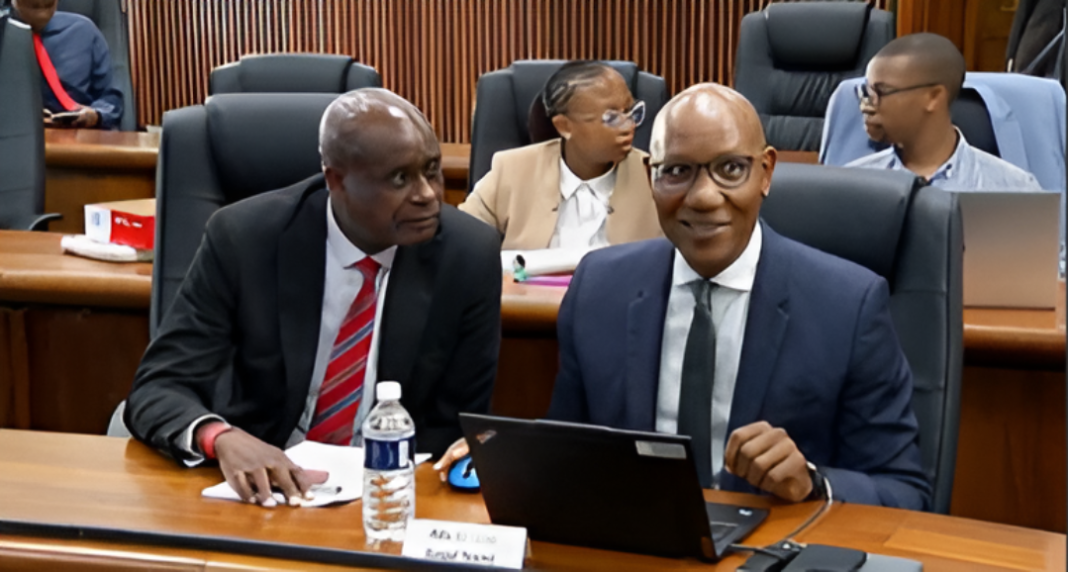


By Johnathan Paoli
The inquiry into the fitness of Gauteng Director of Public Prosecutions (DPP) Andrew Chauke to hold office continued on Tuesday with a sweeping and assertive defence that sought to dismantle the allegations against him at their foundation.
In a detailed and tightly framed opening statement, Chauke’s legal team, including senior counsel Thembeka Ngcukaitobi, argued that the case before the panel is legally defective, factually incorrect, and fundamentally incompatible with the constitutional framework that governs prosecutorial decision-making in South Africa.
“If prosecutors fear that good-faith decisions will be reinterpreted years later as misconduct because others disagree with the outcome, prosecutorial independence collapses,” Ngcukaitobi said.
Chauke, a veteran prosecutor who heads the Johannesburg office of the National Prosecuting Authority (NPA), faces two primary allegations, both more than a decade old.
The first concerns his support for a 2012 racketeering authorisation in the Booysen matter; the second relates to his decision to withdraw murder charges against former Crime Intelligence boss Richard Mdluli in order to proceed with a statutory inquest.
Neither decision, his counsel emphasised, involved dishonesty, corruption, personal benefit, or improper motive.
Before engaging the legal architecture of the case, Chauke’s team placed two clarifications at the centre of their argument.
First, none of the charges allege corruption, bribery, ulterior motive, or any ethical misconduct of the kind that usually underpins a section 12(6) fitness inquiry.
Instead, they arise entirely from two exercises of prosecutorial discretion: discretion that prosecutors must exercise daily, often under immense pressure and based on evidence that later evolves.
Second, his lawyers argued that the factual premises of both matters have been superseded by later judicial findings.
In particular, the judgment in GCB v Jiba revisited the evidence underlying the Booysen authorisation and overturned core criticisms that had fuelled the original complaint, including claims of no evidence, irrationality, and misrepresentation.
Crucially, the court held that even the original decision-maker, then Acting NDPP Nomgcobo Jiba, had not committed misconduct; rendering the case against Chauke, who merely supported the authorisation, legally untenable.
Much of the opening statement centred on the constitutional requirement that prosecutors act without fear, favour or prejudice, as enshrined in section 179(4) of the Constitution.
Chauke’s team argued that allowing retrospective disciplinary action against lawful discretionary decisions would produce a devastating chilling effect across the NPA.
To reinforce this point, Chauke will call a number of high-profile witnesses, including former NDPP Mxolisi Nxasana, senior counsel Laurence Hodes, and seasoned prosecutors such as Sello Maema, Silas Ramaite, and Gerrie Nel.
Each, the panel heard, will testify that Chauke’s decisions in both matters were lawful, rational and professionally sound.
The statement devoted significant attention to the legal threshold governing a section 12(6) fitness inquiry.
According to the Constitutional Court’s decision in previous cases, fitness is an objective fact requiring clear proof of breaches of legal or ethical standards; such as dishonesty, lack of integrity, or abuse of power.
Chauke’s counsel argued that none of the charges identify any clause of the NPA Act, the Code of Conduct, or the Prosecution Policy that he allegedly breached.
They also stressed that no charge alleges bad faith, a defect they described as fatal.
The defence cited the Ginwala Commission, which held that disciplinary processes must not be used to second-guess prosecutorial decisions unless evidence shows corruption, improper motive or gross abuse of power.
The inquiry spent substantial time on the Booysen authorisation, which Chauke did not issue.
His role was limited to supporting the authorisation issued by Acting NDPP Jiba.
The complaint rests on a 2014 judgment by Judge Trevor Gorven, who found that there was no evidence supporting racketeering charges.
But the court later found that Gorven’s judgment was based on incorrect assumptions, including the admissibility of evidence and the nature of annexures Jiba relied upon.
It confirmed that hearsay is permissible under POCA and rejected allegations of misrepresentation, concluding that no mala fides existed in issuing the authorisation.
In light of this, Chauke’s counsel argued, the premise of the charge collapses entirely.
The second charge concerns Chauke’s 2011 withdrawal of murder charges against Richard Mdluli pending an inquest.
His team emphasised that the Supreme Court of Appeal ruled in 2020 that this decision was rational and lawful.
The SCA held that later events or administrative failures cannot retrospectively invalidate what was, at the time, a proper prosecutorial step.
Former NDPP Nxasana independently reviewed the decision and reached the same conclusion.
Chauke’s counsel also objected to what they described as an impermissible expansion of allegations beyond the inquiry’s Terms of Reference.
Such expansion, they argued, breaches fairness and contradicts established principles governing suspension and removal under Nxasana.
In closing, Chauke’s team issued a stark warning that if prosecutors are disciplined for lawful decisions that later become politically or publicly contentious, the NPA’s constitutional independence would face profound harm.
Summarising their case, Chauke’s counsel submitted that the charges are vague, unsupported by evidence, contradicted by judicial precedent, and inconsistent with constitutional protections for prosecutorial discretion.
On this basis, they urged the panel to find that no grounds exist for Chauke’s suspension or removal.
The inquiry continues, with NDPP Batohi to testify next.
INSIDE POLITICS