


By Johnathan Paoli
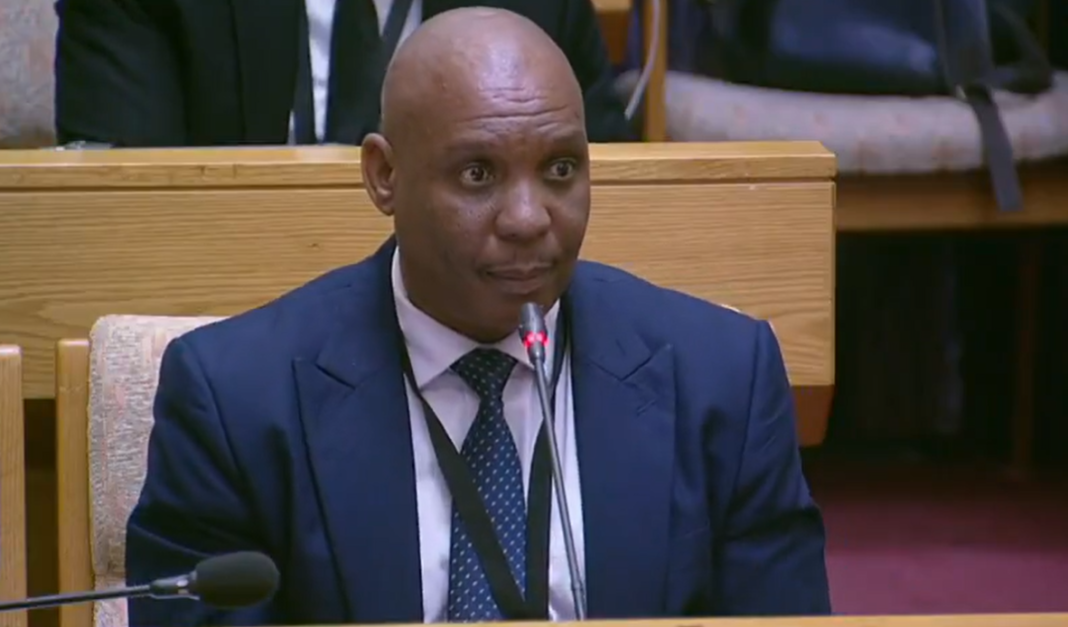
The parliamentary Ad Hoc Committee probing alleged criminal infiltration of the South African Police Service (SAPS) resumed its work on Tuesday with the return of suspended Police Minister Senzo Mchunu’s chief of staff, Cedrick Nkabinde, following his appearance last week which collapsed after MPs flagged material inconsistencies in his affidavit.
Opening his evidence on Wednesday, Nkabinde explained that he had reconstructed his timeline using Mchunu’s official calendar because he still does not have access to his phone and other seized devices.
He said that in August last year, the Police Ministry was monitoring a dangerous standoff at an abandoned goldmine in Stilfontein, where “hundreds, possibly thousands” of “Zama Zamas” or illegal miners were trapped underground.
After some resurfaced and were detained from 18 August, Mchunu convened a staff meeting on 20 August to prepare for a visit to the area.
It was at that meeting, Nkabinde testified, that Mchunu provided him with the contact details of North West community figure Brown Mogotsi.
The minister, he said, wanted local leaders to brief him about the unfolding crisis.
Because Mchunu’s schedule was full for the remainder of August, Nkabinde only managed to arrange a meeting with Mogotsi and four unnamed community members for 30 September.
That meeting was cancelled due to an urgent matter, and rescheduled for 28 October at the minister’s official residence, where it went ahead without Nkabinde present.
He could not speak to its contents.
Pressed by MPs about Mogotsi’s role and identity, Nkabinde maintained that he had no knowledge that Mogotsi was a police informant and that his involvement was limited to Stilfontein-related briefings.
He also contradicted claims by Mogotsi that he had made calls from Mchunu’s office.
On follow-up questions, Nkabinde said a planned January 2025 meeting collapsed when Mogotsi informed him that the four “comrades” accompanying him had been urgently called to Luthuli House.
Responding to KZN Police Commissioner Nhlanhla Mkhwanazi’s annexures, Nkabinde corrected the record, stating he received a call from Mkhwanazi on 1 October, not 30 September, while accompanying Mchunu on a visit to Lusikisiki.
He confirmed telling Mkhwanazi that Mchunu knew who Mogotsi was, but denied ever describing him as a close associate.
Asked about allegations that efforts to implicate the Political Killings Task Team (PKTT) were part of a deliberate campaign, Nkabinde insisted the IPID matter involving Mkhwanazi related to a separate case in which a correctional services official was allegedly found with drugs.
Arendse then turned to a separate matter: National Coloured Congress leader Fadiel Adams’ complaint of fraud, theft and nepotism within SAPS, and whether Nkabinde acted appropriately in referring the matter to the Investigating Directorate Against Corruption (IDAC).
Arendse questioned the undue haste with which Nkabinde forwarded the complaint.
But Nkabinde insisted the referral was correct, explaining that Adams had lodged two distinct complaints: one about dockets allegedly being intercepted in the Western Cape and Gauteng, which Nkabinde treated as a service delivery issue and sent to the national commissioner; and a second in which Adams requested an independent investigation.
He said the only relevant body would be IDAC, noting that other oversight bodies report to the national commissioner.
Nkabinde was ejected from the committee last week after struggling to explain incorrect or unverifiable dates in his sworn statement.
The committee spent more than half an hour engaged in a tense procedural dispute over whether his newly submitted “supplementary statement” was legally valid, whether it contradicted the original affidavit, and whether the witness should continue testifying at all.
Economic Freedom Fighters (EFF) MP Leigh-Ann Mathys opened the session by questioning the manner in which Nkabinde was suddenly returned to the committee without prior notice to members.
She further criticised the general quality of affidavits before the panel, recalling that academic and previous witness Mary de Haas had castigated Parliament for lacking forensic capacity.
She urged the chair, African National Congress (ANC) MP Soviet Lekganyane, to request additional resources from the Speaker.
Evidence leader and senior counsel Norman Arendse defended the investigative team, saying they had done their best with limited resources and routinely had to deal not only with witnesses but also their legal teams.
He clarified that the new document was not a replacement affidavit, but a supplementary statement meant to amplify and clarify the original version.
But the uMkhonto weSizwe Party’s Sibonelo Nomvalo and David Skosana rejected this explanation.
Despite the contention, a multi-party consensus eventually emerged to proceed with the testimony.
The committee continues after lunch.
INSIDE POLITICS