


By Johnathan Paoli
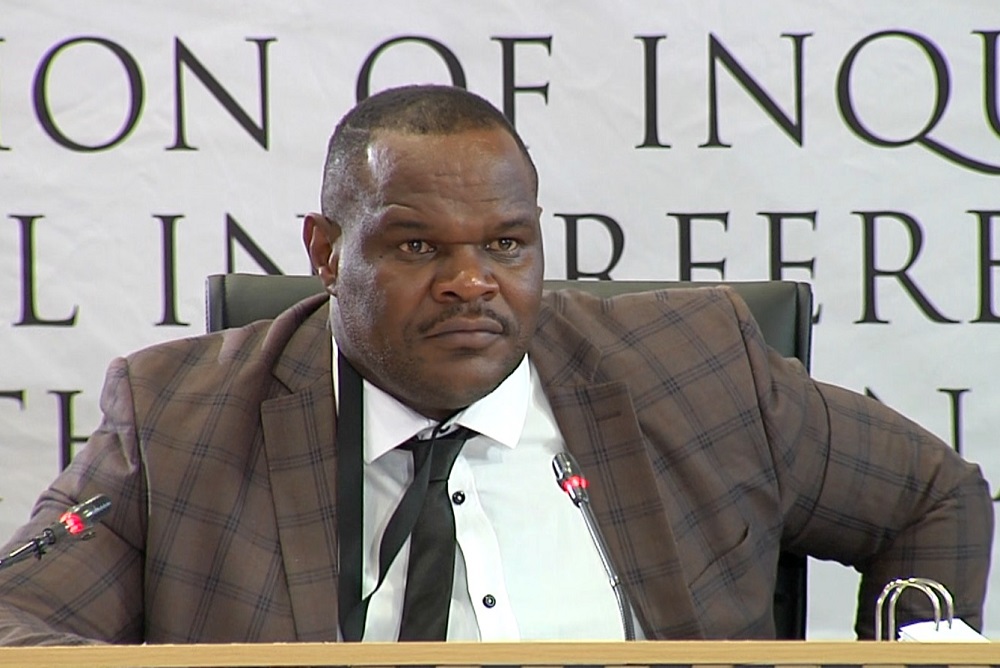
Gauteng Organised Crime SAPS Sergeant Fannie Nkosi has told the Madlanga Commission of Inquiry that the more than R385,000 in cash found in a safe at his home during a police raid in October last year mostly belonged to his brother Bheki Nkosi, and was intended for the purchase of a truck.
Testifying before the commission on Monday, and answering through his third interpreter, Nkosi doubled down on his claim that there was nothing untoward about the cash found, and that it was intended for the purchase, despite inconsistencies.
“R380,000 belonged to my brother and R5,000 was mine, the money was to be used to purchase a truck for him. I won’t go into details on the agreement of sale. I was not present when the sale of agreement was made between Mr Ngoato and my brother. But it appeared a payment would be made in due course. But it depended on trust between the two people,” Nkosi said.
The commission heard that the truck deal involved his brother, Bheki Nkosi, as the seller and attorney Hartley Ngoato, who also represents Nkosi, as the buyer.
The vehicle was allegedly sold in late 2025, with Nkosi claiming the agreed purchase price was R400,000, although documentation and the seller’s own version place it at R380,000.
The sale agreement reflects that Bheki Nkosi signed the document on 7 October 2025, while Ngoato only signed on 19 December 2025, days after Nkosi had already submitted an affidavit referring to the transaction.
Nkosi told the commission that payment for the truck was made on 7 December 2025, shortly before the police raid that uncovered the cash at his home.
Evidence leader advocate Matthew Chaskalson told the commission that Nkosi had referred to annexures in his affidavit that were meant to support the truck purchase, but “none were attached” at the time the statement was made.
He said the alleged sale agreement was only signed by Ngoato, on 19 December 2025, three days after Nkosi had already deposed to an affidavit on 16 December.
“The document didn’t exist when you made your affidavit,” Chaskalson said.
Nkosi disputed this version, maintaining that he had seen an unsigned version of the agreement before submitting his affidavit.
“The sale agreement document was there but not signed,” he said.
He agreed, however, that the annexures were only added later.
While Nkosi repeatedly insisted the vehicle was being sold for R400,000, both the alleged seller and his brother’s affidavit place the figure at R380,000.
Chaskalson pressed him on the discrepancy: “Your brother’s affidavit states R380,000, not R400,000.”
Nkosi responded that the difference related to an outstanding balance, that his brother was owed R20,000, a claim Chaskalson rejected, reiterating that the affidavit reflected a total purchase price of R380,000.
The commission also heard that Nkosi’s brother allegedly received payment for the truck on 7 December 2025, just one day before police raided Nkosi’s home and discovered the cash.
Chaskalson suggested the timing was suspicious and put it directly to Nkosi that the sale agreement had been “created to explain the source of the money”.
Questions were further raised about the nature of the transaction, particularly the use of cash, as well as the involvement of his attorney.
Commission chairperson Justice Mbuyiseli Madlanga expressed concern that the circumstances should have raised alarm bells for a serving police officer.
“As a police officer, this points to money laundering. I’m not suggesting Mr. Ngoato is involved in money laundering,” Madlanga said.
Nkosi, however, maintained that he saw nothing unusual, and that both Ngoato and his brother were businessmen and he found nothing suspicious.
Commissioner Sandile Khumalo was more direct, suggesting the transaction appeared to be “contrived” and possibly fictitious.
“It appears this transaction is meant to cover up something bigger,” he said.
Nkosi rejected that assertion but conceded under questioning that none of the documentation explicitly stated that the purchase price had been paid in cash.
The commission also heard that despite the alleged payment, the truck was never taken by the buyer.
Nkosi said he did not know where the vehicle was at the time and confirmed that Ngoato “did not take the truck” after payment.
“That is why I say the transaction is made up, how is the truck not delivered?” Khumalo asked.
Nkosi maintained that the transaction was valid.
When asked why he did not submit a follow-up statement to authorities explaining the source of the cash after it was seized, Nkosi said he had been waiting for officials to revert to him.
Proceedings adjourned for the day, with a witness from the Tshwane Metropolitan Police Department expected before the commission on Tuesday morning.
INSIDE POLITICS