


By Thapelo Molefe
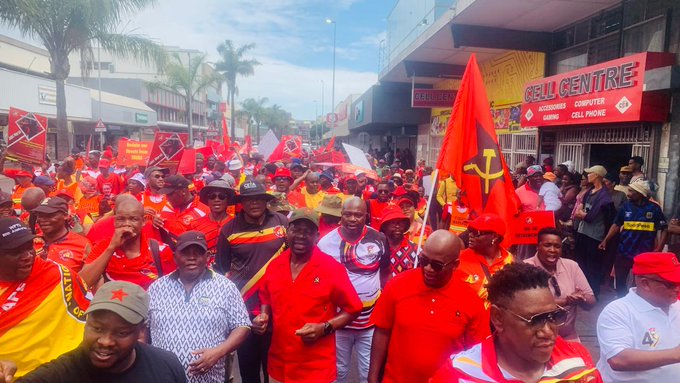
The National Union of Mineworkers (NUM) and the South African Communist Party (SACP) in the Western Cape took to the streets of Bellville on Saturday, leading a joint protest march against Eskom’s unbundling and electricity tariff hikes, which they described as a “backdoor privatisation” of the national power utility.
Hundreds of workers, union members, and activists gathered outside Eskom’s offices and the Department of Employment and Labour, calling for the utility to remain fully state-owned and for electricity to be treated as “a public good, not a commodity.”
The organisations handed over a memorandum of demands to Eskom, calling for the reintegration of the National Transmission Company of South Africa into a single, vertically integrated Eskom, the immediate halt of all privatisation efforts in state-owned enterprises, and the reversal of recent tariff hikes.

NUM President Phillip Vilakazi, who led the march, said the union would oppose any move that weakens Eskom’s public mandate.
“The liberalisation of our energy sector is being sold as reform, but it is reform for the few,” Vilakazi said.
“We will not allow a national asset built by the sweat of South African workers to be handed over to private profiteers. Eskom must serve the people, not the market.”
He said workers were prepared to “intensify the struggle” if their demands are ignored, adding that Eskom’s restructuring threatens jobs, collective bargaining, and fair working conditions.
“Any so-called reform that dismantles centralised bargaining or erodes conditions of service is a declaration of war on workers,” Vilakazi said.
“We have seen what privatisation does – job losses, unaffordable electricity, and instability. We will not allow that to happen here.”
SACP General Secretary Solly Mapaila, who co-signed the memorandum, said Eskom’s crisis was not a result of public ownership but of “deliberate policy failures” that weakened the utility.
“Eskom was not destroyed by being public [but] it was destroyed by being commercialised,” Mapaila said.
“The constant push to privatise and outsource essential functions stripped Eskom of its technical capacity and opened the door to profiteering and corruption.”
Speaking to Inside Politics, the SACP said its opposition to privatisation was not ideological dogma but a practical stance based on global experience.
“Our position is not a romantic defence of the past, It is a material assessment of ownership and accountability. When electricity becomes a profit-driven commodity, the poor are left in the dark, literally and figuratively,” the party said.
Mapaila said the party supports democratic public control of Eskom rather than bureaucratic state control.
“We want an Eskom that is accountable to the people, not to shareholders,” he said.
“That means workers and communities must have a voice in its governance, and Parliament must exercise real oversight to prevent corruption and inefficiency.”
The SACP outlined a detailed alternative to privatisation, proposing a Public Renewable Energy Expansion Programme that invests in state-owned solar, wind, and battery industries.
“We are not against renewable energy, we are against private capture of the transition. Publicly owned renewable projects that are built by Eskom, municipalities, and state agencies can create jobs, lower costs, and guarantee supply without surrendering control to private monopolies,” the party said.
Mapaila added that the SACP’s model envisions a multi-tiered public energy system, with Eskom as the national backbone and municipalities as local implementers.
“Municipalities should be empowered to generate renewable power and feed it into the grid, but under public ownership, not through private contracts,” he said.
“This is how we achieve a just transition that creates jobs, expands access, and ensures stability.”
The SACP also rejected the notion that Eskom’s recent profitability justified privatisation.
“One profitable year does not erase years of structural damage,” the party said.
“The recovery is based on tariff hikes and deferred maintenance, not on rebuilding internal capacity.”
Both organisations condemned the electricity price increases approved by the National Energy Regulator of South Africa (Nersa), saying they disproportionately affect working-class families and undermine industry.
“Electricity tariff hikes deepen poverty and destroy jobs in sectors like mining, ferro-alloys, and manufacturing,” NUM said.
“Workers are being asked to pay the price for mistakes they didn’t make.”
The SACP called for a progressive tariff system to protect poor households while ensuring that large industrial and commercial users pay fair rates.
“Financial sustainability cannot come from squeezing the poor. Public financing, not privatisation, must secure Eskom’s future,” the party said.
Ferrochrome producer Samancor, which has been operating for 50 years, recently announced that it may have to review operation and possibly close some of its furnaces in South Africa due to electricity price hikes over the past decade
The NUM and SACP also demanded the expansion of Eskom’s Agriworker Electrification Project to allow farmworkers to buy electricity directly from Eskom instead of through farmers who resell it at inflated rates.
“When a farmworker’s lights can be switched off at the whim of an employer, that is not just economic exploitation, it is a form of control,” Vilakazi said.
“Every worker deserves direct access to electricity without middlemen.”
The memorandum was received by Eskom’s General Manager for the Western Cape, who acknowledged receipt but did not comment publicly.
The NUM and SACP warned that if their demands are not addressed, they will intensify industrial and political action.
“We will defend Eskom as a public asset. We will not allow energy, the lifeblood of our economy, to be sold to the highest bidder,” Mapaila concluded.
INSIDE POLITICS