


By Johnathan Paoli
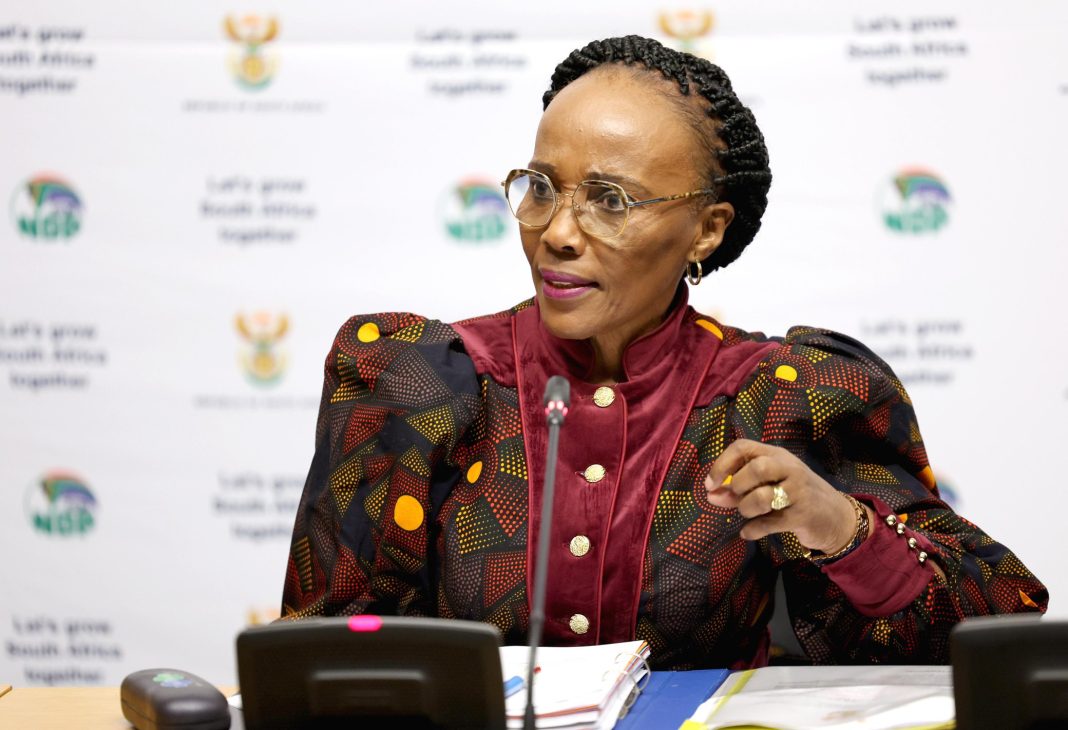
Minister in the Presidency for Women, Youth and Persons with Disabilities Sindisiwe Chikunga has unveiled her department’s budget as a tool for breaking the wheel of systemic exclusion.
She has called for a deepening of rights-based inclusion and accelerated transformation through legislative reform, economic participation and coordinated policy action.
Tabling the department’s R1.36 billion budget for the 2025/26 financial year under the theme “From Mandates to Meaning: Advancing Inclusion through Law, Budget and Action”, Chikunga used her speech to reflect on the Freedom Charter’s legacy and 30 years of democracy.
She said it the time had come to transform policy mandates into mechanisms for tangible change.
“Now more than ever, there is an urgent need for us to bridge the gap between constitutionally assured rights and the lived realities of women, youth, and persons with disabilities,” the minister said.
Of the total allocation, R1.1 billion will go to entities such as the National Youth Development Agency (NYDA) and the Commission for Gender Equality, while the department retains R239.6 million for internal operations.
Key focus areas include passing landmark legislation like the Women Empowerment and Gender Equality Bill, Youth Development Bill and Persons with Disabilities Bill, as well as rolling out a Gender-Responsive Procurement Framework.
The department is also developing a new Socio-Economic Empowerment Index and expanding youth skills initiatives through the South African National Service Institute.
African National Congress MP Tshiamo Tshotetsi welcomed the budget, praising increases to women’s empowerment funds and NYDA support.
He underscored the need to finalise the NYDA board and to invest further in youth innovation and entrepreneurship.
Opposition voices, however, were deeply critical.
uMkhonto weSizwe Party MP Mabel Rweqana rejected the budget outright, describing it as a “death sentence” for poor and vulnerable communities.
She cited the story of Nomvula, a girl who missed school due to lack of sanitary pads, to highlight failed service delivery.
Rweqana slammed the department for spending more on condoms than menstrual dignity and labelled the R90 million budget cut as “fiscal violence.”
The Economic Freedom Fighters’ Sihle Lonzi described the department as “mismanaged and ineffective,” criticising delays in NYDA board appointments and a lack of coherent strategies to tackle learner pregnancy and disability exclusion.
He accused the minister of blocking appointments for political reasons and condemned the committee for prioritising minor scandals over systemic issues like GBV and the Cwecwe sexual assault case.
Democratic Alliance MP Eleanore Spies focused on real-world experiences, recounting the challenges faced by Pastor Edwin Pedro, a disabled community leader who operated a skills centre with limited resources.
She called for collaboration between departments to support grassroots initiatives and criticised government instability, which she said undermines strategic planning.
Inkatha Freedom Party’s Liezl van der Merwe supported the budget but insisted on stronger action to combat GBV and improve disability inclusion.
She questioned why over 600,000 disabled learners remained outside the education system and called for the Commission for Gender Equality to receive enforcement powers.
Van der Merwe also criticised delays in NYDA appointments, warning it eroded youth trust in democratic processes.
She announced her intention to introduce a private member’s bill to reserve entry-level jobs for South African youth.
Patriotic Alliance MP Jasmine Petersen backed the budget but emphasised the need for youth inclusion in policy decisions.
She urged government to ensure that budgets “speak with and for young people,” and insisted that all interventions must be met with accountability, urgency and visible results.
Deputy Minister Mmapaseka Letsike framed the budget as a bold tool for redress, quoting President Ramaphosa’s economic gains since 1994 and envisioning a 2030 future shaped by inclusive empowerment.
She rejected opposition theatrics and affirmed the ANC’s commitment to delivering on the Freedom Charter’s promises.
In her closing remarks, Chikunga thanked MPs and civil society partners for their contributions, welcomed agreement on the need to fully fund the National Council on Gender-Based Violence and Femicide, and defended the department’s clean audit record.
She rejected claims of irregular expenditure and said research partnerships with the Human Sciences Research Council were already addressing knowledge gaps.
“As we begin our final stretch towards 2030, our ability to deliver on our manifesto promises remains entrenched as the yardstick by which this democratic government will not only be assessed, but will also earn its political legitimacy as a genuine custodian of the hopes and aspirations of all South Africans, particularly those who remain on the margins of society,” Chikunga said.
While opinions differed, the debate reflected the urgency of turning inclusive policy into real-world impact for South Africa’s women, youth, and persons with disabilities.
INSIDE POLITICS