


By Thapelo Molefe
The Social Development Department has allocated 96% of its R294 billion budget to monthly transfers to over 27 million social grant recipients.
While the department praised its efforts to fight poverty and modernise social protection systems, the budget debate sparked strong responses across the political spectrum.
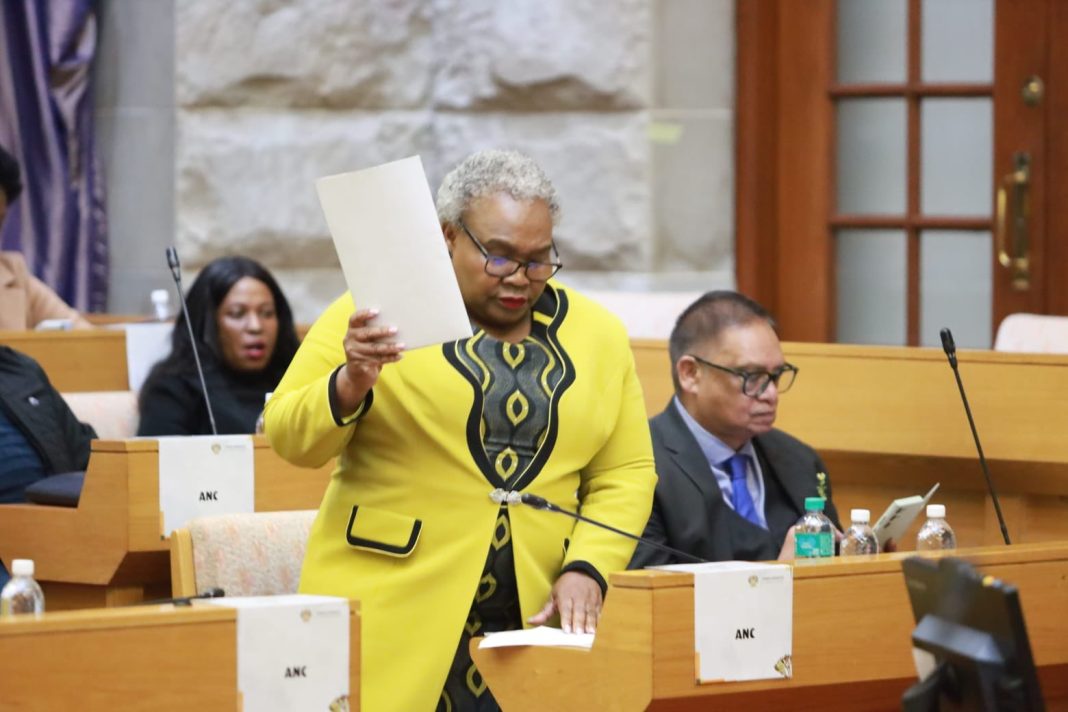
“This budget honours women pioneers who stood strong and sacrificed selflessly,” Social Development Minister Sisisi Tolashe said on Thursday.
“Through this budget, we commit ourselves to fulfil their aspiration of making our world a better place for all.”
Tolashe said that every month, more than 19 million social grants were paid without fail. A further R34.9 billion was earmarked for the Covid-19 Social Relief of Distress (SRD) Grant.
African National Congress (ANC) MP Tshilidzi Munyai described the budget as fulfilling the promises of the Freedom Charter.
“This financial year, 2025–2026, R271 billion is budgeted for social grants… This will increase the social grants payment to over 20 million beneficiaries. This will bring a renewed sense of hope and dignity to the most vulnerable members of our society,” he said.
Munyai defended the push for a Basic Income Support Grant, saying it was not about fostering dependency.
“It is a direct response to South Africa’s structural economic challenges, particularly the widespread unemployment, job insecurity, poverty, hunger and the rising cost of living.”
The South African Social Security Agency (Sassa) will receive R24.7 billion for administration over the medium-term.
Tolashe reiterated that grant reviews aimed to prevent fraud, not penalise the poor.
“Sassa does not stop anybody’s grant without due process,” the minister said.
She said the agency was actively communicating with recipients and had sent over 140,000 SMS messages asking people to visit Sassa offices for verification.
“We emphasise that anyone called upon should be assisted. We are making sure we pay the right person at the right time,” Tolashe said.
Deputy Minister Ganief Hendricks outlined how the department used its welfare budget to support programmes on HIV/AIDS, substance abuse, older persons and people with disabilities.
“With my other budget, we allocate a portion to the association for dementia and Alzheimer and also the South African Older Persons Forum,” he said.
Tolashe said R102 million was allocated for expanding shelters in 30 identified hotspots to support victims of gender-based violence and femicide (GBVF). She also confirmed that the Gender-Based Violence Command Centre was now fully operational and available 24/7 through an emergency line.
Munyai applauded the establishment of the Inter-Ministerial Committee to end Gender-Based Violence and Femicide.
“We must play a practical role to end GBVF… We welcome the progress to strengthen the provision of care and psychosocial support for survivors,” he stated.
“We are working with the United Nations and welcomed their Special Envoy to advance the plight of the victims of this monstrous crime,” The Minister added.
The Democratic Alliance (DA) MP Bridget Masango warned about the risks of conditional funding.
“Conditional allocations that hinge on interdepartmental systems, not yet fully functional, risk harming the very people Sassa exists to serve,” she said.
The DA called for phased implementation and criticised staff shortages, saying many Sassa offices operated at less than 50% capacity.
Economic Freedom Fighter’s MP Paulnita Marais rejected the budget entirely.
She said the budget was not designed to lift the poor out of hunger, unemployment and despair. Instead, it was a “cold, bureaucratic exercise and an administrative illusion” designed to pacify the masses while protecting the pockets of the politically connected.
“What we have is a budget that exists only on paper. In theory, it speaks of social relief, of development, of welfare.
“But in reality, it functions as a mechanism to enrich the inner circle of this ruling elite, those who continue to live in comfort of former liberation credentials by ordinary South African staff.
“The SRD grant is now riddled with fraud. Criminals exploit the system using stolen Identity Documents, while genuine beneficiaries are denied help,” Marais said.
Rise Mzansi MP Makashule Gana again raised concerns about gambling addiction among youth, an issue he said the department was yet to adequately address.
“We are having problem gamblers who are learners,” he said, calling for school-based trauma support systems and early intervention programmes.
African Christian Democratic Party leader Kenneth Meshoe acknowledged the grant increases but criticised the limited value of the child support grant.
“It rises by R30 to just R560, not even covering a jar of peanut butter,” he said, warning that there was no provision for the SRD grant beyond March 2026.
Tolashe responded to concerns about the National Development Agency’s (NDA) poor spending patterns, saying the department was working on cost-cutting measures.
“We are introducing a system where the NDA shares offices with Sassa or DSD where possible,” she said.
“We are talking to Public Works to unlock buildings, especially in Cape Town.”
She added that her department has implemented a sector Non-Profit Organisation (NPO) funding policy to guide provinces.
“We are interacting with Gauteng to ease the pressure on NPOs. They assist in making sure that service delivery is realised,” she said.
On the Central Drug Authority, the minister said a new prevention and treatment bill was being reviewed.
“We are strengthening and collaborating to address alcohol and drug abuse,” she confirmed.
Tolashe defended the decision to close physical pay points due to safety risks.
“Our people, especially the most vulnerable, were shot at daylight… with huge ammunition. We had to take decisions that are not so good for our people, but we had to avoid that kind of violence.”
While the ANC and its allies hailed the budget vote as a moral and constitutional commitment to the poor, other parties were divided. Some praised elements of the budget, but criticised inefficiencies and lack of structural reform.
“The test of a government is how it treats its vulnerable, and not only how it treats them in moments of crisis, but how it helps them with mobility and progress,” said Build One South Africa MP Nobuntu Hlazo-Webster.
INSIDE POLITICS