


By Johnathan Paoli
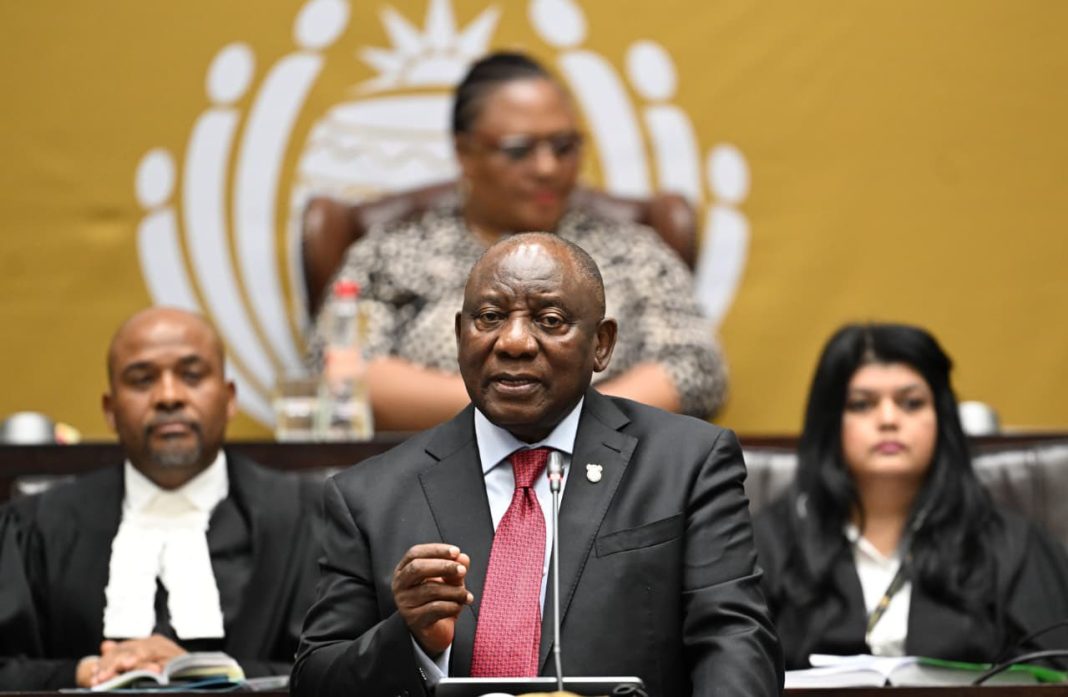
President Cyril Ramaphosa faced tough questions in the National Assembly on Tuesday, defending South Africa’s response to U.S. tariffs, the National Dialogue on the country’s future, the upcoming G20 presidency, and the long-delayed National Council on Gender-Based Violence and Femicide (NCGBVF).
A central point of debate was government’s handling of the newly imposed 30% U.S. tariffs on certain South African exports.
Responding to EFF leader Julius Malema, Ramaphosa said Pretoria was pursuing “active engagement” with Washington, noting that officials were already consulting stakeholders in New York and Washington ahead of formal negotiations.
“The U.S. is South Africa’s second largest trading partner. Our economic relations are strong and go back many years,” Ramaphosa said.
“We are working to stabilise diplomatic relations and are introducing a range of measures to make South African companies more resilient. We will not be bullied. We will stand as a sovereign country, negotiate, and secure the best deal for South Africa.”
He stressed that over 600 American companies operate locally, while 22 South African firms have invested in the U.S.
Ramaphosa dismissed accusations of weakness or “appeasement” of the US, asserting that South Africa would “not be bullied” and would stand as a sovereign state.
Turning to domestic financial policy, Ramaphosa reaffirmed the government’s commitment to establishing a state-owned bank through the Postbank.
He stressed that financial inclusion remains central to supporting small, medium, and micro-enterprises, particularly those led by youth and women.
“Capitalisation of the Postbank is something that needs to be handled with necessary care,” he said, noting that regulatory compliance, governance strengthening, and financial prudence were prerequisites to any recapitalisation.
Ramaphosa highlighted ongoing discussions to ensure the Postbank can operate viably without relying solely on legacy agreements with the South African Social Security Agency.
He drew lessons from the VBS Mutual Bank scandal, underscoring that a future state-owned bank would operate under the strict oversight of the Prudential Authority and Reserve Bank, ensuring transparency and accountability.
Several MPs pressed Ramaphosa on the National Dialogue, an initiative designed to engage citizens on South Africa’s future.
Responding, the president emphasised that the process is not government-driven.
Despite the withdrawal of several foundations and some political parties, Ramaphosa insisted that the steering committee and eminent persons group ensure inclusivity and grassroots participation.
School governing bodies, community groups, professional associations, and rural voices were all set to contribute to shaping national policy priorities, ranging from economic inclusion to land reform.
On South Africa’s upcoming G20 Summit in Johannesburg, Ramaphosa reported that the presidency had received broad recognition internationally.
He described 87 successful meetings across the country as part of preparations, noting that provinces had played a central role in hosting delegates and showcasing the country.
He highlighted four core priorities: disaster resilience, debt sustainability, mobilising finance for a just energy transition, and harnessing critical minerals for inclusive growth.
While acknowledging that tangible benefits for ordinary South Africans may not be immediate, he stressed that the summit positions South Africa as a credible partner in global economic governance, strengthening its influence in multilateral bodies such as the IMF, World Bank, and BRICS.
The session concluded with questions on the National Council on Gender-Based Violence and Femicide.
Ramaphosa expressed “deep disappointment” at delays in operationalising the council, noting that only R5 million had been allocated for the interim secretariat despite the enormous societal need.
Ramaphosa reassured MPs that the Treasury was prepared to allocate resources once the council was legally constituted and stressed that all government departments must prioritise interventions.
Finally, responding to questions from ActionSA on the number and cost of deputy ministers, Ramaphosa said the issue was under review.
“We are always concerned about the size of the executive and deputy ministers. Their salaries, travel, and associated costs are significant, and we must ensure that public funds are spent responsibly while maintaining effective governance,” he noted.
The president pledged to consider reforms while balancing institutional continuity and service delivery, insisting that South Africa would navigate challenges, both domestic and international, without compromising sovereignty or long-term strategic interests.
INSIDE POLITICS