


By Johnathan Paoli
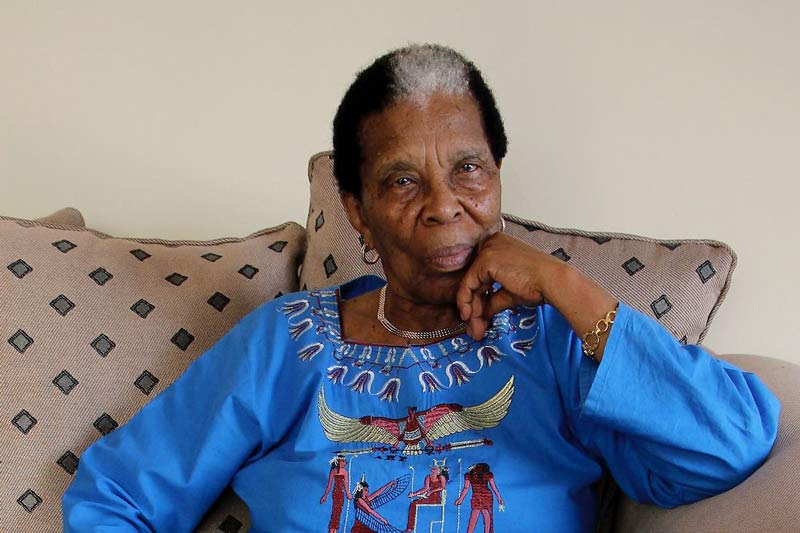
The Great Hall at the University of the Witwatersrand was draped in solemn dignity as President Cyril Ramaphosa delivered a powerful and emotional eulogy at the Special Official Funeral of struggle stalwart Gertrude Shope.
Ramaphosa described Shope as a “revolutionary and a pillar of South Africa”, honouring her life, legacy and immeasurable contributions as a towering figure in the country’s liberation struggle, women’s movement and post-apartheid democracy.
“Women – our mothers, our grandmothers, our wives, our sisters, our aunts and our daughters – are izintsika. Like the pillar that holds the structure of the hut together, women hold up our homes, our families and the nation. Mama Shope’s life is and was intertwined in the fabric of our democracy,” he said.
The service was attended by national dignitaries, family, ANC stalwarts and ordinary citizens who gathered to honour a woman who spent nearly a century in the service of justice and humanity.
Ramaphosa acknowledged the profound loss felt by the nation, especially coming shortly after the passing of ANC Women’s League deputy president Lungi Mnganga-Gcabashe.
Yet, he reminded mourners that Shope’s life was not only a story of resistance, but a blueprint for building a just and inclusive South Africa.
Born on 15 August 1925 in Johannesburg and raised in Bulawayo, Southern Rhodesia (now Zimbabwe), Shope trained as a teacher before returning to apartheid South Africa.
She taught domestic science at Pimville High School in Soweto, where her refusal to enforce the discriminatory bantu education curriculum marked the beginning of her political journey.
Ramaphosa highlighted this act of defiance as an early example of her deep moral clarity: “She could not teach what dehumanised her people.”
Shope’s activism accelerated in the 1950s through her involvement with the Federation of South African Women, culminating in her participation in the historic 1956 Women’s March against pass laws.
Ramaphosa drew a direct line between this activism and today’s gender rights, crediting Shope and her peers with embedding gender justice into the Freedom Charter and, later, South Africa’s Constitution.
The president underscored her belief that democracy was incomplete without the full emancipation of women.
He reminded the nation that many of the rights now taken for granted, access to education, reproductive rights, economic opportunities were “birthed and mothered” by pioneers like Shope.
Her work abroad, Ramaphosa recalled, transformed her into an internationalist voice for South Africa’s liberation.
In 1981, she became head of the ANC Women’s Section in exile and later joined the ANC’s national executive committee in 1985, becoming one of the few women in the upper echelons of the liberation movement.
“She understood that race, gender and class oppression were deeply intertwined,” said Ramaphosa, praising her foresight in insisting that post-apartheid South Africa must institutionalise protections for women and marginalised groups.
Quoting a 1980s interview in which Shope argued for separate women’s organising within the ANC, Ramaphosa said: “She did not seek to fight men but to unlearn the society that had shaped them, and all of us, into instruments of oppression.”
He used this moment to call on men to stand alongside women in the battle against gender-based violence, economic exclusion and cultural marginalisation.
Despite South Africa’s global accolades in gender parity, ranking among the top countries in political representation and legal rights for women, Ramaphosa acknowledged that much work remains.
“We must not become comfortable. Women still bear the brunt of poverty, unemployment, and violence. Ma Shope’s mission is not yet complete,” he said.
He also honoured her post-exile contributions, including her presidency of the ANC Women’s League from 1991 to 1993 and her leadership in preparing for South Africa’s transition to democracy.
Shope served as an MP after 1994 and was instrumental in embedding gender equity within new governance frameworks.
Other speakers at the funeral echoed these themes.
Former Speaker Baleka Mbete and ANC secretary-general Fikile Mbalula paid tribute to Shope’s militant activism and quiet diplomacy.
Defense Minister Angie Motshekga lauded her as a mentor and nation-builder, while Gauteng Premier Panyaza Lesufi praised her as “a torchbearer whose light will never dim.”
Shope’s family offered poignant remembrances of a woman whose life balanced global politics and intimate personal values.
Her granddaughter shared touching stories of baking lessons, gardening and a household guided by education, discipline and love.
He pledged that her legacy would endure through initiatives like the Gertrude Shope Peacebuilding and Capacity Building Programme and through the actions of the young women and men inspired by her example.
“Ma Shope, as men and as women, we will indeed give effect to your clarion call. We owe this to you and to the many women and men who gave their all for South Africa to be free,” he said.
INSIDE POLITICS