


By Thebe Mabanga
President Cyril Ramaphosa used the Government of National Unity’s (GNU) weekend retreat to press the reset button on the coalition, but he did not address pressing issues such as the economic and unemployment crises or the Democratic Alliance’s (DA) attacks on Black Economic Empowerment (BEE).
On Monday, the Presidency confirmed the conclusion of a two-day retreat of the leaders of the ten political parties that make up the GNU.
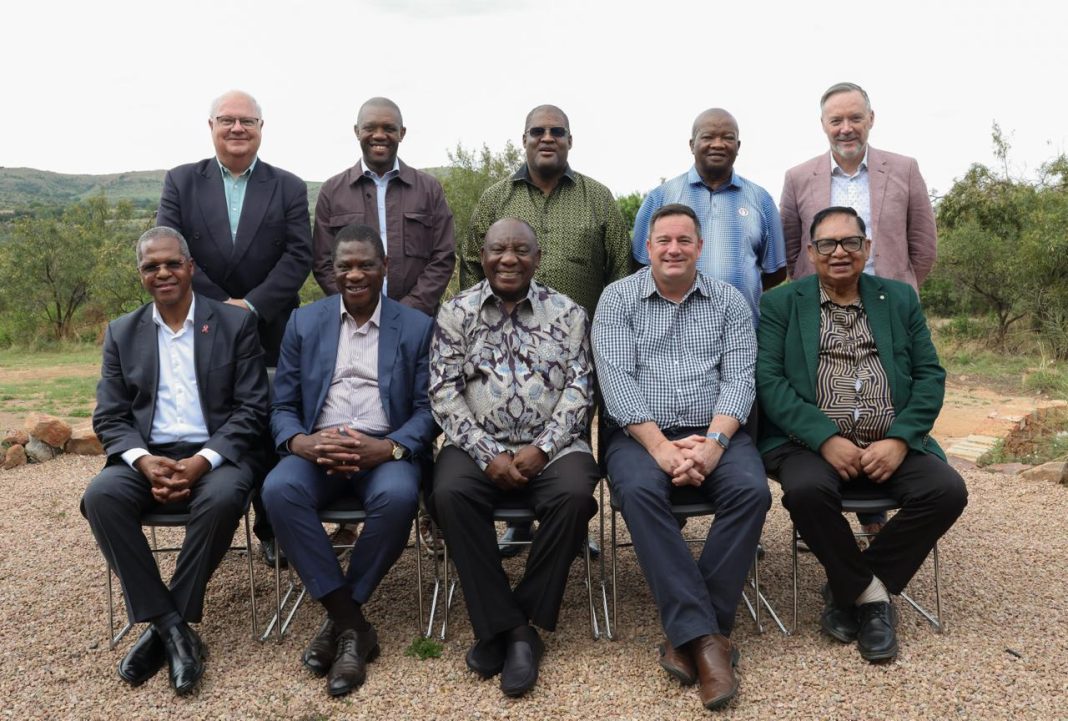
The gathering, described as ‘productive,’ first caught public attention over the weekend when a photo of an all-male lineup of party leaders surfaced.”
“The leaders met to reflect on progress in the implementation of the priorities identified in the GNU Statement of Intent, to discuss contemporary national and international issues, and to address critical issues facing the country.”
Apart from President Ramaphosa and Deputy President Paul Mashatile, the meeting was attended by Democratic Alliance leader John Steenhuisen; Cooperative Governance and Traditional Affairs Minister and IFP leader Velenkosini Hlabisa; Gayton McKenzie of the PA, who is also Minister of Sports, Arts and Culture; Corné Mulder of the FF Plus; Bantu Holomisa of the UDM; Deputy Minister of Defence and Chairman of the Standing Committee of Public Accounts, Songezo Zibi (Rise Mzansi); Ganief Hendricks of Al Jama-Ah; Mzwanele Nyhontso of the PAC, who is also a minister; and Brett Herron of the Good Party.
Zibi, SCOPA chairman, noted that the retreat had been on the cards since last year before finally taking this past weekend and as “highly productive and necessary” noting that it gave the parties an opportunities to assess the progress of the GNU while making sure that their goal and visions remains aligned.
Zibi acknowledged that, as SCOPA Chair, he brings a unique vantage point to proceedings.
While other party leaders serve with Ramaphosa in cabinet, he has oversight over a critical body that has granular insight into governance challenges.
“The position allows me to look at things from a different perspective,” he said.
He noted, for example, that while ministers would understandably fight for their individual departments during the budgeting process, his position allows him to view allocations from a broader perspective.
When asked whether the retreat had strengthened the GNU and its chances of surviving a full term, Zibi said it had indeed done so
“Relationships function on chemistry,” he said, noting that any team, be it an executive team, sports team or a cabinet and parliamentary like the coalition, needs such sessions to function better and will improve the prospects of the GNU.
Zibi rejected the suggestion that the meeting in any way touched on Ramaphosa’s stated desire to step down from the GNU.
“He would not discuss it at this forum” said Zibi, noting that such a discussion would instead take place at the National Working Committee (NWC) of the ANC.
Attempt to directly contact NWC members drew a blank.
The statement noted that ‘the leaders were unanimous that the GNU is united and strong.’
It further stated: “The leaders recognised that the GNU has faced difficulties at times, most notably during the 2025 budget process,” referring to the delayed budget after Finance Minister Enoch Godongwana attempted to push through a 2% VAT increase.
“However, the GNU has drawn important lessons from these experiences and will ensure more effective consultation in developing fiscal priorities and frameworks.”
“The meeting failed to discuss two most important crises facing this country: an economic crisis and a jobs crisis,” said Duma Gqubule, an independent economist.
Gqubule highlighted that South Africa’s GDP per capita has been declining for 18 consecutive years, since 2007.
GDP per capita measures income per person and is a key indicator of living standards.
He warned that with GDP growth forecast at no more than 1.5% over the next two years, South Africans could face two decades of falling living standards by 2027.
Gqubule also pointed to the unemployment crisis, noting that 12.6 million South Africans are out of work.
Yet, despite the meeting discussing a range of important issues, these economic challenges were not addressed.
“This meeting did not move the needle for me on any of the major issues,” Gqubule said.
“There is no plan to get us out of the economic crisis.”
The economist also critiqued the GNU’s infrastructure plans. While the statement claims the coalition has “embarked on a massive infrastructure build and maintenance drive,” infrastructure investment—expected to reach R1 trillion over the next three years—is forecast to decline from 4.3% to 3.9% of GDP.
South Africa is also unlikely to meet its stated goal of investing 15% of GDP in Gross Fixed Capital Formation.
Gqubule dismissed the prospects of the GNU completing its full term.
“The GNU will not finish its term,” he said.
“This is because of the economic crisis. The parties involved will be blamed, tensions will rise, and the coalition will break up.”
The meeting, however, noted several achievements guided by the Medium-Term Development Programme (MTDP).
Besides the infrastructure drive, it highlighted microeconomic stability—a factor recognised by rating agencies.
The statement also cited South Africa’s responses to international challenges, such as tariff increases imposed by former US President Donald Trump, efforts to diversify exports and expand into new and existing markets, and initiatives to expand early childhood development and strengthen foundational learning.
Public employment programmes were credited with providing work and livelihood opportunities to young people on an unprecedented scale.
Additionally, the meeting noted South Africa’s Presidency of the G20, which will culminate with the G20 summit later this month.
On the issue of Broad-Based Black Economic Empowerment (B-BBEE), the gathering briefly discussed the DA’s call to scrap it and replace it with the Economic Inclusion for All Bill, which seeks to use procurement as a tool for empowerment.
“This was not that kind of meeting; it was not the forum for that,” said Zibi, who rejected the DA’s proposal and called for a broader discussion on BEE beyond narrowly focused deals.
INSIDE POLITICS