


By Johnathan Paoli
Limpopo premier Phophi Ramathuba has lashed out at the provincial government for its failure to address infrastructural challenges in the province, calling on officials to do more in assisting rural and marginalised communities.
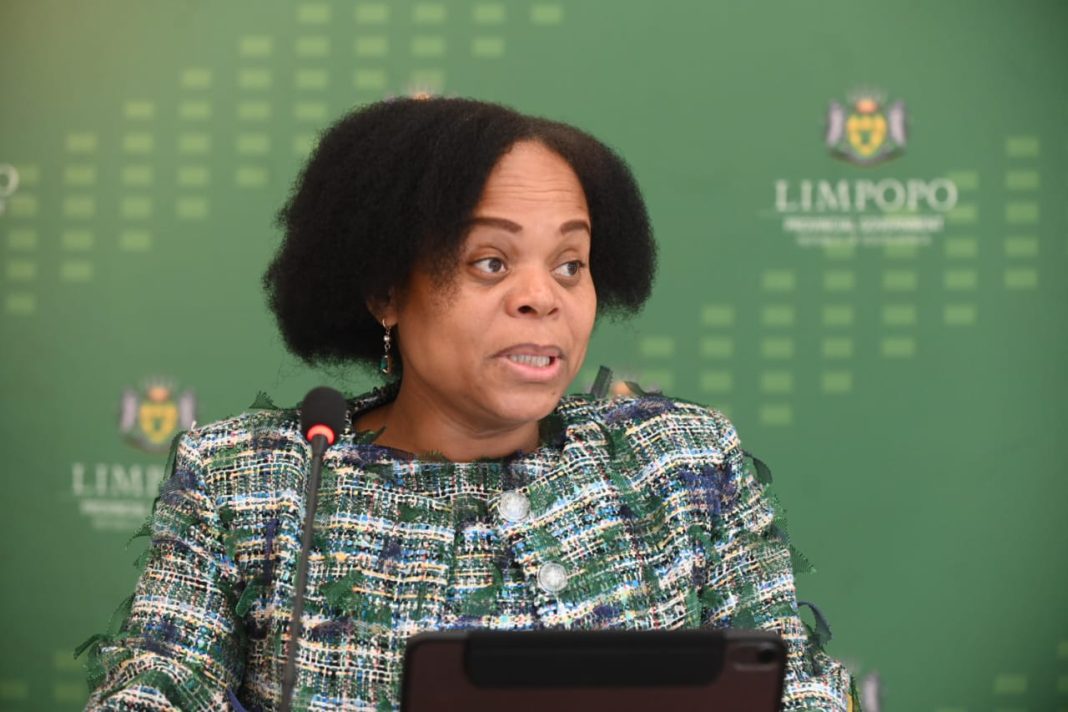
The premier delivered a hard-hitting opening address at the Limpopo Provincial Infrastructure Workshop in Polokwane on Wednesday. She called for urgent reform, accountability and improved delivery in the province’s infrastructure sector.
“Are we equal to the tasks at hand? The current state of our infrastructure management leaves much to be desired. Poor planning has, at times, led to projects without budgets to match our bold declarations. We find ourselves at a precipice, facing unprecedented societal pressures, shrinking economic opportunities and an alarming rise in unemployment.
“It is evident that our society’s despondency towards government is tangible. Their impatience waits for no invitation, emphasising the urgency with which we must act,” Ramathuba said.
Joined by MECs, HODs, municipal leaders, state-owned entities and private sector stakeholders, Ramathuba used the occasion to outline a bold vision for infrastructure development while sharply criticising institutional failures and underperformance.
Framing her remarks within the broader national priorities of South Africa’s seventh administration, the premier highlighted three central pillars: inclusive economic growth and job creation, the fight against poverty and the rising cost of living, and building a capable, ethical and developmental state.
These, she said, are also reflected in Limpopo’s Development Plan, which focused particularly on water provision, road infrastructure and unemployment.
“These are not mere statistics; they embody our people’s aspirations for a sustainable future,” Ramathuba said.
She added that while growth in household numbers across the province signaled progress, it also placed increasing pressure on already strained infrastructure systems.
The premier did not mince her words while assessing the current government performance.
She criticised poor planning and the lack of interdepartmental coordination, particularly in water projects where completed reservoirs remain unusable due to disconnected reticulation systems.
“It makes no sense to build water infrastructure only to have communities remain without water,” she said.
Ramathuba warned that continued project failures, such as roads that flooded after the first rainfall or hospitals that go unfinished, eroded public trust and cost lives.
She pointed to the case of the Maputa Malaji Hospital, where a project initially budgeted at R300 million ballooned to over R900 million, which she linked directly to higher mortality rates due to inaccessible healthcare.
She was particularly scathing of professional engineers and project managers who did not deliver quality work.
The premier made it clear that she expected competent leadership, not just political appointments.
“Political deployment happens everywhere, but in Limpopo, only 20% of the deployed are doing the work. Elsewhere, it’s 80%. Appoint capable people,” she said.
She also sent a strong message to implementing agents such as the Public Works Department, the Independent Development Trust and the Development Bank of Southern Africa, warning that continued delays and inefficiencies would force departments like education and health to consider developing internal infrastructure units.
Highlighting the importance of project execution and financial discipline, Ramathuba said infrastructure budgets must be fully spent and not returned to Treasury.
“Returning funds reflects badly on the type of partnership we have with implementing agents. It cannot be allowed,” she insisted.
She pointed to the provincial cooperative governance, human settlements and traditional affairs department as a positive example, praising it for effectively spending its allocated funds.
“You were not born in Hyde Park. You come from those villages. Don’t forget where you come from or who you serve,” she reminded officials.
Drawing inspiration from international examples, Ramathuba referenced China’s strict accountability standards where officials could be dismissed or arrested not only for corruption, but for non-performance.
“Sometimes they are arrested not for corruption, but for not finishing the project,” she said, challenging local officials to adopt a similar ethos of responsibility.
Despite her candid critique, Ramathuba reiterated her belief in the provincial government’s capacity to turn things around, urging stakeholders to bring innovation to the table, pilot new delivery methods, and reject mediocrity.
She called on all participants to treat the workshop as a springboard for transformative action.
The workshop focused on strategic planning, interdepartmental collaboration and infrastructure financing to develop a concrete roadmap for implementation in the 2025/26 fiscal year.
INSIDE POLITICS