


By Staff Reporter
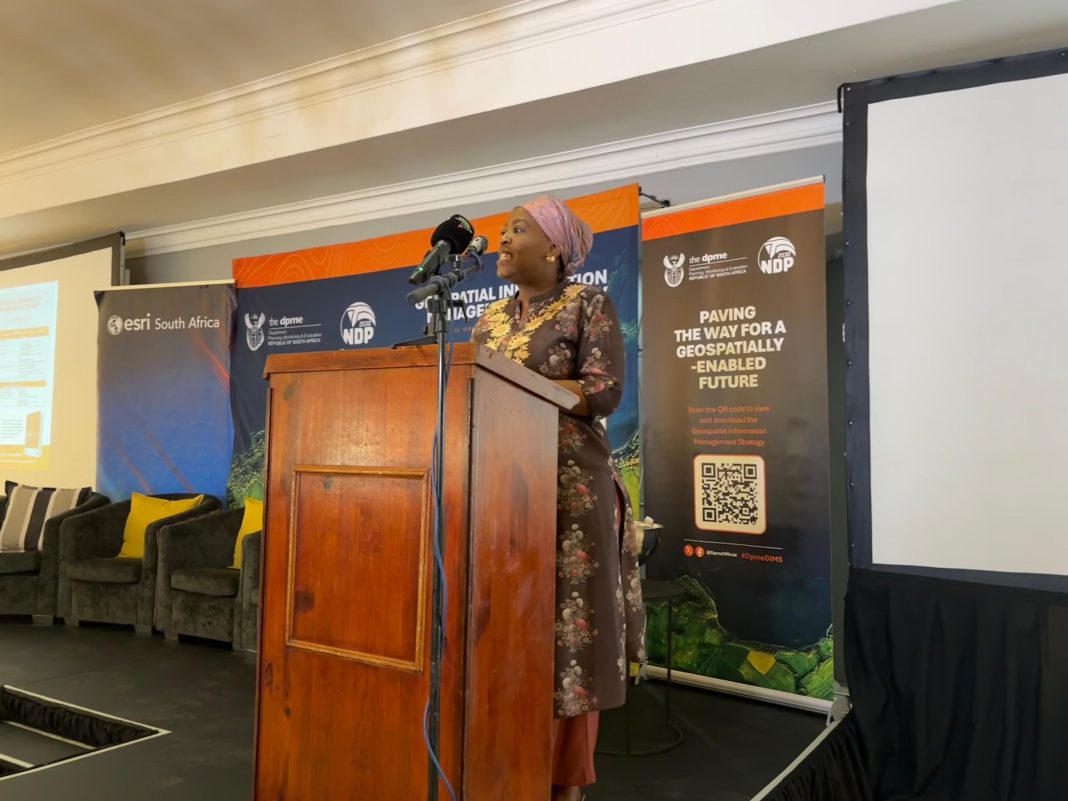
The Minister in the Presidency for Planning, Monitoring and Evaluation, Maropene Ramokgopa, has launched a new planning tool that uses big data, satellite imagery, and advanced geospatial technologies.
Ramokgopa said the Geospatial Information Management Strategy (GIMS) will be used for more effective monitoring and evaluation.
“Today, we are not simply unveiling another government document. We are taking a decisive step towards building a spatially intelligent state, which puts people, communities, and places at the very centre of development,” she said at the launch in Pretoria.
Ramokgopa said GIMS will change how government performs some of its key functions “with a framework and a practical tool to transform how government plans, monitors, and evaluates its work”.
The strategy draws on many of government’s existing planning tools, starting with the National Development Plan (NDP) Vision 2030, the blueprint for long term planning.
Ramokgopa said GIMS also strengthens the Medium-Term Development Plan (MTDP) 2024 – 2029, which sets the priorities of the current administration. It also relies on the National Spatial Development Framework (NSDF), which provides the spatial patterns for development. Lastly, GIMS enhances the District Development Model (DDM) which aligns the service delivery plans of national, provincial, and local government.
GIMS has the capacity to create a visual representation of an area’s development trajectory and can be tracked and measured across all spheres of government.
“Departments will be able to see at the click of a button where infrastructure gaps exist, where poverty is most concentrated, and where interventions will have the greatest impact,” the minister said.
“Equally important is the way in which GIMS strengthens monitoring and accountability,” she added.
“Too often, progress has been measured in aggregate figures that mask local realities. GIMS makes it possible to track change in real time, at the level of districts, municipalities, and communities.”
With GIMS, government departments will be able to identify infrastructure gaps and poverty concentrations in real time, target resources where they are most urgently needed, and track change at district and municipal levels. The intention is to improve transparency and accountability and embrace innovation and the Fourth Industrial Revolution through big data, satellite imagery, and geospatial technologies.
“This is not about maps for their own sake, it is about making visible the story of our development, and ensuring that decisions are informed by the real conditions of the people and places they affect,” the minister said.
“This way citizens can hold government accountable not only for promises made, but for results delivered.”
Ramokgopa said the tool is aimed at policy makers, data specialists, researchers and academics and requires their contribution, along with the contribution of the private sector and developmental agencies.
Ramokgopa called on government departments and agencies to integrate their data into the system and utilise geo spatial intelligence in their planning.
INSIDE POLITICS