


By Simon Nare
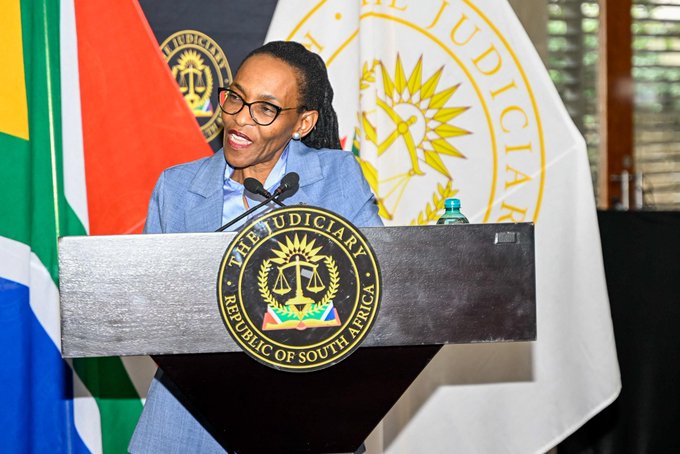
South Africa’s judiciary fell short of key performance targets in the 2023/2024 and 2024/2025 financial years, with regional courts achieving only a 9% criminal case clearance rate and several divisions recording declines in disposed cases and court hours, Chief Justice Mandisa Maya has said.
Presenting the combined annual reports on Tuesday, which were delayed in part by the leadership transition from former Chief Justice Raymond Zondo, Maya said the judiciary had delivered on its constitutional mandate despite severe resource constraints, such as courtroom shortages, faulty recording equipment, power cuts, natural disasters and adverse weather.
Superior courts collectively achieved 71% compliance with reserved judgment delivery within three months, exceeding the 70% target, while district courts finalised 94% of criminal cases and maintenance matters within 90 days. Child justice preliminary inquiries reached 84% finalisation in monitored courts.
The Supreme Court of Appeal resolved 72% of cases, the Labour Appeal Court 71%, the Labour Court 55%, and criminal case backlogs were reduced by only 43%.
In regional courts, 41,512 new criminal cases were registered against 40,072 finalised, yielding the 9% clearance rate.
“This demonstrates that the Regional Courts are largely just managing with the inflow of cases as the ideally the clearance rate must be 100% or above. Compared to the previous year, court days decreased by 3%, disposed cases decreased by 2%, and Court hours also declined by 2%,” Maya said.
Regional courts recorded 65,461 criminal court days and more than 204,325 hours, averaging just over three hours per day.
Maya said the year under review marked a historic milestone in the South African judiciary as it was the first year in which a woman was at the helm of the apex court.
“The 2023/2024 and 2024/2025 Annual Judiciary Reports collectively reflect a watershed period in the history of the Judiciary in the democratic era, highlighting both the constitutional mandate pursued by the new Chief Justice and the successes recorded in the exercise of judicial authority,” she said.
She reiterated the judiciary’s call for full institutional independence under a single, judiciary-led court administration model with financial and operational autonomy.
“Judicial independence remains a cornerstone of constitutional democracy and is indispensable for the proper discharge of judicial functions in a state founded on the rule of law. Independence and innovation are not isolated ideals but mutually reinforcing,” Maya said.
Among achievements, the judiciary-led Court Online system was rolled out to seven superior courts.
Maya also highlighted the adoption of a revamped Sexual Harassment Policy, launched on Women’s Day.
“This significant milestone has been a long time coming and is a result of many challenges of many years towards creating an environment in the workplace within the judiciary institution in which respect and dignity triumph,” she said.
She said that the judiciary was not exempt from sexual harassment and required robust accountability measures.
INSIDE POLITICS