


By Akani Nkuna
The South African Communist Party (SACP) general secretary Solly Mapaila on Thursday led calls for the immediate release of Venezuelan President Nicolás Maduro and his wife, Cilia Flores.
Maduro and Flores were detained by US forces on Saturday during a US military operation in Venezuela and flown to New York, where they appeared in court on Tuesday on narcotrafficking-related charges.
“We are here to condemn US aggression against Venezuela and its democratically elected president, Nicolás Maduro, and his wife, Cilia Flores. We demand their immediate release,” Mapaila said.
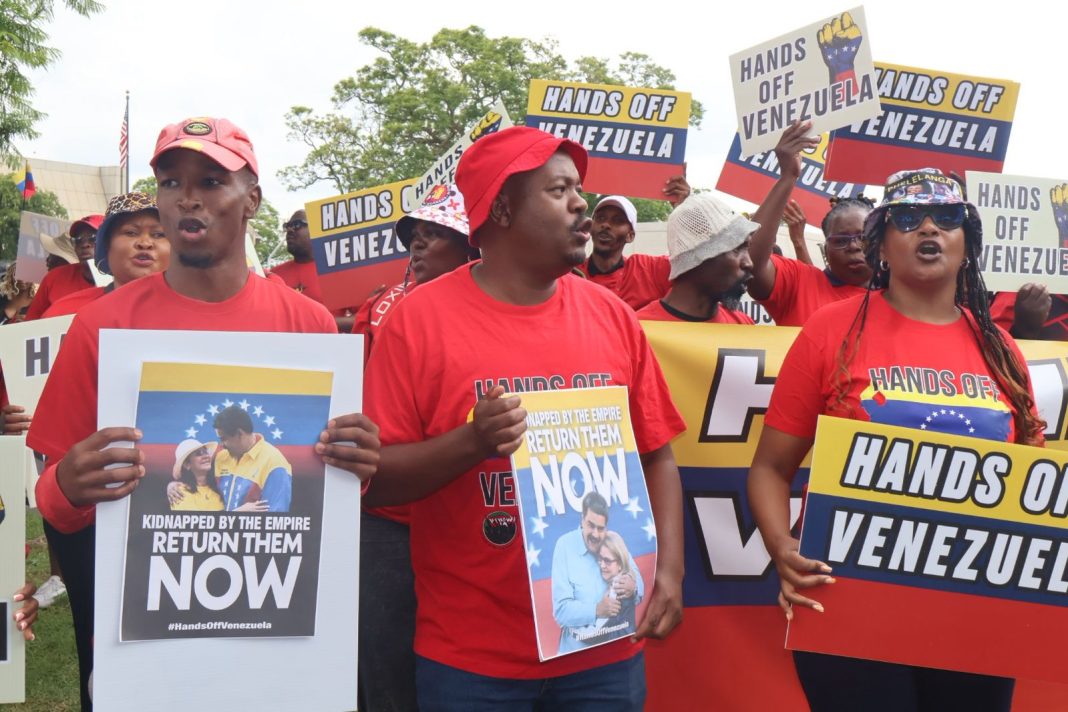
Several organisations, led by the SACP and the Congress of South African Trade Unions (Cosatu), staged a protest outside the United States embassy in Pretoria in solidarity with Venezuela.
Protesters warned that the US action set a dangerous precedent that could undermine international law, and urged the international community to intervene.
SACP spokesperson Mbulelo Mandlana told Inside Politics it was critical to demonstrate collective opposition to the US action to discourage President Donald Trump and his administration from disregarding international law.
He warned that unchecked actions of this nature could trigger a broader international legal crisis.
“We hope this protest communicates a clear message: the American government is acting illegally. It has no authority to act in the manner it has and no right to infringe on the sovereignty of another state,” Mandlana said.
The protest follows the detention of Maduro and Flores on 3 January 2026.
They have since appeared in a US federal court in New York on charges including narco-terrorism conspiracy, cocaine importation conspiracy, and possession of machine guns and destructive devices.
Maduro has pleaded not guilty.
Drawing hundreds of protesters from unions and civil society organisations — including Nehawu, Popcru, Africa4Palestine and Anti-Fascist International — Mandlana said the demonstration reflected the views of many South Africans and reinforced demands for the couple’s release.
He urged the international community to uphold the rules and principles that ensure law and order prevails over what he termed “barbarism”, warning against selective application of international law based on power.
“Because it is the US in this instance, we should not conclude that international law is no longer valid. It must be respected and enforced. Without it, human existence becomes dog-eat-dog,” Mandlana said.
Cosatu spokesperson Zanele Sabela said the US had previously escaped accountability for breaches of international law, citing Iraq, Afghanistan and Libya as examples. She stressed the need for global institutions to assert themselves during periods of heightened conflict.
“The self-righteousness of perceived superpowers sets a dangerous precedent. If left unchecked, international law will not be worth the paper it is written on,” Sabela said.
Responding to concerns by local political commentators that South Africa’s vocal condemnation of the US could further strain relations with the Trump administration, Sabela said international pressure had been vital in ending apartheid.
She added that repercussions were already evident, pointing to economic tariffs and what she described as a “misinformation rampage” by the Trump-led administration.
“Last year, the US threatened sanctions through 30% tariffs on South African exports — the highest in the region. If we’re worried about inviting repercussions, it’s already too late. That process is well under way,” Sabela said.
INSIDE POLITICS