


By Johnathan Paoli
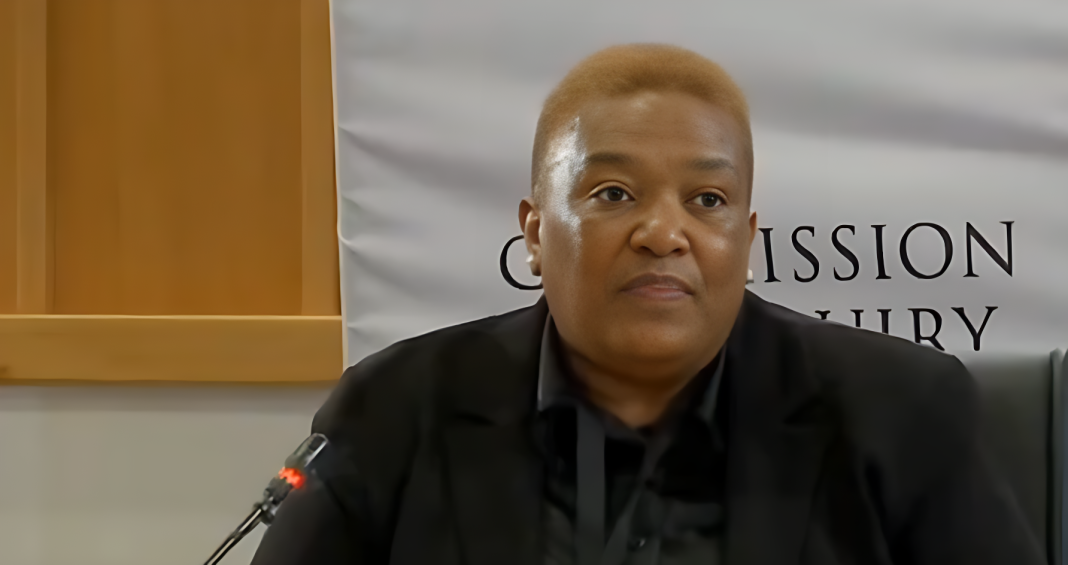
Major-General Mary Motsepe told the Madlanga Commission on Monday that the poorly communicated transfer of 121 Political Killing Task Team (PKTT) dockets to SAPS head office left key cases idle for months.
Her testimony also described missed notifications, uncertainty over who authorised the move and unanswered questions about why the files had to be taken to Pretoria at all, or why the team had to be disbanded.
Motsepe, who heads Serious and Violent Crime Investigations within the Detective and Forensic Services Division, headed by the suspended Lieutenant General Shadrack Sibiya, said she first learned the dockets were being brought to SAPS head office not through official channels, but by a phone call from her commander, Lieutenant-General Khosi Senthumule, on 27 March.
“There was no formal notification, I was never officially informed,” Motsepe testified.
Senthumule asked her to accompany her to Crime Intelligence boss Lieutenant General Dumisani Khumalo’s office to physically collect the dockets.
Motsepe told the commission that the dockets’ arrival at head office made little sense to her, particularly once she was told they were there merely for an audit.
They were expected to be returned to KZN after Senthumule engaged provincial commissioner Lieutenant-General Nhlanhla Mkhwanazi.
But when Senthumule contacted Mkhwanazi, she told Motsepe that Mkhwanazi had insisted he had nothing to do with the relocation of the dockets.
Commission chairman justice Mbuyiseli Madlanga questioned the logic of relocating the files at all.
“If the intention was simply to audit them, why would they need to come to Gauteng? It just does not make sense,” he asked Motsepe.
“It’s true commissioner, I also put myself in the shoes of General Mkhwanazi,” Motsepe replied.
According to Motsepe, national police commissioner Fannie Masemola later told Senthumule that Sibiya should use his own discretion regarding the dockets.
That discretion resulted in the files remaining at head office far longer than initially suggested.
By 24 April, the 121 dockets were still in Pretoria, and a planned return to KZN in phases — from active investigations, to NPA decision-ready matters, to finalised cases — had stalled.
Motsepe said she was called to a meeting on 19 May with Sibiya and Senthumule, where Sibiya formally assigned all PKTT dockets to her division.
She requested more staff, since the files had already sat in a safe for two months.
Her testimony revealed that what was described as a simple audit became a deeper probe into exposing alleged operational lapses within the PKTT.
Although she was not directly involved in the audit itself, Motsepe conducted spot checks and received detailed feedback.
The findings, she said, were troubling: suspects identified by witnesses but never arrested; prosecutor instructions ignored; identity parade identifications with no charges laid; and even cases withdrawn out of fear because accused persons were out on bail.
One of the most serious failures, she said, involved missing statements.
Her team found 32 statements missing from two Eastern Cape dockets, and another 10 to 12 missing in cases from Greytown and Umlazi.
She recorded the issue in an information note for Sibiya, though she never received a response.
“As soon as I detected this, I told General Sibiya. I said, let’s put it in writing. These were statements annexed under the C-clip,” she said.
Motsepe said she asked Sibiya why the PKTT was being disbanded.
Sibiya told her the decision stemmed from the approved organisational structure that required murder and robbery units, not task teams, to handle such crimes nationally.
He allegedly raised concerns over the PKTT’s disproportionately large budget and the need for a more equitable distribution of investigative resources across provinces.
Motsepe accepted parts of this rationale but remained firm that the disbandment was mishandled.
“I agree that the PKTT should not have been disbanded without proper consultation. And I do not agree it should have been disbanded before the elections. KZN has the highest incidence of political killings,” she said.
Despite this, she rejected claims that the PKTT was uniquely high-performing, warning that such narratives demoralise other teams who also handle political murders.
By June, with 118 dockets still unallocated and no funding approved for her investigators to travel to KZN, Motsepe compiled a draft report requesting budget support.
Without funding, she said, her unit could not continue investigations.
She even proposed sending the cases back to KZN if no money was forthcoming, although they were only returned to KZN on 28 August, after copies were made.
Motsepe insisted she played no role in leaking her audit report, which somehow ended up in the media despite being shared only with Sibiya and their two personal assistants.
The commission continues.
INSIDE POLITICS