


By Rafieka Williams
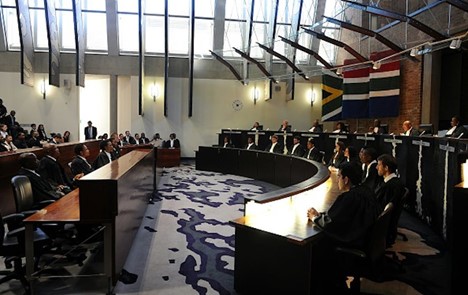
The Constitutional Court on Thursday heard a challenge by rights groups seeking amendments to the Sexual Offences Act as it relates to rape.
The applicants argued that the Act, in its current form, was unconstitutional as it discriminated against victims by failing to fully protect their rights to equality, dignity, privacy, bodily and psychological integrity, and freedom and security.
The Embrace Project, the Centre for Human Rights, the Women’s Legal Centre, and Amici Curiae are asking the court to compel amendments that would require accused persons in sexual offence cases to clarify interpretations of “consent” and “intention.”
The matter before the court, involves separate matters of women survivors who had gone through the trial process, only for the perpetrators to be acquitted on appeal.
It was argued that when women are sexually assaulted, perpetrators are often acquitted because the State is unable to prove beyond reasonable doubt whether the victim consented.
Advocate Nasreen Rajab-Budlender SC, who argued for the team, who brought the matter before the Constitutional Court said: “There is a case to be made that women are denied the equal protection and benefit of the law and that the law as it currently stands discriminates them unfairly.”
“While the court can no longer confer consent from their (survivors’) silence or passivity, the accused can. Because of the way in which these provisions are drafted… the Act compels the court to treat this as a valid defence.”
Rajab-Budlender argued that to protect the rights of the accused, where perpetrators are equal before the court, part of the magistrate’s decision to determine innocence or guilt is based on whether the perpetrator believes they had committed the offence.
“The Act allows the perpetrator to avoid conviction by raising the subjective test defence. If the perpetrator subjectively and unreasonably believes that the victim has consented, he may be entitled to acquittal, unless the State proves beyond reasonable doubt that the accused’s subjective belief was false.
“In this way the Act validates false narratives and reinforces harmful and dangerous behaviours that diminish a person ‘s autonomy and dignity, it also perpetuates victim blaming,” court papers read.
When asked by Justice Nonkosi Mhlantla about the details of these steps, she explained: “Reasonable steps is not an onerous burden, it requires accused to say, ‘are you okay with this?’ … It’s not asking an accused to become a lawyer. It’s not asking a 21-year-old man to become a lawyer and use legal terminology before he engages in a sexual relationship with a partner.”
Rights groups want Parliament to change legislation to include:
“56(1A) Whenever an accused person is charged with an offence under section 3, 4, 5, 6, 7, 8, 9 or 11A, it is not a valid defence for that accused person to rely on a subjective belief that the complainant was consenting to the conduct in question, unless the accused took objectively reasonable steps to ascertain that the complainant consented to sexual conduct in question.”
Rajab-Budlender said these changes would be a tangible step towards for the State to meets its obligations to repeal provisions that allow, tolerate or condone forms of GBV against women.
“It is the most sensible and appropriate choice of relief before you today and one which recognises that the manner in which the Act currently operates infringes the rights of women and victims of sexual offence and correct that unconstitutionality,” she said.
The constitutional challenge to amend the Sexual Offences Act was initiated three years ago by The Embrace Project.
In September 2024, the Pretoria High Court ruled in favour of The Embrace Project and Inge Holzstrager, declaring certain provisions of the Act unconstitutional.
The court further granted a temporary remedy requiring that individuals accused of specific sexual offences must take objectively reasonable steps to ensure the complainant consented to the sexual conduct.
And, on 21 October 2024, The Embrace Project and Holzstrager approached the Constitutional Court, seeking confirmation of the High Court’s order.
They asked the Constitutional Court to confirm the High Court’s finding of constitutional invalidity and to convert the temporary remedy into law while Parliament amends the Act.
After a full day of arguments on Thursday, the Constitutional Court reserved judgment.
INSIDE POLITICS