


By Thapelo Molefe
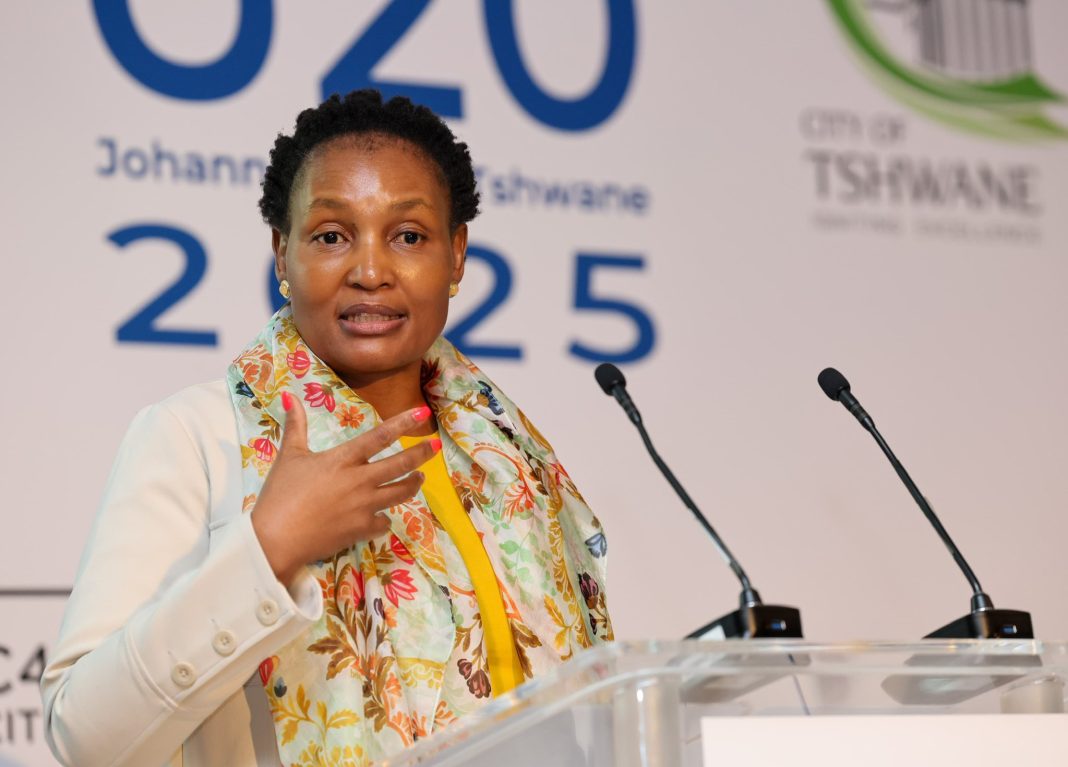
Human Settlements Minister Thembi Simelane has called for strengthened governance, transformation, and collaboration across the community schemes sector as the Community Schemes Ombud Service (CSOS) marked its 3rd Annual Indaba in Fourways on Thursday.
Delivering a keynote address at The Canvas Riversands Conferencing Centre, Simelane said the two-day Indaba, held under the theme “Sustainable Governance: Shared Responsibility as the Cornerstone of Community Schemes,” provided a critical opportunity to reflect on progress made and chart new strategies for sustainable community governance.
“This is an important platform that gives us an opportunity to deeply reflect on a host of issues in the community schemes’ value chain, assess progress, galvanise, and build on the existing partnerships,” Simelane said.
She praised the CSOS for its growing impact and its role in promoting accountability and stability within community schemes, noting that the organisation had achieved a performance rate of 86% according to the Auditor-General.
“This commendable achievement reflects commitment, teamwork, and sound leadership. Despite operational pressures and a complex environment, this performance demonstrates what can be achieved when an organisation is united by purpose and driven by results,” she said.
The minister challenged the newly appointed CSOS board to strive for a 100% performance rate, urging them to translate the entity’s improved visibility into tangible service delivery outcomes, particularly in dispute resolution and compliance.
Currently, over 38,000 community schemes are registered with CSOS, with more than 70% confirmed as compliant. However, Simelane stressed the importance of registering all remaining unregistered schemes to ensure a comprehensive and accurate national database.
“The entire CSOS value chain and service delivery model is underpinned by the success in creating a complete database of community schemes,” she said.
Simelane highlighted the need for CSOS to strengthen its alternative dispute resolution mechanisms and reduce backlogs in resolving community scheme disputes. She noted the importance of empowering residents to resolve conflicts at local levels without relying solely on courts.
“Not all disputes require court intervention. We must develop structures and frameworks that empower communities to find solutions through alternative mechanisms,” she said.
The minister also reaffirmed government’s commitment to transformation within the property and human settlements sector.
She commended the CSOS for implementing a transformation strategy and developing a draft sector scorecard to promote inclusivity and equitable participation, particularly for previously disadvantaged individuals (PDIs).
According to Simelane, 152 PDIs have now been appointed and trained as Executive Managing Agents (EMAs), with 14 already managing schemes across various provinces.
These EMAs are registered property practitioners under the Property Practitioners Regulatory Authority (PPRA), an entity of the Human Settlements Department.
“This demonstrates that we are a sector that embraces transformation,” she said.
“However, it is not enough to place people on panels without engagement or support. We must ensure they are empowered, incubated, and equipped to thrive.”
Simelane also urged closer cooperation among entities within the Human Settlements portfolio, including the PPRA and CSOS, to enhance coordination and data sharing.
“We plan to ensure that our entities, at least quarterly, meet under one umbrella to streamline human settlement processes and systems. There is a lot of interconnectedness that can help us improve efficiency and oversight,” she said.
As CSOS approaches its 10th anniversary next year, Simelane encouraged the organisation and its partners to reflect on their progress and envision a more inclusive and innovative future.
“Next year, CSOS will celebrate ten years of service – a decade marked by dedication, resilience, and meaningful impact. I challenge all of us to reimagine the next decade, characterised by innovation, transformation, and heightened public confidence,” she said.
INSIDE POLITICS