


By Johnathan Paoli
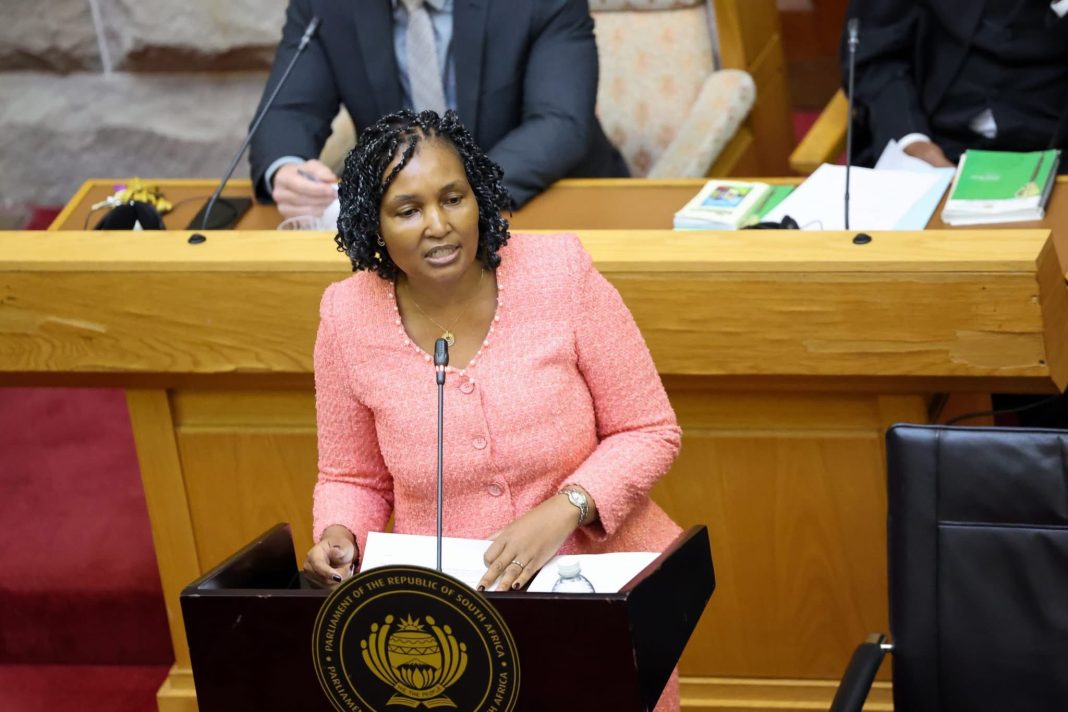
Human Settlements Minister Thembi Simelane has laid out an ambitious housing delivery and reform agenda, pledging to transform South Africa’s human settlements landscape through innovation, resilience, and social justice.
Simelane’s budget speech, themed “Leveraging technologies for resilient, sustainable human settlements”, set targets for the 2024–2029 Medium-Term Development Plan, including housing units, serviced stands upgrades and title deeds among other services.
For the current fiscal year alone, Simelane promised over 41000 housing units, more than 32000 serviced sites, and the eradication of 8000 mud houses. She also emphasised the department’s focus on spatial transformation, digital innovation and community engagement.
Simelane said the R101.2 billion medium-term budget, with R30.8 billion (90.7%) allocated to provinces and metros, was a critical tool in achieving these goals despite acknowledging that allocations like the R336 million for emergency housing were insufficient in light of recent climate disasters.
“Excellence is never an accident. It is the result of high intention and sincere effort,” she told Parliament.
However, opposition parties rejected both the minister’s assurances and the budget she tabled.
The Democratic Alliance (DA), led by Luyolo Mphithi in the debate, said the department was in “freefall” due to systemic governance failures, fraud, and mismanagement across its entities.
Mphithi cited a letter the DA sent to Simelane in April flagging critical issues including the suspension of the National Home Builders Registration Council CEO, the investigation of the National Housing Finance Corporation CEO for misuse of funds, the firing of the Social Housing Regulatory Authority CEO and CFO, the resignation of the Community Schemes Ombuds Services’ Chief Ombud amid a corruption probe, and the Housing Development Agency currently under investigation by the Special Investigation Unit.
“These failures do not just affect offices, they destroy lives. People in Nigel have had their homes sold by corrupt officials. In the Northern Cape, houses collapsed within 10 days of being built. In Johannesburg, title deeds gather dust. Is this the promise of democracy?” Mphithi asked.
The DA also attacked Simelane’s own integrity, pointing to ongoing corruption allegations dating back to her tenure as Polokwane mayor.
The party said Simelane received a R575,600 “loan” from Gundo Wealth Solutions, a company linked to the looted VBS Mutual Bank.
In response, Simelane lashed out at the DA.
“Yes, you stand in the dock before a judge when you are charged. I am undergoing trial without charges. You are trying me in the court of public opinion, because you know you have no case in a court of law,” she said.
The Economic Freedom Fighters (EFF) and uMkhonto weSizwe Party (MKP) also opposed the budget, though for different reasons.
Both parties criticised what they called the “chronic underfunding” of a department tasked with housing millions.
“This budget is inadequate. It cannot meaningfully address the spatial apartheid that persists,” EFF MP Mbali Dlamini said.
ActionSA’s Malebo Kobe voiced support for some of Simelane’s policy initiatives but said the department had failed to account for wrongdoing at key entities.
“We reject this budget not only because of the allegations against the minister, but because of a lack of accountability across the entire housing system,” Malebo said.
Simelane used her speech to highlight important reforms, including new digital platforms enabling online housing applications and improving project transparency, over 40 Innovative Building Technologies being certified with demonstration areas to follow, the NHFC disbursing R4.8 billion in the past five years and delivering nearly 150,000 housing opportunities, and the SHRA facilitating a pipeline of 64 active projects, 95% of which are black-owned.
She also unveiled plans to convert well-located public buildings into social housing to revitalise inner cities and support spatial justice.
The department has secured 2,700 hectares of land for such projects and is working with state-owned enterprises on repurposing four buildings.
A new Policy Framework on Illegal Evictions is also under development, while workforce reviews and transformation targets are being prioritised to align with the department’s 2025–2030 strategy.
INSIDE POLITICS