


By Akani Nkuna
United Democratic Front (UDF) activists Alex Matshapa Matsepane and Solomon Mankopane were reburied with liberation honours in their ancestral home in Ga-Maupa village, outside Modjadjiskloof, in Limpopo, on Saturday.
The two were executed by the apartheid regime on December 5, 1986, just six months after being sentenced to death, and buried in unmarked pauper graves in Mamelodi, east of Pretoria.
Their remains were exhumed and reburied as part of the Gallows Exhumation Project, led by the Department of Justice and Constitutional Development, the TRC Unit, and the NPA’s Missing Persons Task Team.
Justice Minister Mmamoloko Kubayi said the apartheid regime believed that burying freedom fighters in obscurity would erase their legacy from public memory.
“We are, therefore, gathered here today to restore the dignity of these patriots who were indeed the midwives of the democracy that we are enjoying today,” said Kubayi.
“Alex and Solomon were sentenced to death by an illegal regime that was run by men and women who were frightened that the people of South Africa were stopping at nothing to put an end to white supremacy and its privileges.”
“These two patriots were a threat to a system that was on the verge of collapse, which its leaders knew could not be maintained for much longer.”
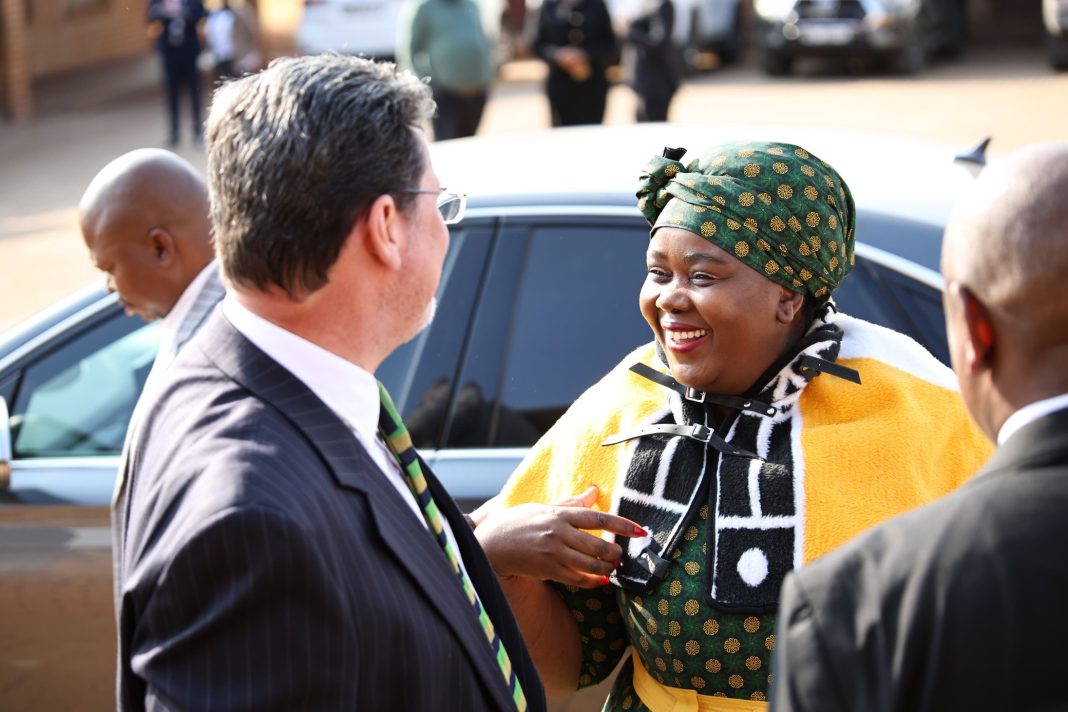
Kubayi was accompanied by Deputy Minister Andries Nel, with Limpopo provincial officials and the kingship of the village of Ga-Maupa —where the ceremony took place on the morning of Saturday, 19 July—also in attendance.
The families of the two anti-apartheid activists said they were relieved that their loved ones will finally rest in their ancestral home of Ga-Maupa village.
“As a family, we are so proud of the work that the department has done. We have been trying to get our uncle’s remains. It has been a really long journey for us in collaboration with the department. So today, as a family, we are very happy,” the families’ representative Masale Rasebotsa told SABC News.
Despite Matsepane and Mankopane losing their lives at just 20 and 21 years old respectively, Kubayi praised their bravery, saying their actions helped render the apartheid system unworkable and the country ungovernable in the face of oppression.
“They were part of the unstoppable force of the people who confronted the organs of government designed to assert apartheid and oppression, and rendered them ineffective. These two young people were part of that organising force called the United Democratic Front (UDF), which played a crucial role in mobilising resistance during the 1980s,” Kubayi said.
The minister commended the Missing Persons Task Team (MPTT), working with the Truth and Reconciliation Commission (TRC) under the Gallows Exhumation Project, launched by the Department of Justice in March 2016.
She said the initiative ensures that fallen struggle heroes are laid to rest with dignity, and their families afforded closure.
“The project has exhumed 81 of the 83 remains. Only two are left, and we aim to exhume them before year-end. Through this project, which recovers the bodies of hanged political prisoners, we are able to help families bury our heroes at home, with dignity, and in honour of the price they paid,” said Kubayi.
Meanwhile, Nel described the reburial as a symbol of South Africa’s healing – a country learning from its past to entrench democratic values.
“We are committed to healing the divisions of the past and building a society based on democratic values, social justice, and fundamental human rights. Respect for the dignity of all human beings is especially important in South Africa, because apartheid was a denial of our common humanity,” he said.
INSIDE POLITICS