


By Johnathan Paoli
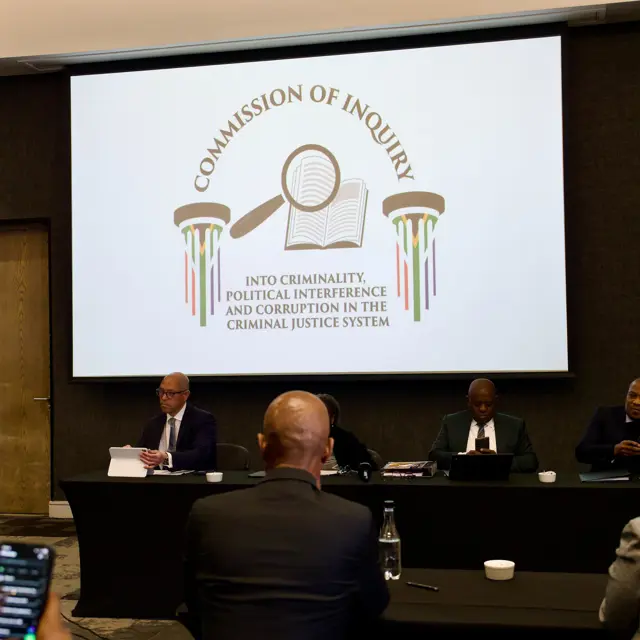
Deliberate delays and false kidnapping allegations were used to derail the investigation into the murder of engineer Armand Swart, according to new testimony before the Madlanga Commission of Inquiry on Wednesday.
Witness B, a veteran investigator in the Serious and Violent Crimes Unit now under police protection, told the commission that the probe into Swart’s April 2024 assassination was systematically sabotaged through tampered forensic evidence and a fabricated kidnapping complaint aimed at discrediting her team.
She said the interference appeared designed to protect powerful individuals linked to a network of state corruption, organised crime, and political influence that has emerged during the ongoing inquiry.
“Maybe now, in totality of all the information I’ve gathered, it starts to make me feel as if some of the things were deliberate, to delay the investigation,” Witness B testified.
Her testimony follows two days of evidence by Witness A, her colleague, who traced how the probe led to the arrests of businessmen Katiso “KT” Molefe and Vusimusi “Cat” Matlala, both now facing charges for their alleged roles in Swart’s murder.
The two are accused of orchestrating the hit to conceal a corrupt Transnet tender linked to Molefe’s nephew, Lucky Molefe, who remains at large.
Witness B testified that the origins of the case lay in the awarding of a lucrative Transnet contract to a company called SK Group, irregularly granted under circumstances that made competition impossible.
Two other bidding companies were found to be dormant, effectively clearing the way for SK Group’s success.
Investigators later discovered that SK Group was controlled by Lucky Molefe, who had used his position at Transnet to manipulate the procurement process.
The contract involved industrial springs normally sold by Swart’s employer, Q Tech, to Transnet for under R4 per unit but the parastatal had instead bought them from SK Group for a staggering R152 each.
When Q Tech raised concerns about this gross inflation, Transnet demanded documentation from Lucky Molefe.
Rather than comply, Witness B said, Molefe “had to do something,” implying that the whistleblower at Q Tech was targeted for elimination.
Swart was mistakenly gunned down outside Q Tech’s Vereeniging offices on 17 April 2024, hit 23 times in what Witness B called “a well-prepared and not a random hit.”
Police quickly arrested Johannesburg Central detective Michael Tau, Musa Kekana, and Tlego Mabusela, who were allegedly acting as shooters and scouts for the hit.
Cellphone data linked the trio directly to Katiso Molefe, who was in constant contact with them before the murder.
Witness B, who has handled numerous homicide investigations, told the commission she had “never seen so much interest” in a case from within the police service itself.
She said people seemed desperate to access the docket, not to seek justice but to protect the suspects.
During the suspects’ first court appearance, security officials intercepted an attempt to photograph her and her colleagues.
From that day, Witness B said, her car was followed by unknown vehicles and she survived multiple attempts to run her off the road.
Although she and Witness A reported the incidents and completed threat assessment forms, she said “nothing came of it.”
A crucial part of Witness B’s evidence concerned the ballistics reports linking seized firearms to the Swart murder.
The first report, she said, “contained glaring omissions,” excluding cartridge evidence found with Tau and Kekana and failing to identify the serial numbers of the guns.
The same ballistics analyst who prepared that flawed report had previously told investigators that the weapons were connected to “high-profile” and cash-in-transit cases, but none of those links appeared in the official version.
When Witness B’s team returned to the police lab to seek clarification, they took the analyst along in a police vehicle so he could access his workstation and retrieve missing data.
The analyst later claimed he had been kidnapped, a charge Witness B described as laughable and completely false.
Nonetheless, a criminal docket was opened against the investigators, further stalling the probe, with Witness B believing this was no coincidence.
The rectified ballistics report, eventually produced in August this year, confirmed that the cartridges recovered from Tau and Kekana’s possession had been fired by a specific assault rifle, conclusively linking the suspects to Swart’s murder.
It also showed that multiple earlier versions of the report had existed, with evidence removed or altered.
The Integrated Ballistics Identification System (iBIS) entry for the weapons was also found deleted on 6 December 2024, the same day that Katiso Molefe was arrested.
This deletion effectively prevented the guns from being matched to other crimes.
By the time the so-called kidnapping incident occurred in January 2025, Witness B and her team had already been denied further access to the police laboratory.
She said the deliberate interference in forensic processes, the intimidation of investigators, and the protection of key suspects painted a picture of deep-seated corruption and collusion.
INSIDE POLITICS