


By Johnathan Paoli
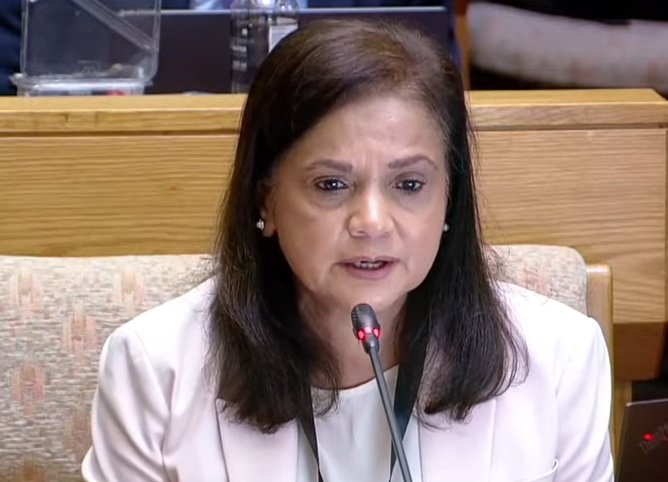
A heated exchange unfolded in Parliament on Tuesday as National Director of Public Prosecutions (NDPP) Shamila Batohi clashed with members of the ad hoc committee probing corruption within the criminal justice system over her refusal to disclose the name of a suspended prosecutor accused of involvement in organised crime.
Appearing before the committee in Cape Town, Batohi detailed her efforts to rebuild the National Prosecuting Authority (NPA) since her appointment in 2019, describing her term as one defined by rebuilding from the ruins.
However, what began as a reflective testimony quickly descended into confrontation when Batohi confirmed that a prosecutor had been suspended following information from National Police Commissioner Fannie Masemola and Crime Intelligence head Lieutenant-General Dumisani Khumalo, but declined to reveal the individual’s identity.
“I will not reveal the name, Chair, with all due respect. The allegations are at the level of intelligence, not evidence, and may not be true. It would not be fair to the person concerned or the process,” Batohi said.
Her insistence on confidentiality ignited fury across the political spectrum.
MK Party MP David Skosana was the first to demand clarity, urging Batohi to name the prosecutor to help the committee’s probe into alleged criminal infiltration of the justice system.
When she refused, Economic Freedom Fighters (EFF) leader Julius Malema accused Batohi of undermining Parliament.
“We want to know who captured the criminal justice system. If she can’t tell us who the corrupt people are, then she must take her bag and go. A rotten NPA is a danger to the Constitution,” Malema declared.
Malema speculated that the suspended individual might be South Gauteng Director of Public Prosecutions (DPP) Advocate Andrew Chauke, whose suspension President Cyril Ramaphosa announced earlier this year.
Batohi, visibly exasperated, replied that Chauke’s case was separate and that revealing further details would in effect expose another identity.
Several MPs accused her of stonewalling.
MK Party’s Sibonelo Nomvalo charged that Batohi was refusing to cooperate with Parliament, while ActionSA’s Dereleen James argued that the purpose of this committee is show and tell, and that everyone else has been named.
ANC MP Xola Nqola attempted to strike a compromise, proposing that Batohi submit the name in writing or disclose it during a closed session.
EFF MP Leigh-Ann Mathys supported this: “If we’re serious about accountability, we can’t keep hiding behind classified intelligence reports. They’re outdated tools of secrecy.”
Batohi stood firm, warning that premature disclosures could destroy reputations and compromise investigations.
DA MP Glynnis Breytenbach, herself a former prosecutor, sided with Batohi’s caution, saying that revealing the name publicly could undermine the work of the Independent Directorate Against Corruption (IDAC) and other investigative bodies.
ANC MP Khusela Diko and Inkatha Freedom Party MP Albert Mncwango agreed that the matter should be handled in camera.
Chairperson Soviet Lekganyane attempted to defuse the standoff by suggesting Batohi consult her legal team during lunch.
Despite the tension, Batohi reiterated that the NPA does not sweep allegations under the carpet.
She acknowledged the public’s frustration with the slow pace of high-profile prosecutions.
“The reality is we are not winning the fight against organised crime in this country,” she said.
Strengthening intelligence and financial investigation capacity, she argued, was essential to dismantling criminal networks.
Batohi urged legislative reform to clarify the relationship between the Special Investigating Unit (SIU) and the NPA, suggesting that the SIU be legally compelled to refer evidence of criminality directly to law enforcement rather than the prosecution service.
The proceedings will continue after lunch, while Batohi consults her legal team.
INSIDE POLITICS