


By Johnathan Paoli
Deputy President Paul Mashatile has called for the urgent empowerment of young people as central actors in building a capable, ethical and developmental state.
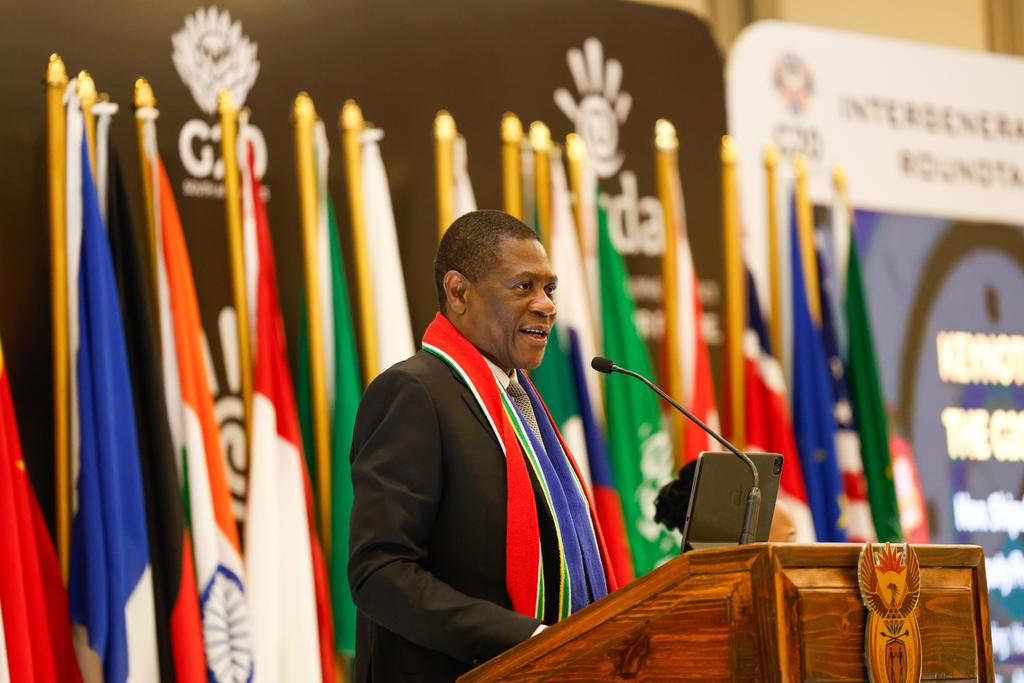
Delivering the keynote address at the G20 High-Level Intergenerational Roundtable held in Sandton on Friday, Mashatile stressed that the time had come for youth inclusion to move beyond symbolic rhetoric and become a measurable pillar of public policy.
“Youth are not merely beneficiaries of policy; they are builders of nations. We must now ensure that the decisions we take at multilateral forums reflect this truth,” he declared.
The roundtable, hosted by the National Youth Development Agency under the theme “Advancing Equity, Building Capabilities and Igniting Innovation”, marked a key moment in South Africa’s G20 Presidency; bringing together youth leaders, policymakers, civil society representatives and global development partners to tackle the persistent barriers to youth inclusion in economic and governance ecosystems.
Mashatile highlighted that youth activism has historically played a pivotal role in South Africa’s liberation, referencing 16 June 1976, and the legacies of Hector Pieterson, Tsietsi Mashinini, Solomon Mahlangu and others.
“We have attained political freedom, but economic freedom remains elusive. The involvement of young people in tackling unemployment, inequality, and poverty is still as crucial as it was during apartheid,” he said.
Fresh from a working visit to Russia, the deputy president shared insights from his trip, including his engagements at the St. Petersburg International Economic Forum Youth Academy.
He was particularly struck by Russia’s advancement in artificial intelligence and digital technologies; areas he said South Africa must invest in to remain globally competitive.
“Artificial intelligence, machine learning and computational intelligence must be embedded in our education system, starting from early childhood development,” he said, echoing the vision of South African AI pioneer Tshilidzi Marwala.
Mashatile also lauded South African scholars for their contributions in science and mathematics, arguing that scientific training is key to national self-reliance and global relevance.
In a call for continental solidarity and global justice, the deputy president framed South Africa’s G20 Presidency as a pivotal opportunity for Africa’s youth to redefine international cooperation.
“We are witnessing a multi-polar shift in global power. The Global South is asserting its voice and South Africa must use its G20 platform to mainstream youth and women in development policy,” he said.
He welcomed South Africa’s ratification of the Protocol on Women and Youth in Trade under the African Continental Free Trade Area, describing it as “not just a symbolic gesture, but a decisive policy action”.
“The protocol operationalises the inclusion of youth-led enterprises in regional and global value chains. It mandates the removal of structural trade barriers, expands access to finance and markets, and ensures legal reforms for economic participation,” Mashatile said.
He argued that for Africa to harness its “demographic dividend”, it must simplify trade regimes, digitise customs systems and create youth procurement quotas.
Looking ahead to the G20 Leaders’ Summit in November, Mashatile committed to anchoring youth inclusion across all pillars of South Africa’s G20 agenda, including climate finance and just energy transitions, digital transformation and AI, cross-border trade and mobility, and skills development and intergenerational co-leadership.
“We must institutionalise youth in governance frameworks, not just through consultation, but through shared power,” he said.
Mashatile endorsed the African Union’s Agenda 2063, saying it was a blueprint for transforming Africa into a global powerhouse.
“Africa is the youngest continent, if we do not leverage this demographic advantage, we risk squandering our future. But if we invest in youth, support youth-led enterprises, and remove systemic barriers, we can realise the Africa we want,” he said.
He urged young people to persist through adversity, stressing that the voices of the youth were no longer on the sidelines, but at the heart of the national and global development agenda.
INSIDE POLITICS