
By Marcus Moloko
Deputy President Paul Mashatile has reaffirmed government’s commitment to Broad-Based Black Economic Empowerment (B-BBEE), declaring that abandoning the policy is “not an option” as South Africa continues to grapple with structural inequality and economic exclusion.
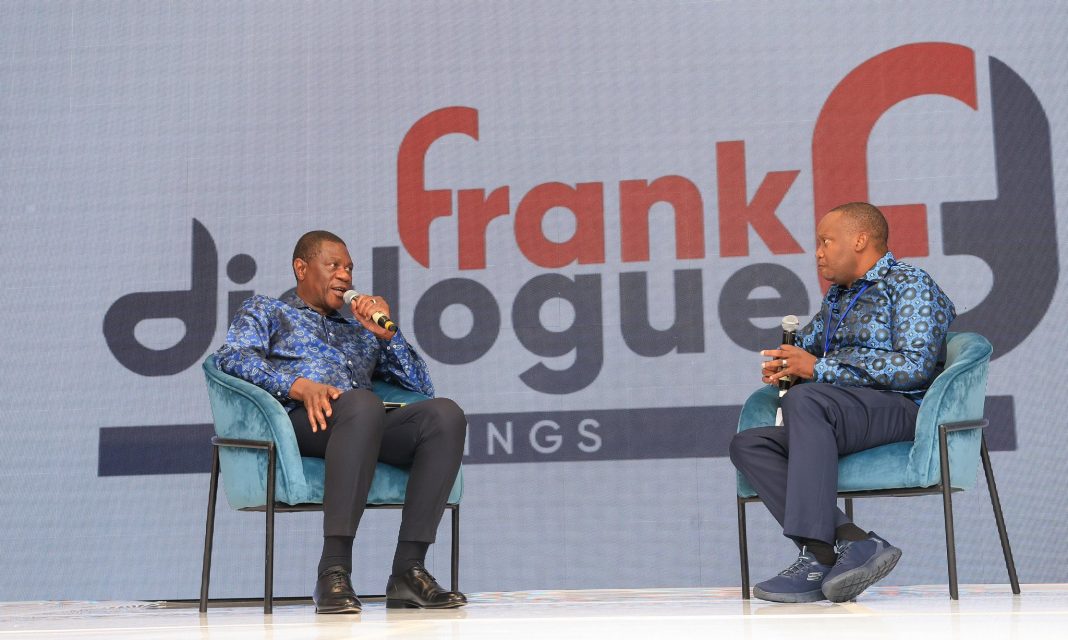
Mashatile was at the Coastlands Umhlanga Hotel and Convention Centre in Durban, KwaZulu-Natal, where he participated in the Frank Dialogue on the Future of B-BBEE.
The engagement brought together leaders from government, business, civil society, and the ocean economy to debate the current trajectory of empowerment policy and propose practical recommendations for strengthening economic transformation.
ALSO READ: US and Israel launch a major attack on Iran and Trump urges Iranians to ‘take over your government’
He was welcomed by Trade, Industry and Competition Minister Parks Tau, KwaZulu-Natal MEC for Transport and Human Settlements Siboniso Duma, Dialogue Convener Professor JJ Tabane, and Dr Nthabiseng Moleko, Chairperson of the National Economic Fund and member of the B-BBEE Advisory Council.
Mashatile said B-BBEE remains “necessary” in addressing South Africa’s entrenched inequalities.
He argued that while progress has been made since the policy’s inception, loopholes and weak enforcement have allowed fronting practices to undermine its credibility.
“We need to bolster monitoring and enforcement mechanisms to close the gaps exploited by fronting practices, thereby aligning agency interests more closely with the principles of B-BBEE. Our enforcement posture must therefore be firm and consistent, supported by credible oversight,” Mashatile said.
Mashatile’s remarks at the Dialogue underscored the need for stronger institutional capacity to enforce compliance.
ALSO READ: Madlanga Commission rebukes Gxasheka over claims that Revo Spies misled Ekurhuleni Metro
He called for credible oversight structures that can detect and penalize fronting, while ensuring that empowerment translates into tangible benefits for communities.
He also highlighted the importance of aligning empowerment with emerging sectors such as the ocean economy, where opportunities for inclusive growth remained underdeveloped.
“Economic transformation must be practical, measurable, and sustainable. It is not enough to tick boxes; we must ensure that empowerment policies genuinely shift ownership, skills, and opportunities to those historically excluded,” he said.
The Frank Dialogue provided a platform for diverse stakeholders to exchange views on how B-BBEE can be recalibrated to meet contemporary challenges.
INSIDE POLITICS



