
By Johnathan Paoli
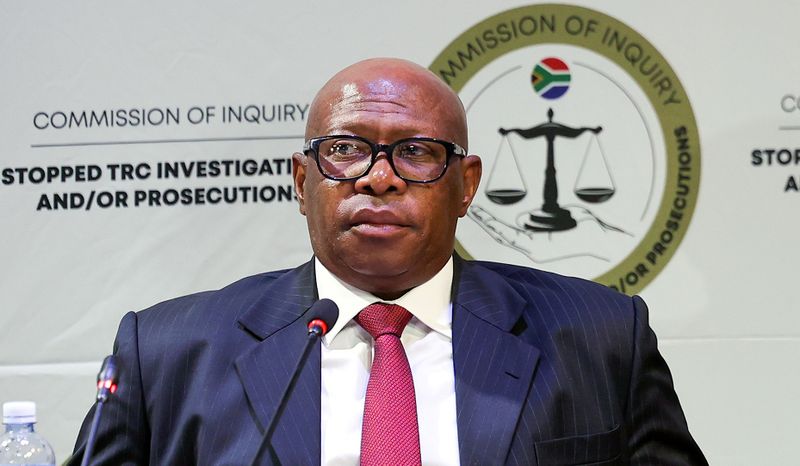
Former National Director of Public Prosecutions Bulelani Ngcuka has flatly rejected claims that he delayed or obstructed investigations into apartheid-era crimes.
He told the Khampepe Commission of Inquiry that decisions not to pursue Truth and Reconciliation Commission (TRC) cases were mostly driven by a lack of evidence and severe resource constraints, not political interference or deliberate inaction.
Appearing before the commission on Monday, Ngcuka said he came voluntarily to account for his role during his tenure from 1998 to 2004, a period now under scrutiny for why many TRC cases remained unresolved for decades.
“Most importantly is that you are going to take people to court well knowing that you are going to lose. It would have been wrong. The evidence was just not enough for us to do that,” Ngcuka said.
Ngcuka is one of several former senior officials accused by victims’ families and civil society groups of frustrating or delaying accountability for apartheid-era crimes.
Ngcuka was represented by advocate Rafik Bhana, who applied to cross-examine his own client to formally place Ngcuka’s version before the commission.
Commission chair Sisi Khampepe agreed to the procedure, allowing Bhana to lead Ngcuka’s evidence in chief.
“I thought it was important to give the background of the cases to this commission,” Ngcuka said, explaining why he had chosen to testify.
Ngcuka told the inquiry that when he established the National Prosecuting Authority (NPA), he inherited staff who had served under the apartheid system, a reality that raised serious concerns about who could credibly prosecute TRC matters.
“And some of these people are the ones who were prosecuting us when we were waging the struggle. So I was worried that I could not have the very same people to prosecute the TRC cases,” he said.
Ngcuka said his first step after receiving the TRC report was to commission an independent assessment of the cases.
He appointed then advocate (now Judge) Vincent Saldana and former senior prosecutor advocate Brink Ferreira to evaluate the dockets in a newly established working group called the Human Rights Investigative Unit (HRIU) within the NPA.
“I needed to have a record to know which cases were ready for prosecution, which cases needed to be further investigated, what the shortcomings were, and so forth,” he said.
The HRIU was later place within the Special National Projects Unit of the Scorpions in 2000 to ensure a centralised, nationally coordinated approach.
Ngcuka said the unit identified extensive problems across many cases, including prescribed offences, destroyed evidence, unreliable or unavailable witnesses, and pending amnesty applications that stalled decision-making.
Ngcuka cited the death of anti-apartheid activist Steve Biko as a stark illustration of these challenges.
“We all knew that the police had killed Steve. We knew that. But to go and take those police to court when we didn’t have sufficient evidence, they would have been acquitted and we would have ended up with egg on our faces,” he said.
Out of approximately 21 cases identified as warranting further investigation, Ngcuka confirmed that at least six were taken to court before he left office; a record he described as significant given the constraints at the time.
Ngcuka also rejected allegations that politicians or senior officials pressured the NPA to halt TRC prosecutions.
“There were no attempts during my time. Nobody tried to do anything. At the end of the day, the decision was mine and mine alone. It never happened during my tenure,” he said.
While his advisers attended a Justice Department meeting that discussed possible amendments to prosecutorial policy, Ngcuka said they concluded there was no need to change existing guidelines and no reason for the NPA to participate further.
“I am also not aware of any collusion by any member of the NPA with any such attempt to stop investigations,” he said.
Ngcuka painted a picture of an overstretched prosecuting authority juggling TRC cases alongside organised crime, commercial crime, national security matters and international obligations.
At its peak, the NPA had between 300 and 350 investigators nationwide.
“Very, very, very, very, very thinly. Everybody wanted all their cases to be investigated by the DSO, and it just was not possible,” Ngcuka said.
The commission ruled that Ngcuka must make himself available for cross-examination by the legal representative of the Calata Group at a date still to be determined, as the inquiry continues to probe one of South Africa’s most enduring accountability failures.
INSIDE POLITICS



