
Simon Nare
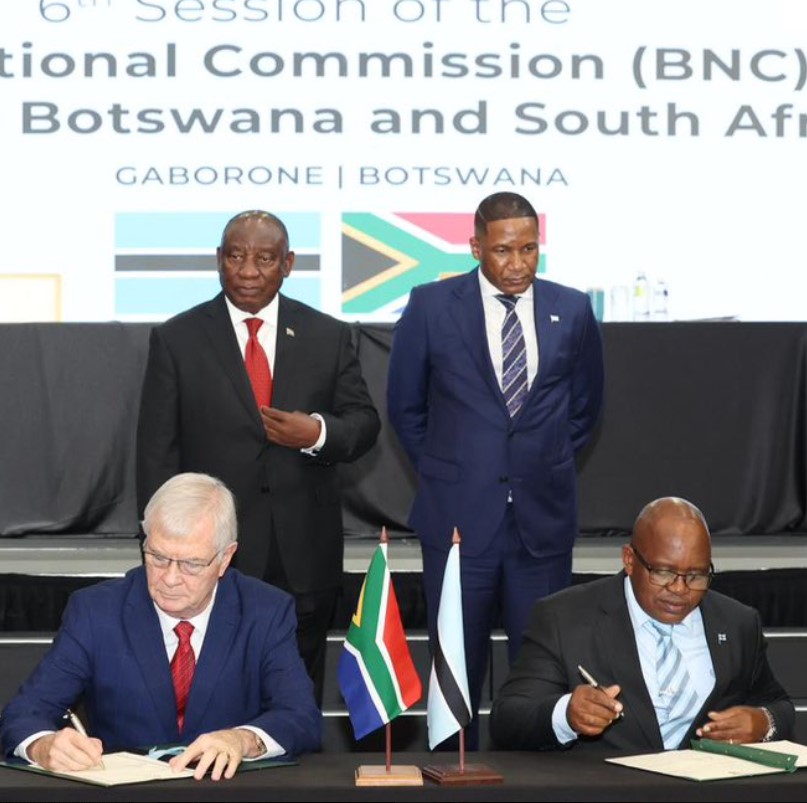
President Cyril Ramaphosa has hailed the agreements signed between South Africa and Botswana at the conclusion of the sixth session of the Bi-National Commission on Thursday, saying they affirmed that bilateral relations remained strong and laid the basis for effective implementation in the months ahead.
The two countries signed four additional bilateral instruments during the session, held in the Botswana capital, Gaborone, in addition to the 28 agreements already in place.
On Thursday, as the session ended, it was revealed in a joint statement that the two countries had agreed on:
- Memorandum of Agreement on the Joint Management of Water Quality and Aquatic Invasive Species in the Upper Limpopo River Basin;
- Agreement on the Co-ordination of Aeronautical Search and Rescue Services;
- Agreement on Cooperation in the Field of Energy; and
- Memorandum of Agreement on Cooperation in the Field of Correctional and Prison Services.
Further, according to the joint statement, the two countries committed to improving and resolving consular matters affecting citizens of both countries and enhancing cooperation in migration management, border management and defence and security.
“On diplomatic and political cooperation, the two heads of state acknowledged that they are meeting at a time when the global order is undergoing profound transformation characterised by geopolitical uncertainty and instability and reaffirmed the importance of multilateralism, international cooperation and rues-based world order,” read the statement.
Ramaphosa, in his closing remarks, said the agreements and the report coming out of the deliberations captured the scope of the strategic and fraternal relations between the countries.
“It affirms that our bilateral relations remain strong. It lays the basis for effective implementation in the months ahead. The agreements we are signing today give practical and legal expression to our cooperation.
“In our deliberations, we have identified priority areas to scale up economic partnership between our countries. Levels of bilateral trade and investment must be substantially increased. We must explore more opportunities in agriculture, while working together to resolve some of the challenges we have experienced in this area,” he said.
The challenges in agricultural relations have been linked to Botswana’s previous restrictions on some fresh vegetable imports, introduced as part of efforts to grow the country’s local farming sector and build self-sufficiency.
The measures affected South African exporters and were also reported to have contributed to price pressures in Botswana when local farmers struggled to meet demand.
The president said the two countries were committed to deepening cooperation in other areas, including vaccines.
South Africa has relied on Botswana’s vaccine production capacity, including the Botswana Vaccine Institute, during recent outbreaks of Foot-and-Mouth Disease, while also working to strengthen local vaccine production.
“We welcome the commitment by South Africa’s Agricultural Research Council and the Botswana Vaccine Institute to conclude a cooperation partnership in the production of vaccines to fight animal diseases, including food and mouth disease,” he said
On migration, Botswana President Duma Boko expressed concern during the closing session about the different implications for overstaying visitors from both countries.
He pointed out that an overstaying South African visitor to Botswana was fined P10 a day, whereas a Botswana citizen could be barred from entering South Africa for a year if he or she did the same.
Boko appealed for fair treatment, saying the matter needed to be addressed. Ramaphosa agreed and committed to addressing immigration difficulties affecting, among others, students from Botswana and business people from South Africa.
“We should direct our respective Ministers of Home Affairs to develop a sustainable resolution of these matters by September this year. Working together within SADC, South Africa and Botswana will continue to promote regional integration, including through investment in infrastructure and manufacturing,” he said.
The president said both countries should continue to promote social, cultural, educational and scientific ties, and that it was critical for the region to promote peace, stability and security.
He added that South Africa and Botswana should continue to work for a global order based on peace, stability and respect for international law.
Both presidents also rejected rumours that the United States had a military base in Botswana and could attack the Union Buildings from Botswana soil, as tensions between Pretoria and Washington remain strained.
Ramaphosa said the two countries concluded the session inspired by the vision of the forebears of both nations, who laid a firm foundation for a strong relationship forged through struggle, sacrifice and unity.
“The strong bonds of friendship and cooperation are founded on our shared desire to fulfil the promise of a brighter future for our two nations and for our region.
“We once again express our deep appreciation for the warmth and hospitality extended to us during this State Visit and Bi-National Commission,” said Ramaphosa.
INSIDE POLITICS





