By Johnathan Paoli
Durban Hawks Serious Organised Crime Investigation Unit head Colonel Gavin Jacob has come under fire after admitting that he had assumed that police stations near Durban Harbour, including Maydon Wharf, was incapable of holding the 541kg cocaine consignment that would end up at Port Shepstone.
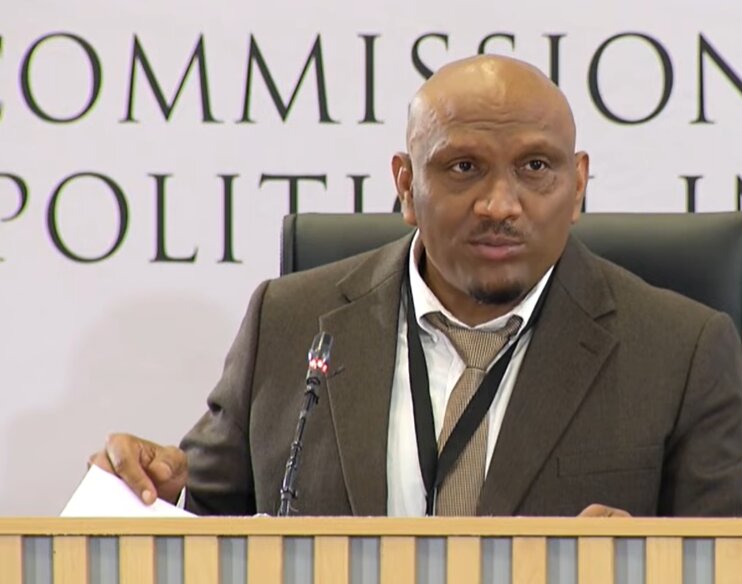
Continuing proceedings at the Madlanga Commission of Inquiry on Thursday, Jacob’s evidence came under scrutiny from commission chairperson Mbuyiseli Madlanga and evidence leader Advocate Mahlape Sello, who challenged his repeated assertions that no suitable storage facilities were available closer to the Durban harbour crime scene.
Madlanga accused Jacob of making assumptions instead of conducting basic inquiries with nearby police stations before deciding where the drugs should be stored.
“You assumed that there was no storage. You assumed, because you never asked. It’s as simple as all of that. Why did you make such an assumption on so serious a matter?” Madlanga asked.
The exchange followed Jacob’s admission that he had not contacted nearby police stations, including Maydon Wharf, to determine whether storage space was available.
Evidence before the commission showed that Maydon Wharf Police Station had previously stored large drug consignments and that Jacob himself had utilised the facility in the past.
Madlanga further challenged Jacob’s claim that all avenues had been explored before alternative arrangements were made.
“You incorrectly state you exhausted all avenues, when you simply made an assumption?” Madlanga asked.
Jacob ultimately conceded that his statement to his superior, Brigadier Campbell Nyuswa, that all storage options had been exhausted was inaccurate.
Although he resisted suggestions that he had lied, describing the term as “harsh”, Jacob admitted that his account was “not the truth”.
The commission heard that Jacob chose to take the cocaine to Isipingo Police Station before it was later moved to the Hawks’ offices in Port Shepstone under instructions from Nyuswa.
Sello repeatedly questioned the rationale behind bypassing closer police stations and challenged Jacob’s explanations regarding the alleged lack of storage space.
Evidence presented to the commission suggested that an operation later in the same year (2021) involving 999kg of drugs was successfully accommodated, undermining Jacob’s argument that suitable storage facilities were unavailable.
In another point of contention, Jacob maintained that the area at the CHC depot where the drugs were discovered was congested and unsuitable for a comprehensive examination of the container.
But Sello pointed out that another, larger seizure had been processed at the same depot shortly afterwards.
The evidence leader also turned her attention to Jacob’s decision to exclude the Local Criminal Record Centre (LCRC) from the operation, despite national instructions requiring forensic officials to attend major drug seizures.
Jacob admitted that he deliberately deviated from the prescribed procedures because of previous negative experiences with LCRC officials.
He told the commission that investigators had often been disappointed by delays and incomplete forensic reports.
While defending his reasoning at the time, Jacob acknowledged that the decision had been wrong and said he would not repeat it in future.
Sello suggested that the decision to bypass LCRC processes and transport the drugs to Isipingo was deliberate and formed part of an effort to avoid proper SAPS recording procedures.
She put it to Jacob that the cocaine was never intended to be formally recorded through standard SAPS systems and was instead destined to be registered only as a cryptic SAP13 exhibit.
Jacob rejected the allegation.
Further criticism centred on the subsequent decision to move the drugs to Port Shepstone.
Jacob testified that he acted on instructions from Nyuswa, who described the storage facility as a secure vault or strong room.
He admitted that he conducted no independent assessment of the facility’s security, despite the seizure being the largest drug consignment of his career.
When questioned about accountability for the drugs after they left Isipingo, Jacob sought to place responsibility on Warrant Officer Livingstone Mpangase, who signed the exhibits out of the SAP13 register.
However, both Sello and Commissioner Sesi Baloyi challenged that position, noting that Mpangase had acted under Jacob’s direct instructions.
Jacob eventually conceded that Mpangase would be “90% correct” to say he was merely following the orders of his immediate commander.
Before proceedings started, Madlanga ruled that the evidence of “Witness I”, scheduled to testify on 9 June, would be heard partially in camera.
Media organisations will be prohibited from publishing the witness’s identity or image, while only portions of the testimony will be broadcast through an audio feed.
The commission continues.