
By Charmaine Ndlela
Former president Kgalema Motlanthe has warned that attacks on foreign nationals will not solve South Africa’s unemployment crisis, arguing that migration has been central to the country’s economic development for more than a century and that government must maintain authority to prevent lawlessness.
Delivering the keynote address at the Kgalema Motlanthe Foundation Winter Seminar in Sandton, Johannesburg, on Thursday, Motlanthe said recent demonstrations targeting undocumented migrants reflected growing competition for scarce jobs and resources in poor communities, but cautioned political leaders against inflaming tensions.
“The recent spate of demonstrations against so-called foreign nationals highlights the competition for limited resources and opportunities in South Africa’s poorest communities,” Motlanthe said.
He said the structure of the economy meant government must remain firmly in control as it responds to the challenges facing the unemployed, the poor and the marginalised.
Motlanthe warned that any failure by government to maintain authority would invite lawlessness and “near anarchy” with devastating consequences.
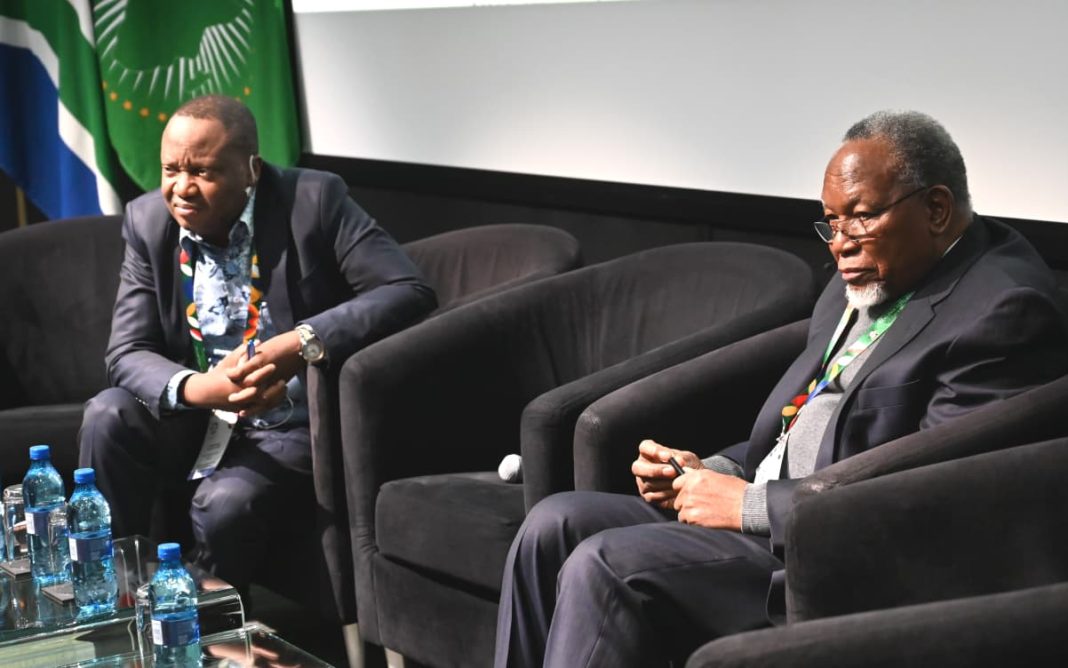
The seminar, held under the theme “The Continent and Migration”, brought together business leaders, government officials, academics, civil society representatives and international guests to discuss migration, regional integration and economic development.
The event also marked Motlanthe’s 77th birthday.
Motlanthe said political leaders must accept responsibility not only for their own conduct but also for the actions of those they lead, particularly during periods of social and economic upheaval.
“Political leaders need to know that they are not only responsible for the way they lead, but also for what is done by those they lead, particularly in times of crisis and upheaval,” he said.
He warned that anti-foreigner campaigns were already harming key sectors of the economy.
“The tourism and agriculture sectors of the South African economy have been negatively affected by the crusade against so-called foreign nationals. Both sectors are creators of sorely needed jobs in our country and across the region,” he said.
Motlanthe argued that migration was neither new nor abnormal, describing human mobility as a defining feature of civilisation that has shaped settlement, trade and economic development throughout history.
Quoting former International Labour Organization Director-General Guy Ryder, he said migration remained “a key feature of today’s world of work” and presented complex policy challenges requiring innovative responses.
Motlanthe said South Africa’s economy was built on imported slave labour, indentured labour and migrant labour, particularly after the discovery of diamonds in Kimberley in 1867 and gold on the Witwatersrand in 1886.
“South Africa’s modern economy was quite literally dug out of the ground by migrants,” he said.
He explained that the mining industry depended on workers recruited not only from the Eastern Cape, Natal and the former Transvaal, but also from territories that are now Mozambique, Lesotho, Botswana, Malawi and Eswatini.
The Chamber of Mines, he said, established one of the world’s most sophisticated labour recruitment systems through organisations such as the Witwatersrand Native Labour Association (WANLA) and the Native Recruiting Corporation (NRC), which were designed to secure a steady supply of cheap labour.
According to Motlanthe, the migrant labour system relied on fixed-term contracts, single-sex hostels and the separation of workers from their families.
He noted that until 1969, gold mines were legally prohibited from providing family accommodation for more than three percent of their Black workforce and were barred from housing foreign Black workers with their families.
Motlanthe said the migrant labour system created lasting economic interdependence between South Africa and neighbouring countries long before the establishment of the Southern African Development Community (SADC).
He argued that this history explained why modern immigration policies continue to prioritise regional mobility, academic exchanges and special permit arrangements with countries such as Lesotho and Zimbabwe.
He described current hostility towards regional migrants as historically ironic.
“The contemporary anxiety about foreign migrants from the region is historically ironic because those migrants, or their forebears, helped build the economy that now debates their admission,” he said.
Motlanthe added that South Africa’s economic influence on the continent remains evident in trade, with about one-quarter of the country’s exports destined for African markets and more than 80% of intra-African trade taking place within the Southern African Development Community.
He said the Southern African Customs Union, comprising South Africa, Botswana, Lesotho, Namibia and Eswatini, remained one of the clearest examples of long-standing regional economic integration.
Born in Alexandra, Johannesburg, on 19 July 1949, Motlanthe rose through the trade union movement after serving as education secretary of the National Union of Mineworkers before becoming the union’s general secretary in 1992.
During his tenure, the union established the JB Marks Education Trust, which provides bursaries for mineworkers and their dependants, and the Elijah Barayi Memorial Training Centre to strengthen worker education.
Motlanthe was elected ANC deputy president at the party’s 52nd National Conference in Polokwane in 2007.
He became Minister in the Presidency in July 2008 and was sworn in as South Africa’s third democratically elected president on 25 September 2008 following the resignation of Thabo Mbeki.
He later served as deputy president from 2009 to 2014 and currently chairs the ANC Electoral Committee.
The Kgalema Motlanthe Foundation said the annual seminar reflects its guiding principle of promoting “dialogue among equals” through informed discussions on issues shaping South Africa and the African continent.
INSIDE POLITICS





