
By Akani Nkuna
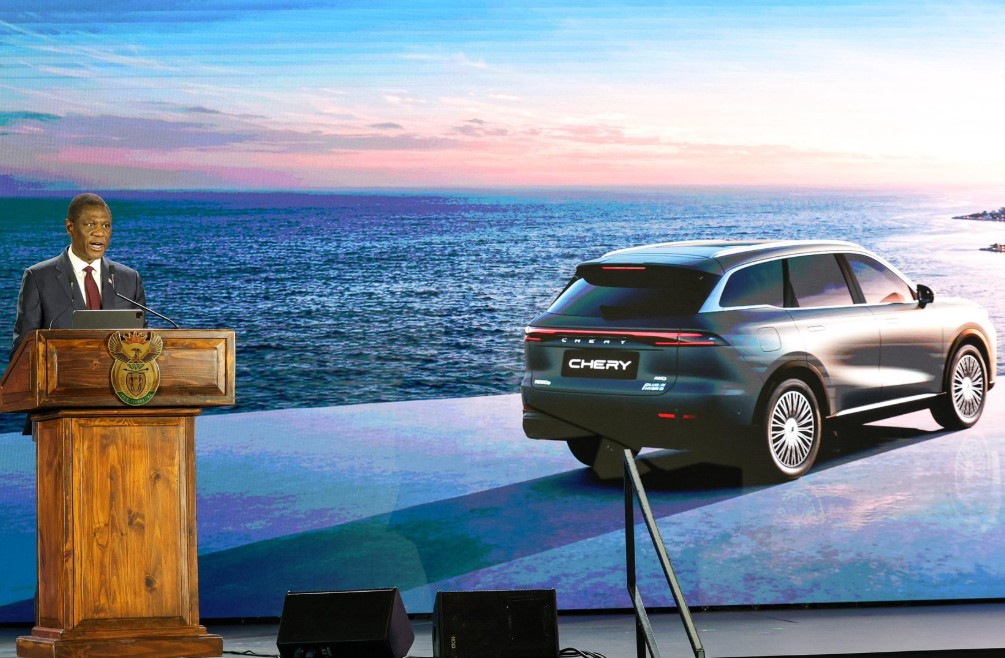
Deputy President Paul Mashatile has welcomed Chery International’s takeover of Nissan’s former Rosslyn manufacturing plant in Tshwane, saying the investment would support technology transfer, localisation and South Africa’s industrial capacity.
Mashatile delivered the keynote address at the celebration on Friday, where government officials, business leaders and automotive industry stakeholders marked the Chinese carmaker’s acquisition.
China’s Chery formally took over the plant under a deal announced in January, with the company expected to spend millions of dollars upgrading the facility and adding machinery before vehicle production begins in South Africa in mid-2027.
Mashatile said the acquisition was a signal that South Africa remained a trusted destination for industrial investment.
“Our people are absolutely the greatest asset. It is critical to invest in training, apprenticeships and technical education, thereby empowering young South Africans to recognise opportunities within advanced manufacturing and technology driven industries,” he said.
“South Africa needs to be at the forefront of the technologies that will shape the future of mobility.
“Chery’s investment will pave the way for technology transfer, automation, digitalisation and advanced manufacturing systems.
“These developments will beef up our industrial capacity and put South African engineers and technicians at the cutting edge of innovation.”
Nissan announced in January that it would sell its manufacturing assets in Rosslyn to Chery SA, including the land, buildings and associated assets. The move formed part of Nissan’s global turnaround plan, which included closing or consolidating seven plants.
Chery said it wanted to establish South Africa as its African hub for manufacturing, exports, research and development, and regional operations.
The takeover comes as Chinese vehicle brands continue to gain ground in South Africa’s new-vehicle market. According to Naamsa’s June 2026 flash report, Chery Auto South Africa was the country’s seventh-largest vehicle seller for the month, with 2,602 local sales.
Naamsa said aggregate domestic new-vehicle sales reached 54,482 units in June, the strongest June performance since 2007. Passenger vehicle sales accounted for 38,393 units, up 18.1% from June 2025.
“These developments are encouraging, as improving logistics efficiency and higher freight volumes typically translate into increased fleet utilisation, stronger replacement demand, and renewed investment in commercial vehicles over the medium term,” Naamsa said in its June sales statement.
Mashatile said the Rosslyn investment should benefit surrounding communities, including Mabopane, Soshanguve, Ga-Rankuwa and Hammanskraal, through jobs, supplier opportunities and skills development.
“Assembly by itself may provide only shallow employment, but prospects are better with localisation because it creates significant job multipliers, broadens industrial ripple effects, and promotes skill development across generations,” he said.
He urged Chery to work with government to identify and promote local suppliers, especially youth-led businesses, and said township enterprises should be supported to participate in logistics, components, services and technology.
Chery Auto Vice President Charlie Zhang said the Rosslyn plant would be central to the company’s African expansion plans.
“Our long-term goal is to turn the Rosslyn plant into a complete auto center with research and development, supply chain operations, and training, supporting Chery’s expanding presence and the goal of exceeding 100,000 annual vehicle sales in South Africa,” Zhang said.
Chery has committed to retaining 692 existing employees at the plant, while the project is expected to create nearly 3,000 direct and indirect jobs across manufacturing, supply chains and related services.
The company is expected to initially produce Jetour T series vehicles, including the T1, Jaecoo J5 and Chery Tiggo 4 sport utility vehicles. The Jaecoo J5 will be produced in both internal combustion engine and new energy vehicle versions.
Chery has also launched a localisation programme aimed at moving towards 40% local content in its initial production phase and is surveying tier-one suppliers. The company also plans to bring in Chinese suppliers, particularly for electric and intelligent vehicle components.
INSIDE POLITICS





