
By Des Erasmus
South Africa is exploring the establishment of an aerospace and defence special economic zone (SEZ) in the Western Cape as it seeks to revive an industry that has lost about 90% of its workforce since 1990.
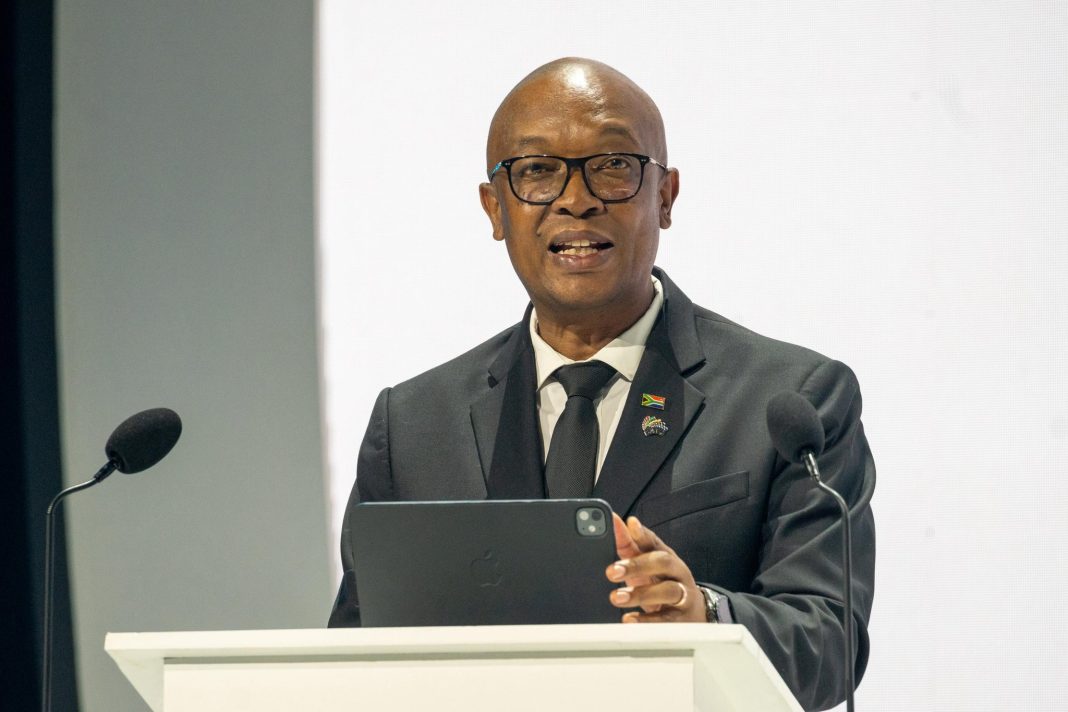
Trade, Industry and Competition Minister Parks Tau outlined the proposal in a keynote address on Monday at the Defence Industry Lekgotla at the Council for Scientific and Industrial Research in Pretoria, where nearly 300 delegates from government, the military, industry, labour, and academia gathered for the three-day conference.
ALSO READ: Former Eskom managers finally face trial in R1.4bn Kusile corruption case
He said the cluster would draw on the province’s concentration of defence, aerospace and commercial space companies to develop an integrated industrial ecosystem.
He did not give a timetable for the proposal.
The proposal formed part of a call at the lekgotla for the government to coordinate military procurement, export support, industrial financing and regulation as the country tries to preserve its domestic capacity to design, manufacture and maintain defence equipment.
“What we lack is coordination,” Tau told attendants.
South Africa’s defence industry employed about 130,000 people across 3,000 companies in 1990, compared with approximately 13,000 people across 600 companies today, Tau said.
Domestic military acquisitions fell in constant-price terms from R26.2 billion in 1989/90 to R850 million in 2017, while research and development funding declined from R6.1 billion to about R500 million.
The revival attempt comes after cabinet approved the SANDF’s Long-Term Force Evolution Strategy on 6 May.
The 30-year programme, known as “Journey to Greatness”, is intended to address ageing equipment, constrained funding and underdeveloped military capabilities. It ties defence modernisation to economic growth and regional security.
But parliament’s defence committee has warned that the strategy has not been fully presented to lawmakers or accompanied by a detailed costing model.
The Department of Defence received R57.605 billion for 2026/27 but remains constrained by personnel costs and limited funding for operations, equipment and maintenance.
ALSO READ: Ramaphosa: Building on Madiba’s legacy by expanding access to water
In his speech, Tau said South Africa retained industrial capabilities across the air, maritime, land, cyber and space sectors, with exports accounting for more than 80% of industry revenue and products reaching more than 115 countries. “This is not a domestic industry that happens to export. It is an export industry that happens to be domestic,” he said.
Global military spending increased by 2.9% in real terms to a record $2.887 trillion in 2025, while spending in Africa rose by 8.5% to $58.2 billion, according to the Stockholm International Peace Research Institute.
Tau said delays in issuing arms-export permits, restrictions affecting the drone industry and the absence of recognition agreements with European and US aviation regulators were preventing local companies from accessing some international markets.
“Government’s task now is to match that resilience with coordination, so that the demand exists in the market, the capability exists on our factory floors, and the machinery of the state stands behind both of them together,” Tau said.
Opening the lekgotla, Joint Standing Committee on Defence chairperson Phiroane Phala said parliament had been calling for such a conference for some time.
“The defence industry has faced challenges for many years, and while policy discussions are important, the sector now requires decisive implementation,” he said, adding that meeting should not be reduced to “another talk shop”.
“The purpose of this Lekgotla must be action,” he said.
Phala also said maintaining sovereign defence capabilities did not require South Africa to manufacture every component domestically.
“Rather, it means that South Africa must retain the ability to maintain operational freedom, protect critical technologies, sustain essential capabilities and make strategic decisions in the national interest,” he said.
ALSO READ: IDAC oversight Judge says his office has already received complaints against IDAC head Johnson
He said the future of the industry would increasingly depend on digital technologies, artificial intelligence, cyber capabilities, systems integration, research and skilled personnel.
“The success of this Lekgotla will not be measured by the quality of the discussions alone, but by the actions that follow,” Phala said.





