
- Advertisement -spot_img

Johnson in hot seat over contradictory testimony at ad-hoc committee and Madlanga Commission

- Advertisement -spot_img

Must read

By Johnathan Paoli

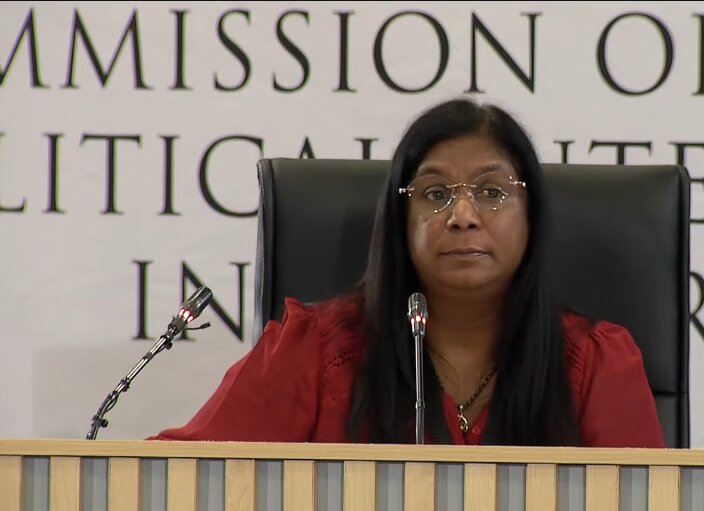
Investigating Directorate Against Corruption (IDAC) head Andrea Johnson has come under intense scrutiny over contradictions between evidence she gave to Parliament’s ad hoc committee and her testimony before the Madlanga Commission, with evidence leaders and commissioners repeatedly questioning why key aspects of her account had changed.

Evidence leader Mahlape Sello on Thursday confronted Johnson on inconsistencies relating to when she became aware that National Coloured Congress MP Fadiel Adams had complained to suspended police minister Senzo Mchunu, when the Section 27 referral reached her desk, and how IDAC obtained the SAPS dockets that ultimately formed part of its investigation into senior Crime Intelligence officials.

Sello pointed to Johnson’s earlier parliamentary testimony in which she had denied any knowledge that Adams had referred his complaint to either the National Commissioner or the minister.

“Yesterday, Johnson admitted that she had received a letter from the office of the Police Minister. However, during her appearance before the Ad Hoc Committee, she said she was unaware that MP Fadiel Adams had lodged a complaint with the minister,” Sello said.

Johnson insisted the discrepancy stemmed from a failure of memory rather than an attempt to mislead Parliament.

“At ad hoc, I didn’t recall anything from the Minister,” she said.

Sello questioned why Johnson had not corrected her evidence when parliamentary members later referred her to documents showing the complaint had indeed been sent to the minister’s office.

“[I]f one has regard to the content of this report, then it was brought to your attention, at least at the ad hoc committee, about the complaint to the Minister’s Office, it being referred to the National Commissioner, and so on. Why then do you not say, ‘Oh, now I learn that this happened?'” Sello asked.

Johnson said that she had indicated to the ad hoc committee that then was the first time she saw the report and that it had not been made available to IDAC before.

The commission also examined conflicting accounts of when Johnson became aware of Adams’s complaint and the Section 27 referral.

In her testimony before the committee, Johnson said she received the referral during “the middle of December” after first being informed that an authorisation (or Section 28) application would be submitted for her consideration.

However, she has since told the commission that the referral was received during November 2024.

Commissioner Sandile Khumalo noted that Johnson had effectively created the impression before parliament that Adams approached IDAC directly, rather than IDAC initiating contact with him after receiving correspondence from the minister.

But Johnson maintained that the correct position was that Adams “came to IDAC”.

She further explained that, after receiving the referral, she instructed investigator Dylan Perumal to engage with Adams.

Johnson accepted that aspects of her parliamentary testimony were incorrect, but explained the discrepancies were due to not being prepared sufficiently.

“I confused the dates during my appearance before Parliament’s ad hoc committee because I was not fully prepared at the time,” she said.

Commissioners also questioned Johnson about conflicting accounts concerning requests for the Crime Intelligence dockets.

At the committee, Johnson said she had written to Divisional Commissioner of Detectives Lieutenant-General Hilda Senthumule requesting the dockets.

Before the commission, however, she explained that IDAC had first written to Gauteng detective head Major-General Mbuso Khumalo before subsequently writing to Senthumule on the same day.

“So, at the time, commissioners, my recollection was my letter to General Senthumule. I had subsequently, but well after ad hoc, the investigation team advised, and in fact showed, that we had first written that morning to General Kumalo and on the same day, a letter followed to Lieutenant General Senthumule,” she said.

Johnson said the first letter was directed to Khumalo because Adams’ affidavit referred to cases opened at Orlando Police Station in Gauteng.

She said investigators were informed that the dockets were no longer with Gauteng detectives and had instead been transferred to the SAPS Inspectorate, prompting the subsequent correspondence to Senthumule.

Commissioner Sesi Baloyi questioned why IDAC had not first established whether the Inspectorate was already investigating Adams’ allegations before launching its own investigation.

“So, you unquestioningly just accepted his say-so. He says to you in the affidavit, my dockets have disappeared, they’ve been intercepted, and you go into investigation mode,” Baloyi said.

The questioning followed earlier evidence in which Johnson conceded that nine individuals included in IDAC’s Section 28 authorisation should not have been investigated because they did not appear in Adams’ original Section 27 affidavit.

Johnson admitted to the commission that initially claiming she got the expanded list from the prosecutor, she had subsequently learned that the list originated from her office, and specifically Perumal.

But Johnson said that when she asked the investigator, he claimed to have no memory of handing in a list.

The commission continues.

INSIDE POLITICS

More articles

LEAVE A REPLY

Please enter your comment!
Please enter your name here

Inside Education E-edition June 2026

spot_img

Services Seta 2026

spot_img

CATHSSETTA

spot_img

AVBOB STEP 12

spot_img

Inside Metros G20 COJ Edition

spot_img

JOZI MY JOZI

spot_img

QCTO

spot_img

Latest article



